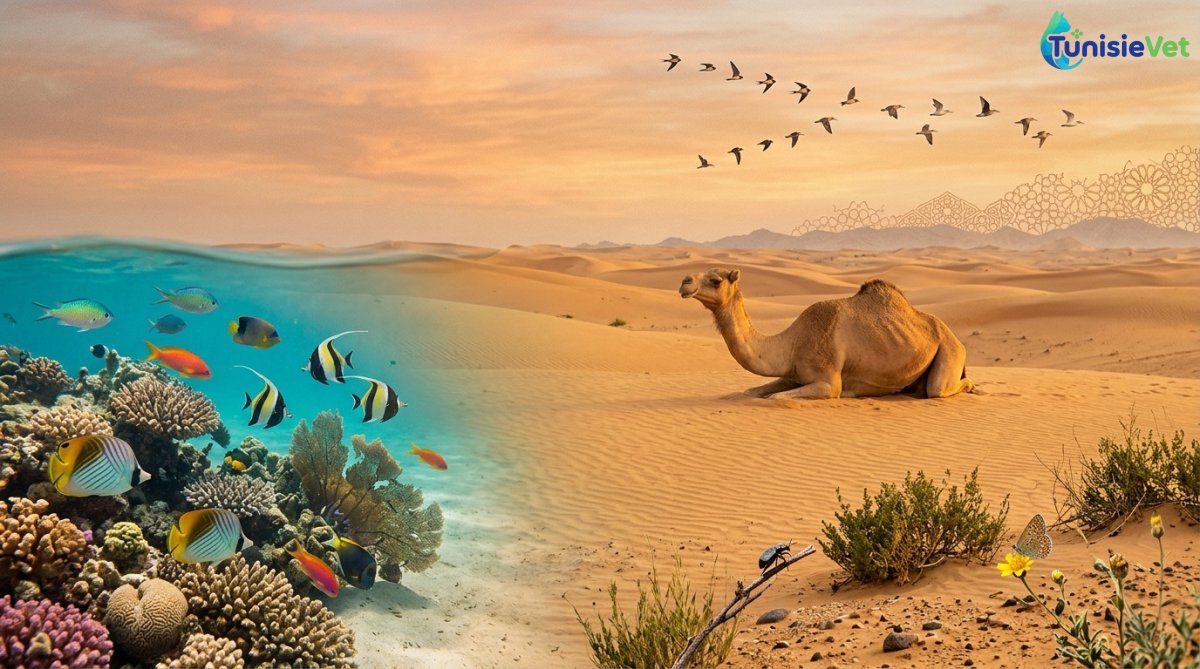
From the tiniest insect to the creatures of the ocean depths, the Qur'an invites us to contemplate the infinite variety of the animal world as a brilliant proof of the Creator's greatness.
In a verse of Surah Fatir, Allah draws the attention of believers to a phenomenon that each person can observe around them: the infinite diversity of living beings, from the colours of mountains to the varieties of humanity, passing through the entire animal kingdom. This diversity is not presented as a mere fact of nature, but as a sign (ayah) meant to make those with knowledge reflect.
A verse that invites contemplation
In Surah Fatir, Allah mentions the creatures we tread upon on earth and in the waters, specifying that they exist "in diverse colours" just as the mountains and human beings do. The text then emphasizes that only "the learned among His servants" truly fear Allah, thus establishing a direct link between knowledge of the natural world and piety. Out of caution regarding the exact Arabic text, we do not reproduce the verse word for word here, but its meaning is unanimously recognized by scholars of interpretation: the extraordinary variety of animals — their sizes, colours, modes of life, habitats — is not the result of chance, but the manifestation of boundless creative power.
Exegetes point out that this diversity is found at every scale of creation. There are microscopic creatures invisible to the naked eye and immense animals such as the whale; beings that crawl on the ground and others that fly through the skies; species that live in the darkness of ocean depths and others that thrive under the burning sun of the desert. This multiplicity of life forms, far from being chaotic, obeys a precise balance that is also mentioned in Surah Al-An'am, where it is recalled that every living creature on earth or flying with its wings forms communities similar to those of humans.
The wisdom behind the multitude of species
Muslim scholars have often pondered this animal richness as an invitation to break free from indifference. Observing a fish with shimmering colours, a bird capable of travelling thousands of kilometres, or an insect organized in complex society, is to perceive an infinitesimal part of divine wisdom at work. The Prophet ﷺ himself drew the attention of his companions to the animal world: it is reported in Sahih al-Bukhari that he spoke of the discipline and organization of ants, as well as the behaviour of other creatures, to draw moral lessons from them.
This diversity is therefore never presented in the Qur'an as a mere naturalist inventory. It is systematically linked to an invitation: that of recognizing, behind each form of life, the mark of a unique Creator. A desert camel, a fish from the ocean depths, a industrious bee or a migratory bird all testify, in their own way, to one and the same origin and one and the same organizing wisdom. It is precisely this unity in diversity that constitutes, according to scholars of interpretation, one of the most accessible signs to every human being, whether learned or a simple observer of nature.
From contemplation to responsibility
Recognizing this diversity as a divine sign must not remain an abstract reflection. It naturally calls for an attitude of respect towards all creatures, whatever their size or appearance. If each animal species carries within it a share of the Creator's wisdom, then caring for it, avoiding harming it needlessly, and preserving its habitat become concrete extensions of this contemplation. The believer who observes with attention the richness of the animal world is invited to become its attentive guardian as well, in the very spirit that runs through the prophetic teachings on kindness towards all sentient life.