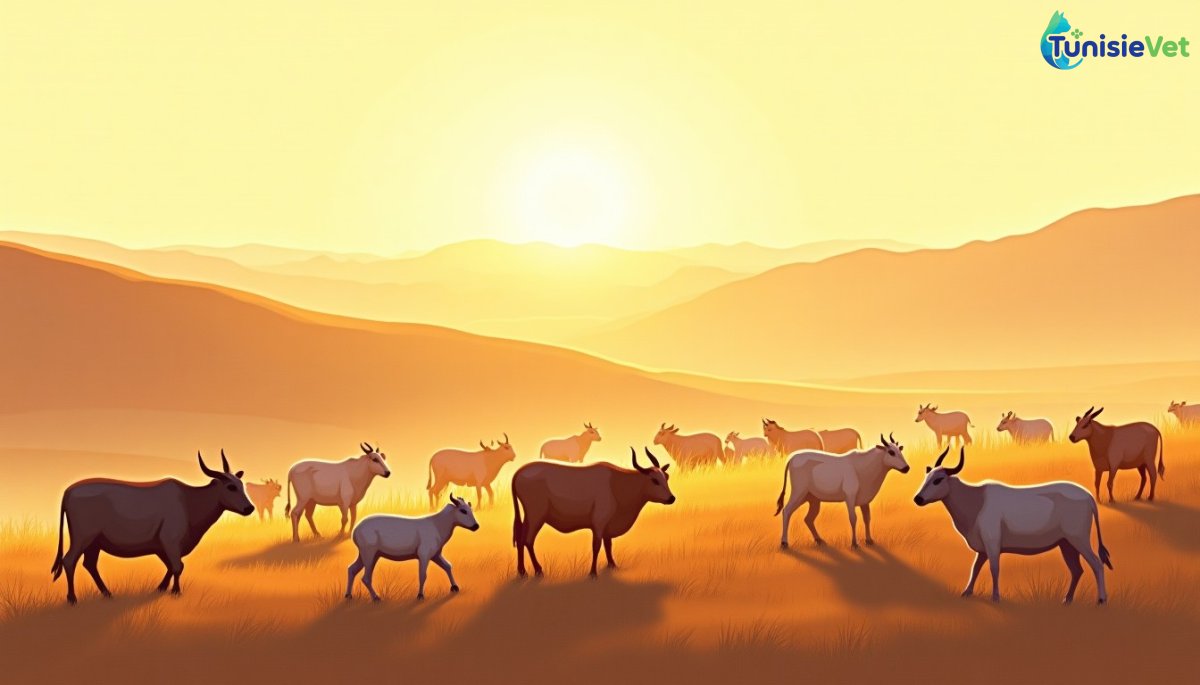
In herds that graze peacefully, the Quran invites us to read a sign of Allah's creative power: pure milk flowing forth between digestion and blood, and the many blessings offered to humanity.
3 min read · Published 1 day ago · 3 views
Among the animals that have always lived alongside humans, livestock — camels, cattle, sheep and goats, designated in Arabic by the term "an'âm" — hold a special place in the Quran. They are not presented simply as resources, but as signs (ayât) that God sets before humans so that they may reflect upon His creation.
A sign in the milk of herds
Surah An-Nahl, known as "The Bees", devotes several verses to these animals. One of them describes with striking precision the process by which milk forms within the body of the beast:
"And indeed, within the livestock there is a lesson for you. We give you drink from what is within their bellies — between the digestion and blood — pure milk, pleasant to drink for those who drink it."
(Surah An-Nahl, verse 66)
This verse invites us to pause and reflect upon a phenomenon we observe without always giving it thought: within the animal itself, between the waste products of digestion and the circulating blood, there forms a liquid of complete purity, nourishing and showing no apparent mixing with what surrounds it. For Quranic commentators, this perfect separation illustrates the precision of creative power, able to draw forth, from within one body, a substance so different from its origin.
Multiple blessings bestowed upon humans
Other verses from the same surah expand upon the countless blessings these animals bring: their flesh for food, their wool and hair for clothing and tent-making, their strength to carry burdens to lands that would be reached only with great difficulty. It is reported that commentators see in this diversity of uses — nourishment, clothing, transport, warmth — further proof that nothing in creation is left to chance: each element of life answers to a purpose and serves, in one way or another, the balance of human life.
The Quran also reminds us, in Surah Al-An'âm — whose very name means "The Livestock" — that these animals are created "in pairs", some for draft, others for riding, each according to its own nature. This classification is not a mere inventory: it invites the believer to observe the order and measure that preside over creation, from the smallest insect to the largest of herds.
A lesson for those who observe
What strikes us in these verses is the insistence on the verb "to reflect", "to think", "to see a sign". The Quran does not merely describe nature; it constantly invites the reader to draw a spiritual lesson from it: the silent complexity of a peaceful animal, grazing without knowing the subtlety of the processes taking place within it, becomes thus a reminder of the greatness of the Creator, perceivable to anyone who takes time to observe.
This way of viewing livestock as signs to reflect upon resonates even today in the manner in which they should be treated. If their very existence is presented as proof of divine wisdom, then caring for them, ensuring them healthy food, worthy shelter and a life free from cruelty is not a minor detail: it is to acknowledge, through a gesture of daily kindness, the value that the Quran attributes to each of these creatures.