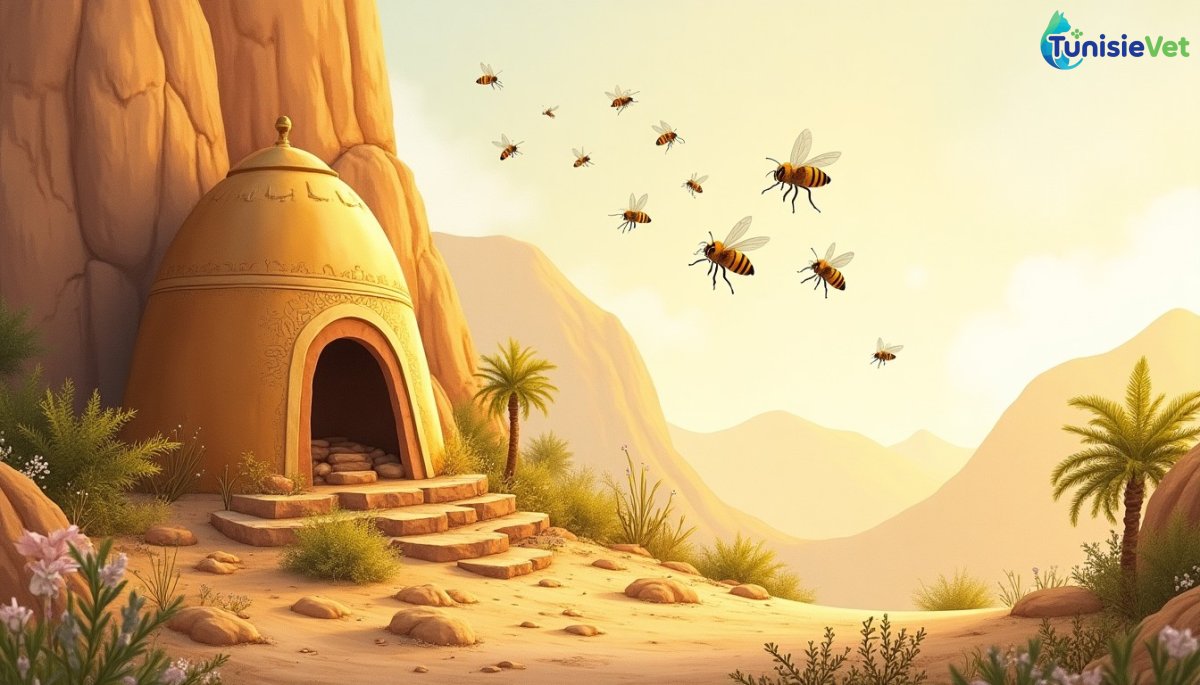
Among the one hundred and fourteen surahs of the Qur'an, one bears the name of a small industrious insect: the bee. This choice is not arbitrary; it reveals a profound lesson about divine inspiration and the order of creation.
In the Qur'an, the sixteenth surah is titled "An-Nahl," which means "The Bees." This name often surprises those who discover the Holy Book for the first time: why would a religious text devote its title to an insect? The answer lies in a specific passage of this surah, where Allah directly evokes the bee and its extraordinary behavior as proof of His wisdom.
An Inspiration from Heaven
The central verse of this evocation describes how the bee receives a form of divine guidance to build its dwellings and forage. The text is reported thus:
﴿ وَأَوْحَىٰ رَبُّكَ إِلَى النَّحْلِ أَنِ اتَّخِذِي مِنَ الْجِبَالِ بُيُوتًا وَمِنَ الشَّجَرِ وَمِمَّا يَعْرِشُونَ ﴾
"And your Lord inspired the bee: 'Take for yourself dwellings in the mountains, the trees, and what people construct as trellises.'"
(Surah An-Nahl, verse 68)
The following verse completes this description by evoking the varied food that the bee forages, then the honey that results, presented as a remedy for people. This link between divine inspiration, the meticulous work of the insect, and the benefit it brings to humanity is presented as a sign for the believers to reflect upon.
A Meticulous Order Serving Creation
Commentators of the Qur'an, throughout the centuries, have highlighted several teachings drawn from this passage. It is reported that this verse inspired many exegetes to reflect on the social organization of bees: their collective work, the division of tasks in the hive, and the geometric precision of their cells are often cited as concrete illustrations of this "inspiration" mentioned in the text.
So it is not the bee itself that is glorified for its own merits, but rather what it reveals of the care exercised by the Creator over each element of the universe, even the smallest. The choice to name an entire surah after this insect reminds readers that divine wisdom is not limited to great events or prophetic figures: it manifests itself also in the quiet gestures of a tiny creature that forages from flower to flower.
Honey, a Benefit Mentioned in the Qur'an
The surah continues by evoking honey as a drink "of varied colors, in which there is a healing for people." This mention has nourished, throughout Islamic history, a particular interest in the virtues of honey, including in several hadith where the Prophet Muhammad ﷺ recommends its use, notably in an account reported by Sahih al-Bukhari where he counsels honey as a remedy to a man who came before him complaining of an ailment of his brother.
Thus, Surah An-Nahl weaves a link between the animal world, nature, and human well-being, inviting the reader to observe what surrounds them with attention rather than indifference.
This story teaches us that no creature, however small, is insignificant in the eyes of the Creator. Observing bees, protecting their habitat, and respecting the essential role they play in pollination and the balance of nature is to extend in our daily actions this lesson of kindness toward all living beings that the Qur'an invites us to contemplate.