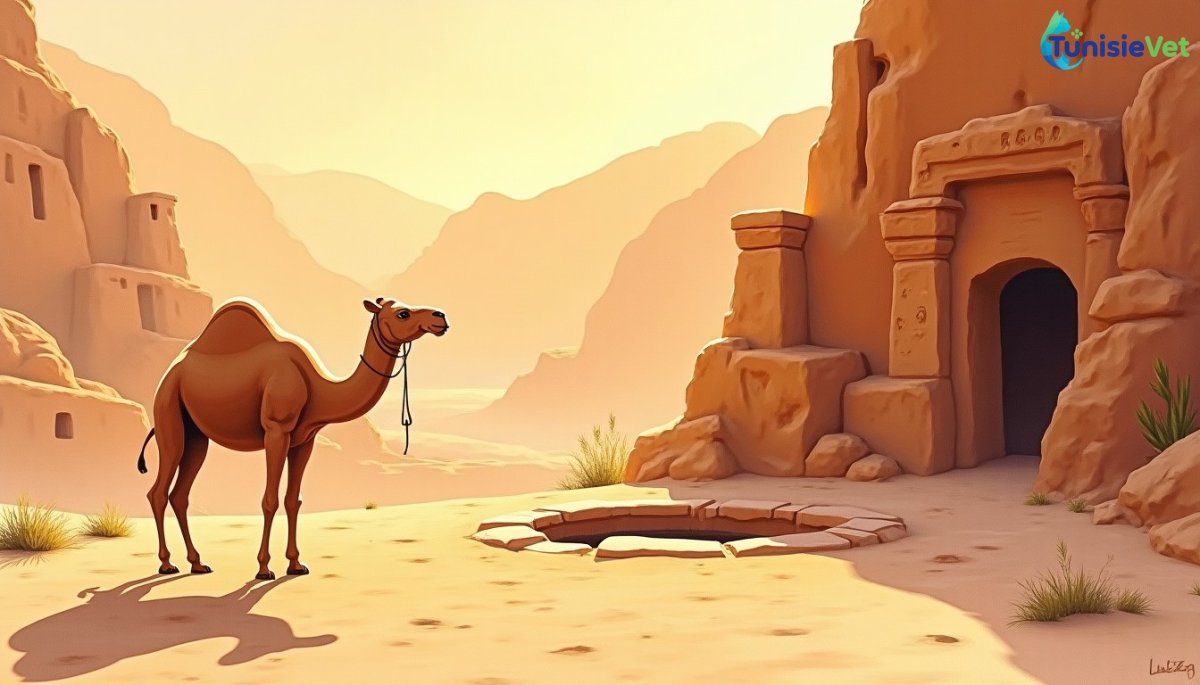
Among the rocky ruins of Al-Hijr, a sacred she-camel was sent as a sign to a disbelieving people. Her tragic fate would seal the destiny of the Thamûd and forever remind them of the reverence due to God's creatures.
The people of Thamûd lived in the region of Al-Hijr, skillfully carving dwellings out of rock. God sent them the prophet Salih (peace be upon him) to call them to worship of the One Lord and to abandon idolatry. Faced with their defiance, the people's notables demanded an extraordinary sign to believe in his mission.
A She-Camel Sent as a Sign
God then caused a she-camel to emerge miraculously from a rock, as tangible proof given to the Thamûd. Salih told them that this she-camel now belonged to their community and must be allowed to drink freely, taking turns with them, and no harm was to be done to her. The Qur'an reports this warning in Surah Ash-Shams:
﴿ فَقَالَ لَهُمْ رَسُولُ اللَّهِ نَاقَةَ اللَّهِ وَسُقْيَاهَا ﴾
The Messenger of God said to them: "Guard against God's she-camel and her drinking!"
(Surah Ash-Shams, verse 13)
This she-camel was thus no ordinary animal: she represented a divine sign entrusted to the people's keeping, a test of their submission and compassion toward an innocent creature.
The Crime and the Punishment
Despite this clear warning, certain members of the Thamûd people, driven by pride and stubbornness, plotted to kill the she-camel. It is reported that one of them, identified by the scholars as the most wretched among them, carried out the deed, encouraged by the others. Surah Ash-Shams describes their fate:
﴿ فَكَذَّبُوهُ فَعَقَرُوهَا فَدَمْدَمَ عَلَيْهِمْ رَبُّهُم بِذَنبِهِمْ فَسَوَّاهَا ﴾
But they rejected him and killed her. Their Lord destroyed them for their sin and levelled the consequences upon all of them without exception.
(Surah Ash-Shams, verses 14-14)
Salih had warned his people that the death of the she-camel would bring a terrible punishment within three days. This period passed without any sign of genuine repentance appearing among the guilty. The promised punishment then fell upon the Thamûd, described in several surahs of the Qur'an, notably in Surah Al-A'raf and Surah Hud, as a dreadful cry and an earthquake that destroyed them, leaving standing only those who had believed with Salih.
A Lesson for All Times
This account, mentioned repeatedly in the Qur'an, particularly in Surahs Al-A'raf, Hud, Ash-Shu'ara, An-Naml, and Ash-Shams, shows how contempt for a divine sign, embodied here in a simple she-camel, can have far-reaching consequences. The animal was not merely a creature among others: she carried the weight of a trial of faith and compassion.
This story teaches us that kindness toward animals is never a minor detail in the Islamic tradition. To care for a living creature, to respect its need to drink and to live in peace, is a matter of profound moral responsibility. Even today, this account invites each person to reflect on how we treat the animals around us, keeping in mind that every created life deserves respect, gentleness, and protection.