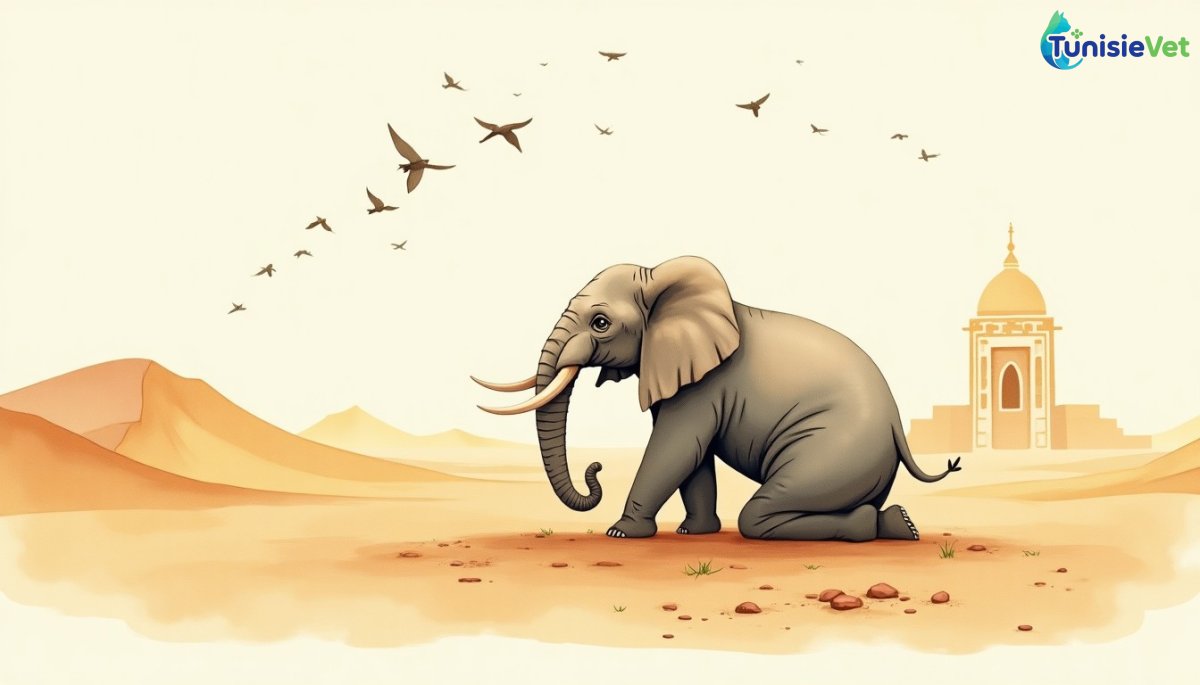
A powerful king marched on Mecca with an army and elephants to destroy the Kaaba. What took place that day is recounted in the Quran, in a chapter named after that very animal.
This story takes place in the year of the birth of the Prophet Muhammad ﷺ, a period known in Islamic tradition as "the Year of the Elephant." A ruler named Abraha, who reigned over Yemen, had built a great church and wanted to divert to it the pilgrims who traveled to the Kaaba in Mecca. Seeing that the Arabs continued to go there, he decided to march on the Kaaba with a powerful army in order to destroy it.
An Army Led by Elephants
What made this army particularly formidable was that it was accompanied by elephants, creatures that the Arabs of the peninsula had scarcely ever seen and which seemed invincible against their modest defenses. It is reported that one of the elephants, often called Mahmoud in tradition, refused to advance when the army approached Mecca: each time it was directed toward the holy city, it would stop and kneel down, and it had to be turned in another direction for it to consent to move. This strange behavior of the animal is regarded by commentators as a sign foretelling what was to follow.
Abd al-Muttalib, the grandfather of the Prophet ﷺ, who then had charge of the Kaaba, went to Abraha to ask only for the return of his camels that had been taken from him, leaving the protection of the Sacred House to God Himself. According to tradition, he is said to have declared that the Kaaba had a Master who would defend it.
The Punishment from the Sky
Then came the event reported in the Quran, in the chapter that bears precisely the name of that animal, Al-Fil ("The Elephant"). God sent against Abraha's army flocks of birds, called "Ababil," which hurled small stones at the soldiers. This bombardment brought about their complete destruction, and the army was annihilated before it could even approach the Kaaba.
﴿ أَلَمْ تَرَ كَيْفَ فَعَلَ رَبُّكَ بِأَصْحَابِ الْفِيلِ * أَلَمْ يَجْعَلْ كَيْدَهُمْ فِي تَضْلِيلٍ * وَأَرْسَلَ عَلَيْهِمْ طَيْرًا أَبَابِيلَ * تَرْمِيهِم بِحِجَارَةٍ مِّن سِجِّيلٍ * فَجَعَلَهُمْ كَعَصْفٍ مَّأْكُولٍ ﴾
"Have you not considered how your Lord dealt with the people of the Elephant? Did He not render their stratagem completely futile? And He sent against them birds, in flocks, which pelted them with stones of baked clay. He thus made them like chewed straw."
(Surah Al-Fil, verses 1 to 5)
The scholars recall that this event took place not long before the birth of the Prophet ﷺ, and that it became known throughout Arabia as a manifest proof of divine protection granted to the Kaaba, even before the advent of Islam. The elephant that refused to advance holds a particular place in the narratives: it was not the instrument of destruction but, by its very refusal, the silent sign that something extraordinary was about to occur.
A Lesson in Compassion
This story reminds us that animals, whether small birds or mighty elephants, occupy a place willed by God in the order of the world, and that their behavior may carry signs that humans do not always perceive. It invites believers to observe the creatures around them with humility and respect, never using them for purposes of destruction or domination, but rather recognizing in them signs of divine wisdom that deserve our attention and our gentleness.