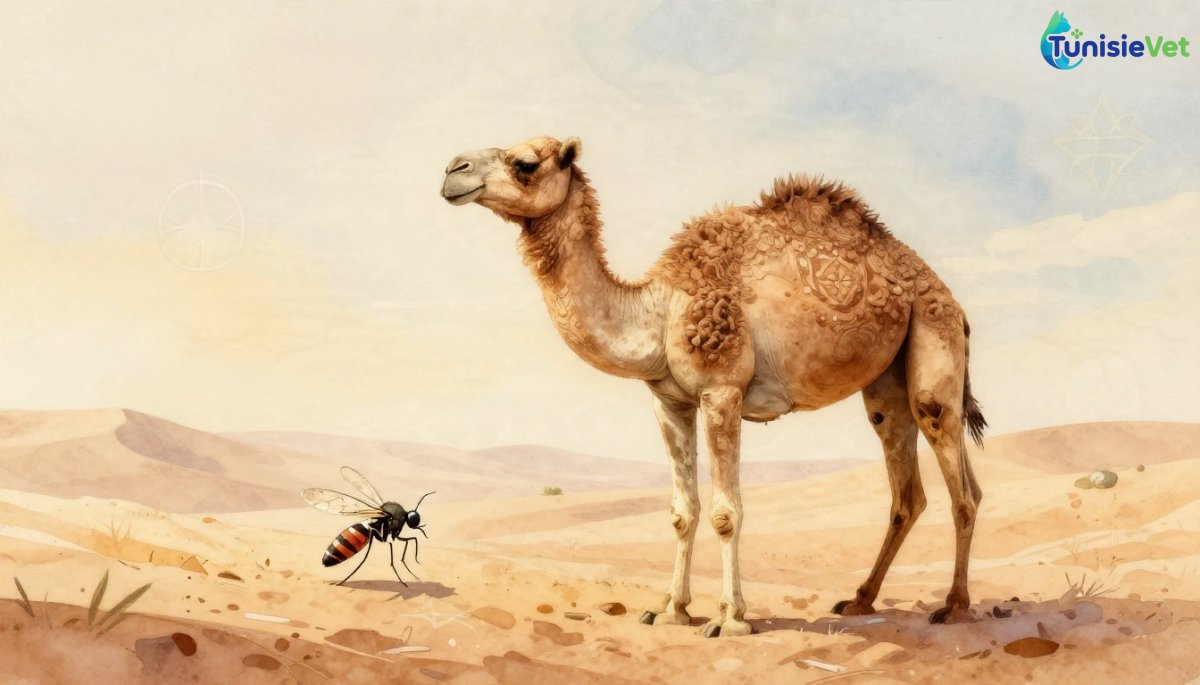
From the camel to the mosquito, animals appear in the texts at very different scales. The Qur'an invites us to observe this diversity, without giving each species a value linked to its size.
The camel is among the creatures that the Qur'an invites us to look at. Its great size catches the eye, but the text goes further than this first impression: it asks us to consider how this animal was created. In Surah Al-Ghashiya, this invitation takes the form of a question.
﴿ أَفَلَا يَنْظُرُونَ إِلَى الْإِبِلِ كَيْفَ خُلِقَتْ ﴾
Do they not look at the camels, how they have been created?
(Surah Al-Ghashiya, verse 17)
On a completely different scale, Surah Al-Baqara mentions the mosquito in an example. The presence of this small animal in the text reminds us that a creature does not need to be imposing to hold our attention. The camel and the mosquito are not presented in the same account: each appears in a separate passage, but both invite us to look at the living world.
A diversity to contemplate
Why are some species large and others tiny? The Qur'an presents the diversity of creatures as a sign to observe, without separately explaining the size of each species. It therefore does not give, for each animal, a particular reason that we could state with certainty. Faced with this diversity, the text rather invites reflection and recognition of God's creation.
Surah An-Nur refers to animals that move on their belly, on two legs or on four. Surah Al-An'am, for its part, notes that the animals on the earth and the birds that fly with their wings form communities. These passages draw attention to beings with varied forms and ways of life, without making their size a measure of their worth.
The Qur'an also mentions the bee in Surah An-Nahl. God inspires it to take up dwellings in the mountains, in the trees and in the structures that humans build. The passage speaks of what comes out of its belly: a drink of various colours, in which there is a healing for people. Thus, even a small animal can be at the centre of a sign offered for reflection.
Observing and caring
The hadiths also invite us to consider the needs of animals. In an account related by Sahih al-Bukhari and Sahih Muslim, a man finds a dog overcome by thirst. He goes down into a well, fills his shoe with water and gives it to the dog. God is pleased with this act and forgives him. The account reminds us that a simple kindness can respond to a very real suffering.
Large or tiny, every animal deserves our attention. Observing without contempt, avoiding causing suffering, and responding, when we can, to the needs of a living being are acts of kindness that give each creature a place in the world around us.