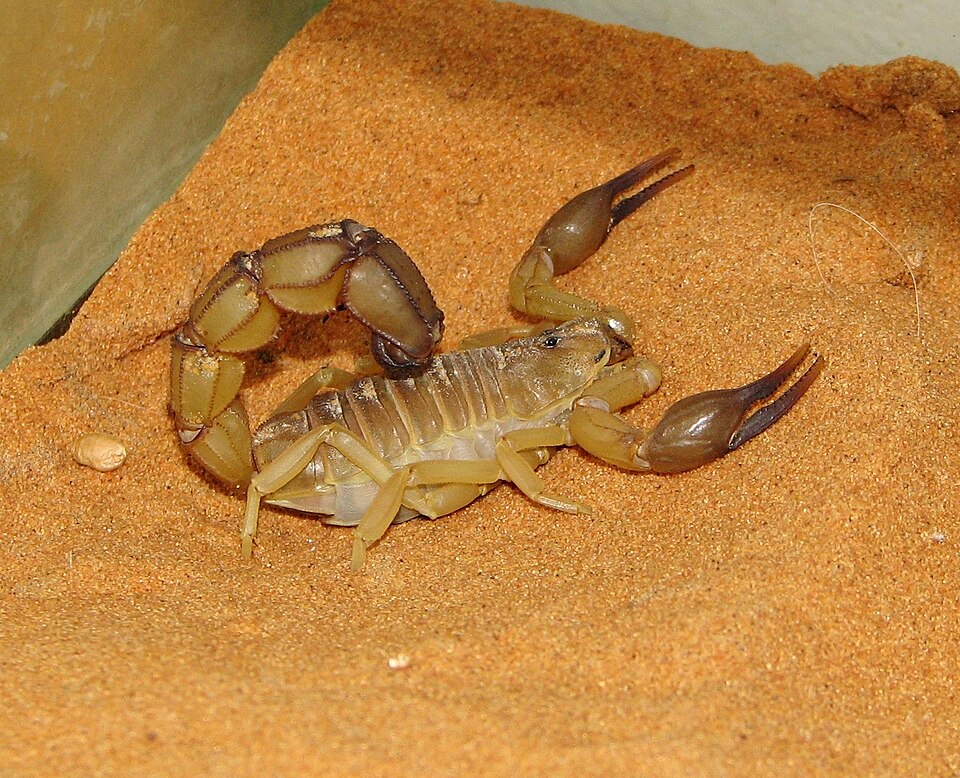
The yellow Sahara scorpion survives with very little water thanks to an almost waterproof cuticle, an almost dry excretion of its nitrogenous waste and an extremely slowed metabolism, combined with a nocturnal and burrowing lifestyle which limits water loss by evaporation.
A physiology designed for aridity
The cuticle of Androctonus australis is covered with a thin layer of epicuticular waxes which considerably reduces water permeability, a trait shared by many desert arthropods but taken to the extreme in this scorpion. Unlike mammals, which excrete nitrogen in the form of diluted urea in urine, this scorpion excretes its nitrogenous waste primarily in the form of guanine, a virtually insoluble compound that requires almost no water for evacuation.
Its basic metabolism is among the lowest measured among arthropods: oxygen consumption at rest can be several dozen times lower than that of an insect of comparable mass. This energy saving allows it to fast for several months, with some individuals surviving without any food intake for six months to a year in the laboratory, by drawing on their lipid reserves stored in the opisthosoma.
Publicité
Publicité
Nocturnal activity completes this system: by remaining holed up during the day in its burrow or under stones, where the relative humidity remains much higher than on the surface, the scorpion avoids daytime temperatures which can exceed 45°C and the resulting loss of water through skin evaporation. He only goes out to hunt at nightfall, when the air cools and the humidity rises.
Almost exclusively metabolic water
Most of the water used by this scorpion comes from the oxidation of fats contained in its prey, a process called metabolic water. This internal source, associated with the capacity to recover nocturnal atmospheric humidity at the level of the burrow, is sufficient to compensate for residual losses, making the species almost independent of a free water point, a characteristic which explains its presence in the driest areas of the Tunisian Sahara.