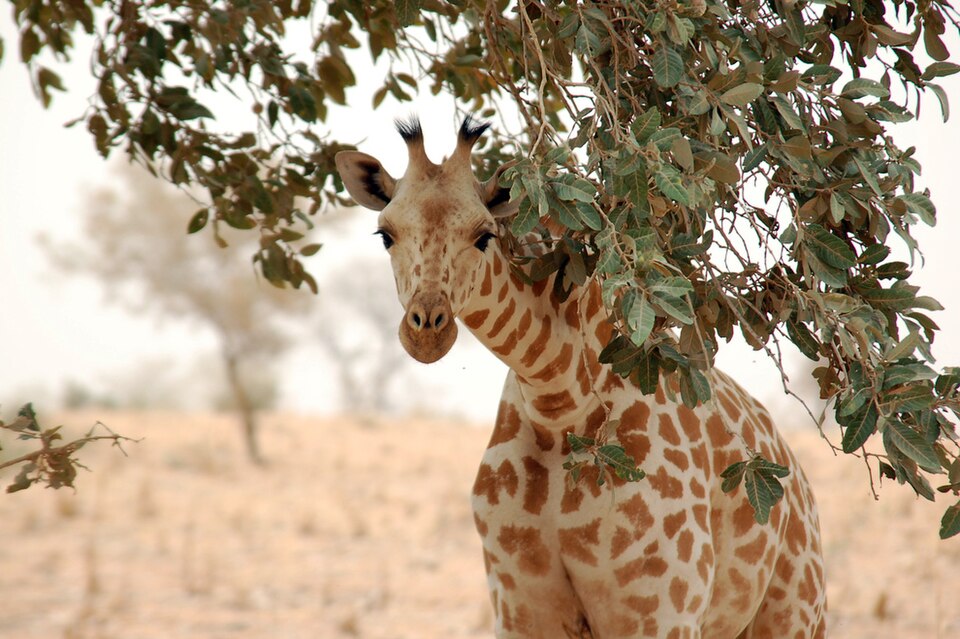
The giraffe's neck has exactly seven vertebrae, like those of all mammals, but each can measure up to 25 cm long. The evolutionary origin of this excess remains debated: it would have favored access to the upper foliage of acacias, or it would be the result of sexual selection linked to neck fights between males, “necking”.
Publicité
Publicité
Two hypotheses, an unresolved debate
The historical so-called “foliage hypothesis” assumes that a longer neck provides exclusive access to resources above the reach of other herbivores, reducing food competition. But observations show that giraffes often feed at shoulder height, weakening this argument. The “necking” hypothesis suggests that the massive neck and head, used as weapons during clashes between males for access to females, would have been selected for their striking force rather than for their reach. The two mechanisms are not mutually exclusive and may have acted in combination during the evolution of the species.
Whatever the origin of the trait, its physiological consequence is major: the heart of the giraffe, which can weigh around 11 kg, develops a blood pressure almost twice that of a human being to propel the blood to the brain, located more than 2 meters above the ground.
A vascular network so you don't faint
This same system must manage the opposite: when the animal suddenly lowers its head to drink, gravity could cause a dangerous flow of blood to the brain. To achieve this, the giraffe has a network of tight vessels at the base of the skull, the rete mirabile, which cushions sudden variations in pressure, as well as venous valves in the neck limiting blood reflux. These vascular adaptations allow the animal to raise and lower its head quickly without loss of consciousness, a point that still intrigues researchers in comparative physiology.