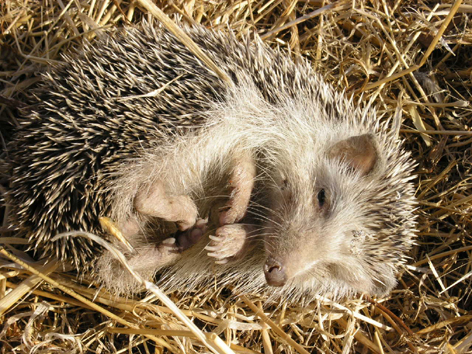
The quills of the Algerian hedgehog are modified, keratinized and stiffened hairs, which form a passive defensive armor: at the slightest danger, the animal rolls into a ball thanks to a powerful orbicularis muscle, exposing only these spines to a predator.
An armor made of transformed hairs
Each quill is in reality a hair whose keratin has densified and stiffened over the course of evolution, giving it a hollow and light but resistant structure. An adult Algerian hedgehog carries around 5,000 to 7,000 of them, distributed over the entire back and sides, while the stomach, face and legs remain covered with soft hairs and bare skin, which are more vulnerable.
The defense mechanism is based on a particularly developed circular muscle, the orbicularis muscle (or panniculus carnosus), which surrounds the body under the skin. By contracting, it acts like a bag cord and literally closes the animal on itself, head and legs drawn in, leaving only a sphere bristling with spikes outside. This position makes capture difficult for most predators, who give up due to lack of possible grip on the soft parts.
Publicité
Publicité
A myth to be corrected: the hedgehog does not throw its quills
Contrary to a tenacious preconceived idea, the Algerian hedgehog never projects its quills at an attacker. Each quill remains implanted in the skin and is only lost during natural shedding or rubbing, like any hair. The confusion often comes from an erroneous comparison with the porcupine, a completely different rodent from which certain spines can actually detach on contact, but which does not actively throw them either.
Present in North Africa, particularly in Tunisia where it frequents gardens, wadis and agricultural edges, this species illustrates a passive rather than offensive defense strategy: the quills protect, they never attack.