
Presentation
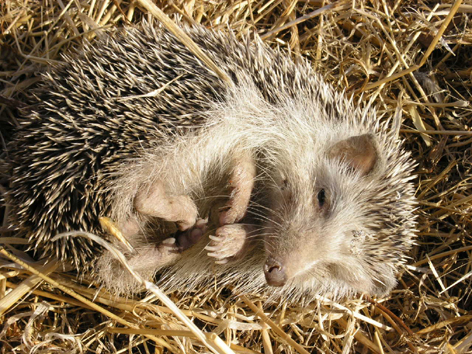
The North African hedgehog is a small insectivorous mammal recognizable by its quills covering its entire body. These quills, modified from hairs, serve as effective protection against predators. It is a nocturnal and solitary animal, active mainly at dusk.
The body of the North African hedgehog is massive and stocky, covered in 5,000 to 7,000 quills. Its muzzle is pointed and elongated, its eyes small and black. Its legs are short but sturdy, ending in claws adapted for digging. The underside of the body is less prickly than the back.
Did you know?
Can hedgehogs throw their quills?
Characteristics
Indicative values: they vary by subspecies, sex and region.
Habitat and distribution
The North African hedgehog mainly inhabits semi-arid steppes, cultivated areas, grasslands and peri-urban areas. It adapts well to environments transformed by humans and readily frequents farms, gardens and even urban areas. It prefers areas with soft soil where it can dig its burrows.
CURRENT RANGE
North African hedgehog is native to North Africa, particularly the Maghreb. Its distribution area extends over northern Algeria, Morocco and Tunisia. It has also been introduced to parts of southern Spain and Portugal, where it has successfully established itself.
Behaviour
The North African hedgehog is a crepuscular and nocturnal animal that rests during the day in burrows or hiding places. It is solitary, except during the breeding season. When threatened, it rolls itself into a tight ball, exposing only its spines. It hibernates or considerably slows down its activity during harsh winters.
Reproduction
The breeding season of North African hedgehog generally extends from spring to summer. Gestation lasts approximately 35 days. Females give birth to a litter of 4 to 8 young, called “hedgehogs”. The young are born naked and covered with a thin skin; their spines begin to emerge in the first days of life.
Peculiarities
The North African hedgehog has the remarkable ability to roll itself into a ball so tight that no predator can bite it. Its quills are covered with a smelly secretion which strengthens its defense. It uses its sensitive vibrissae to navigate and explore its environment. Its keen sense of smell allows it to detect prey under the ground.
Threats and conservation
The species is classified as Least Concern (LC) by the IUCN. However, it faces threats linked to the use of pesticides which reduce its food resources, habitat fragmentation, and road accidents. It is also vulnerable to parasitic diseases. Overall, its populations remain stable in its natural range.
Numbers and trends vary across sources and regions. See the IUCN assessment for the latest reference data.
Gallery
1 documented photographs.
References
UICN — Liste rouge des espèces menacées
Profile updated 01 September 2026 · Reviewed by the TunisieVet editorial team.
Comments (0)
No comments yet.
CONSERVATION STATUS
Least concern (LC)
IUCN source, latest published assessment.
Species health
Documented diseases for this species.
Find a veterinarianThis information is provided for educational purposes only and is not a substitute for a veterinary consultation. If you have any concerns about your animal's health, consult a veterinarian.
To discover around: North African hedgehog
Videos, facts, stories and records linked to this species.
Similar animals
Other species documented in Animalpedia.

TunisieVet in your pocket 📱🐾 Access your veterinary services wherever you are. [ Download the app ]
Learn more