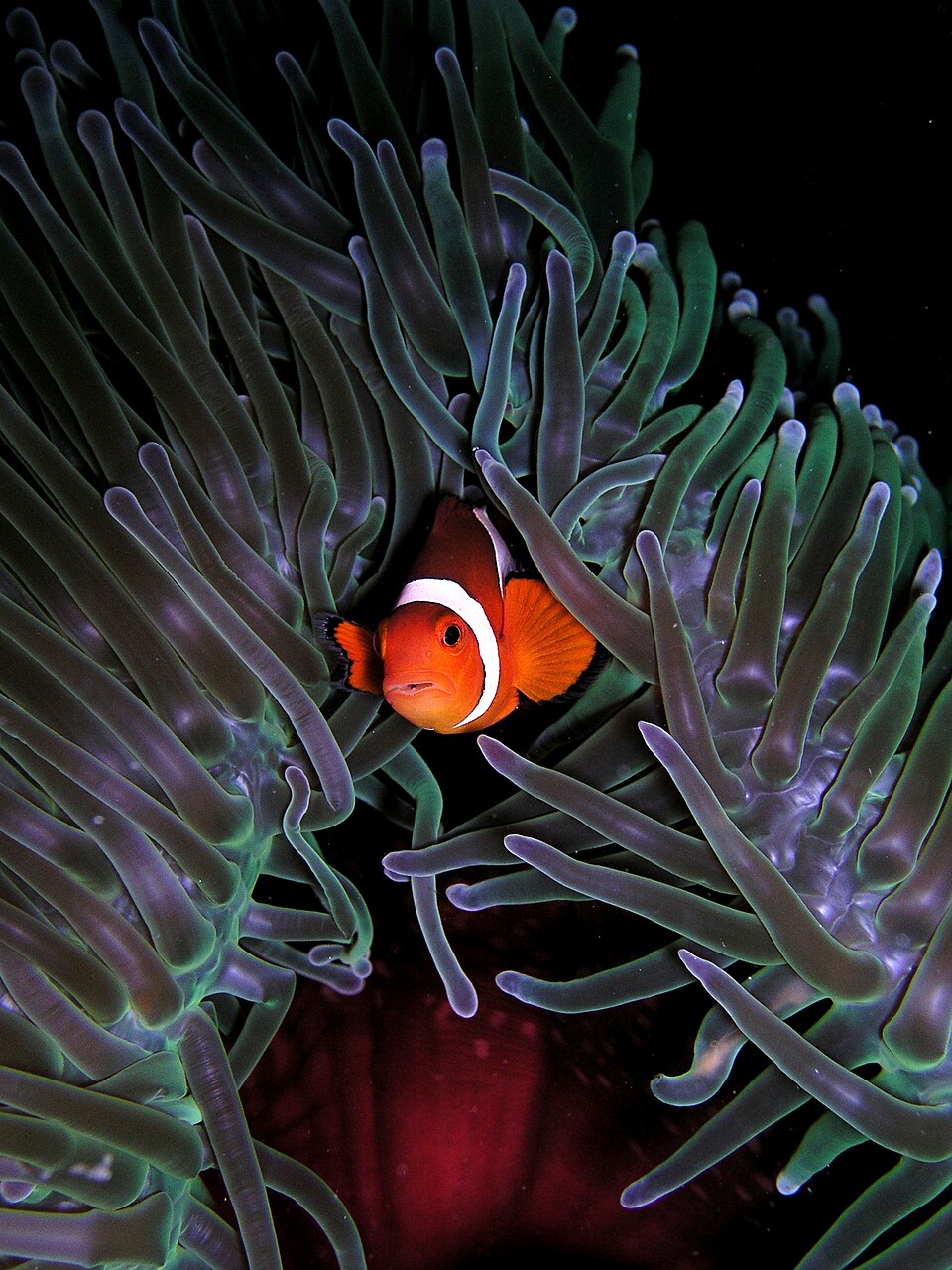
How does clownfish live in an anemone without getting stung?
91 views · 1 month ago
The clownfish is covered with a thick layer of mucus which prevents the anemone's cnidocytes (stinging cells) from firing; this protection is acquired gradually, through careful and repeated contact with the tentacles, and not from birth.
Mucus which deceives the stinging cells
The anemone's tentacles carry thousands of cnidocytes capable of injecting a paralyzing toxin as soon as an unusual chemical or mechanical contact is detected. The mucus of the clownfish (Amphiprion ocellaris) contains a high proportion of complex sugars close to those of the mucus of the anemone itself: the stinging cell then does not recognize “prey” and remains inactive. This mucus is not innate in its final composition: the young fish must acclimatize by touching the anemone in small sequences, often a few seconds at a time repeated over several hours, until its protective layer has chemically adjusted to the host.
This acclimation is specific: a clownfish transferred to an anemone of another species than the one on which it usually lives must sometimes start a period of adaptation again, proof that the mechanism depends in part on the biochemistry specific to each host-fish pair.
An exchange with reciprocal benefits
This mutual tolerance benefits both partners. The clownfish, immune, finds an almost inviolable refuge against its predators, who benefit from no protection against the tentacles. In return, it cleans the anemone of parasites and organic debris accumulated between the tentacles, chases away certain anemone-grazing fish and, through its movements, promotes better oxygenation of the water around the host. Its excrement also provides nutrients that can be assimilated by the anemone's symbiotic zooxanthellae. This relationship, described as an obligatory mutualism for fish (it does not survive long without a host in its natural environment) illustrates a fine coevolution between two marine organisms of the coral reef.