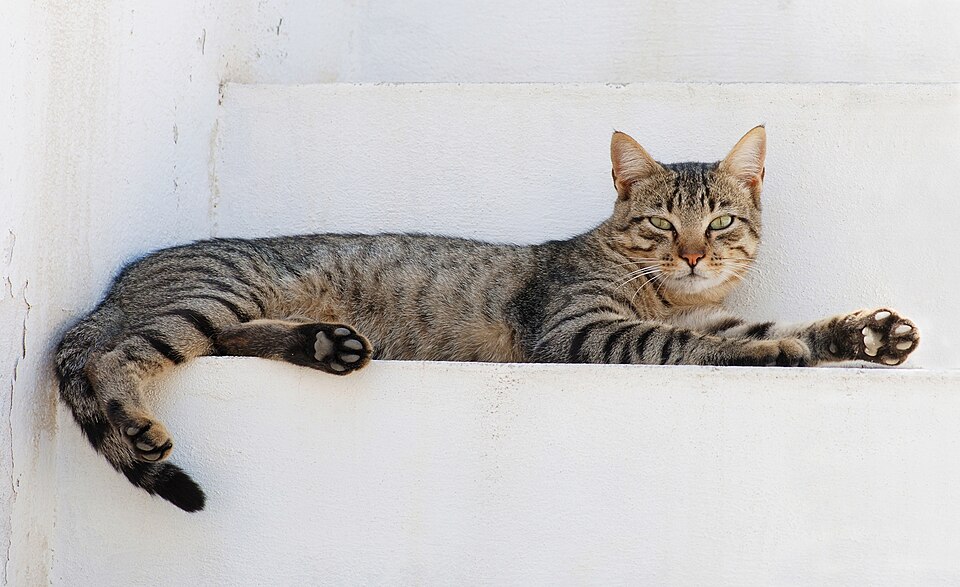
No, cats do not have nine lives: this belief is a cultural legend with no biological basis. It rests on their remarkable agility and their ability to survive falls that would be fatal to other animals, which has fueled the idea of a near-supernatural resistance to death.
Publicité
Publicité
A righting reflex, not immortality
The real foundation of this myth is physiological: the cat possesses a highly developed righting reflex that allows its body to rotate in mid-air to land on its feet. This mechanism relies on a sensitive vestibular system, a very flexible spine (lacking a functional collarbone) and a distribution of muscle mass that absorbs impact at landing. These assets, combined with a reduced body weight, explain why some cats survive falls from several stories high, a phenomenon documented as "feline high-rise syndrome".
This natural suppleness and stealth (silent movement, ability to squeeze through tight spaces, constant vigilance) have reinforced, over the centuries, the image of an elusive animal, nearly impossible to kill. But this is a real anatomical adaptation, not a fixed number of lives.
A number that varies by culture
The number of lives attributed to the cat differs according to regions of the world: Anglo-Saxon tradition speaks of nine lives, while in Spain, Italy, and the Arab world, seven lives are more often mentioned. These differences have no common scientific basis; they reflect numerical symbolism unique to each culture, with the number seven being associated with luck or the sacred in many traditions, while nine refers to multiple cycles of three in British culture.
It is essential to stress that a fall, even from a low height, remains a frequent veterinary emergency in cats: fractures, chest trauma, or internal injuries can occur despite the righting reflex. Any suspected fall should lead to prompt veterinary attention.