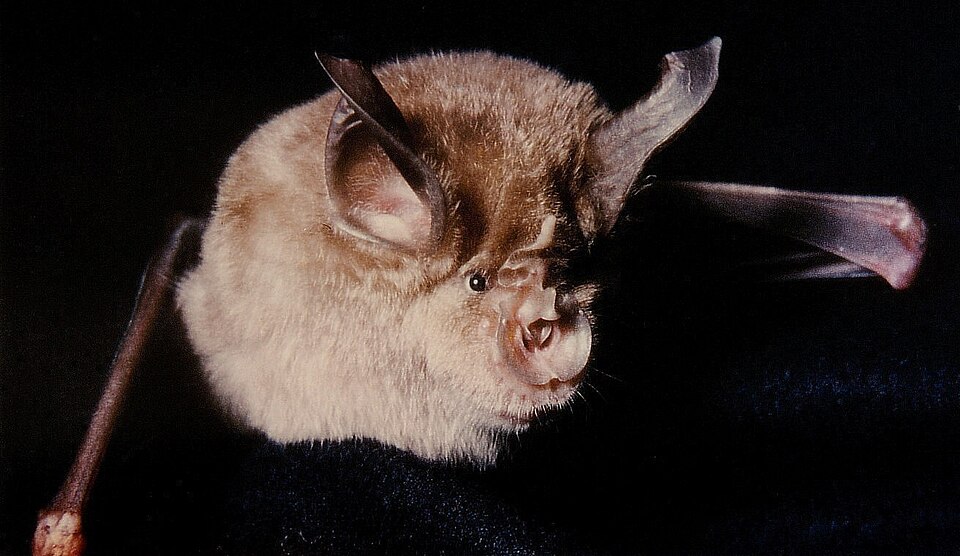
The greater horseshoe bat navigates in the dark using echolocation: it emits high-frequency ultrasound through its nostrils, then analyzes the echo returned by obstacles and prey to reconstruct a precise “soundscape”. Contrary to popular belief, this bat is not blind: it sees, but hunts mainly by ear.
Ultra-precise biological sonar
In the Greater Horseshoe Bat, ultrasonic calls are emitted through the nostrils, surrounded by a horseshoe-shaped nasal appendage (hence its name) which acts as a megaphone and focuses the sound beam forward. The species emits at a near constant frequency of around 80 kHz, well beyond human hearing. By comparing the delay between the emission and return of the echo, the animal calculates the distance of the obstacle or the targeted insect, with sufficient resolution to avoid a fine wire in mid-flight.
The second mechanism used is the Doppler effect: when the target moves, the frequency of the received echo shifts slightly compared to that emitted. The greater horseshoe bat actively compensates for this shift by adjusting the frequency of its calls in real time, a capacity called Doppler compensation, described in this species by several bioacoustics studies. This fine tuning allows it to keep the echo returning in the frequency band where its inner ear is most sensitive, improving detection of a moth's wingbeat up to several meters away.
Sight and echolocation, two complementary senses
All bats have functional eyes and can see, particularly at dusk or for large-scale orientation. Echolocation is not a substitute for sight but a complementary sense, particularly effective in the total darkness of the caves where the Greater Horseshoe Bat establishes its breeding and wintering colonies. This dual sensory capacity explains its reputation as a fearsomely precise nocturnal hunter, capable of detecting and capturing small flying insects in mid-flight, in dense vegetation.