
Household Products and Pets: A Beginner's Guide to Staying Safe

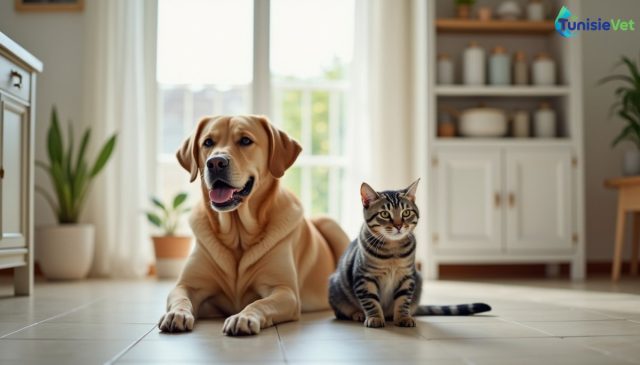
Household products are useful at home, but many can poison a dog, a cat, a rabbit or a bird. The golden rule: store them out of reach, rinse, ventilate and choose suitable products. This practical guide brings together simple veterinary advice to limit risks and react quickly in case of an accident.
The TunisieVet app to care for your pet
Vets, adoption and products


1. Why household products are dangerous for animals
Animals explore with their mouths, tongues and paws. They lick a floor that is still damp, chew on a bottle or drink from a bucket of water. They are also much smaller than we are: a tiny dose can be enough to make them ill.
Three routes of exposure
- Ingestion: a leaking bottle, rinse water, a chewed sponge.
- Skin contact: a wet floor, followed by licking of the paws and fur.
- Inhalation: fumes, aerosols, diffusers. Birds and small rodents are very sensitive to them.
2. The products carrying the highest risk
| Product | Main risk | Good reflex |
|---|---|---|
| Bleach | Burns to the mouth, stomach and eyes | Dilute, rinse, keep the animal away until dry |
| Ammonia | Fumes that irritate the respiratory tract | Never mix it with another product |
| Drain and descaling cleaners | Serious chemical burns | Store under lock or up high |
| Scented disinfectants | Irritation, drooling, vomiting | Check the composition, rinse thoroughly |
| Aerosols and air fresheners | Breathing difficulties, especially in birds | Avoid them in the animal's room |
| Rodenticides and insecticides | Often severe poisoning | Place out of reach, consult quickly if in doubt |
Essential oils, often marketed as "natural", are not harmless. Cats tolerate them particularly badly.
3. Common mistakes made by beginners
- Believing that an "eco-friendly" or "natural" product is necessarily harmless.
- Mixing two products, for example bleach and descaler: this releases toxic gases.
- Leaving a bucket of soapy water unattended.
- Refilling a water or drink bottle with a product, without a label.
- Letting the animal return to a floor that is still wet.
- Cleaning the cage, litter or drinking bowl with a product that has not been rinsed properly.
4. Good habits for cleaning safely
- Move the animal to another room before you start.
- Read the label and follow the recommended dilution.
- Ventilate by opening the windows during and after cleaning.
- Rinse with clean water any surfaces the animal comes into contact with: bowls, floors, toys.
- Let everything dry completely before the animal returns.
- Close and store the product in a closed cupboard or up high.
Gentle alternatives
Neutral soap and hot water are enough for most everyday tasks. Diluted white vinegar can help on certain surfaces, but never mix it with bleach. For litter trays and cages, regular cleaning with water and mild soap, followed by a thorough rinse, is better than a powerful disinfectant.
5. Special cases: farms, birds and small pets
In a henhouse, cowshed or sheepfold, disinfectants are useful for hygiene, but they call for precautions. Remove the animals or wait until surfaces are dry, rinse drinkers and feeders, and store products away from feed. Pet birds, rabbits and hamsters have fragile respiratory systems: avoid smoke, aerosols and fragrances in their room.
6. What to do in case of poisoning?
Act calmly and quickly. Keep the product packaging: the veterinarian needs the name and the composition.
- Move the animal away from the source and remove the product.
- If the product is on the skin or in the eyes, rinse thoroughly with clean water.
- Do not induce vomiting without professional advice, especially with a corrosive product.
- Do not give milk or any home remedy without advice.
- Call a veterinarian without delay: you can find one through the TunisieVet veterinarian directory.
Excessive drooling, vomiting, difficulty breathing, weakness or redness of the mouth are warning signs. If you notice them, seek consultation without delay.
In summary
- Store all household products out of reach, in a closed cupboard.
- Never mix two products and always respect dilution instructions.
- Move the animal away, ventilate, rinse and let surfaces dry before its return.
- Favour neutral soap and water for everyday cleaning.
- In case of ingestion or contact, keep the packaging and call a veterinarian.
Frequently asked questions
Can I use bleach when I have pets at home?
Yes, but with caution: dilute it, rinse well and keep the animal away until the surface is completely dry. Never mix it with another product.
Are natural household products safe for animals?
Not always. Some essential oils are toxic, especially for cats and birds. A simple product such as neutral soap remains the safest choice.
What should I do if my dog has licked a household product?
Remove the product, rinse the mouth or skin if needed, and keep the packaging. Contact a veterinarian quickly, and do not induce vomiting yourself.
Conclusion
Choosing and using your household products wisely protects the whole household, humans and animals alike. Storing them safely, ventilating and rinsing: these simple habits prevent most accidents. If you are unsure about a product or notice an unusual symptom, ask your veterinarian for advice.
Leave a comment
Be the first to comment on this article.
