
Presentation
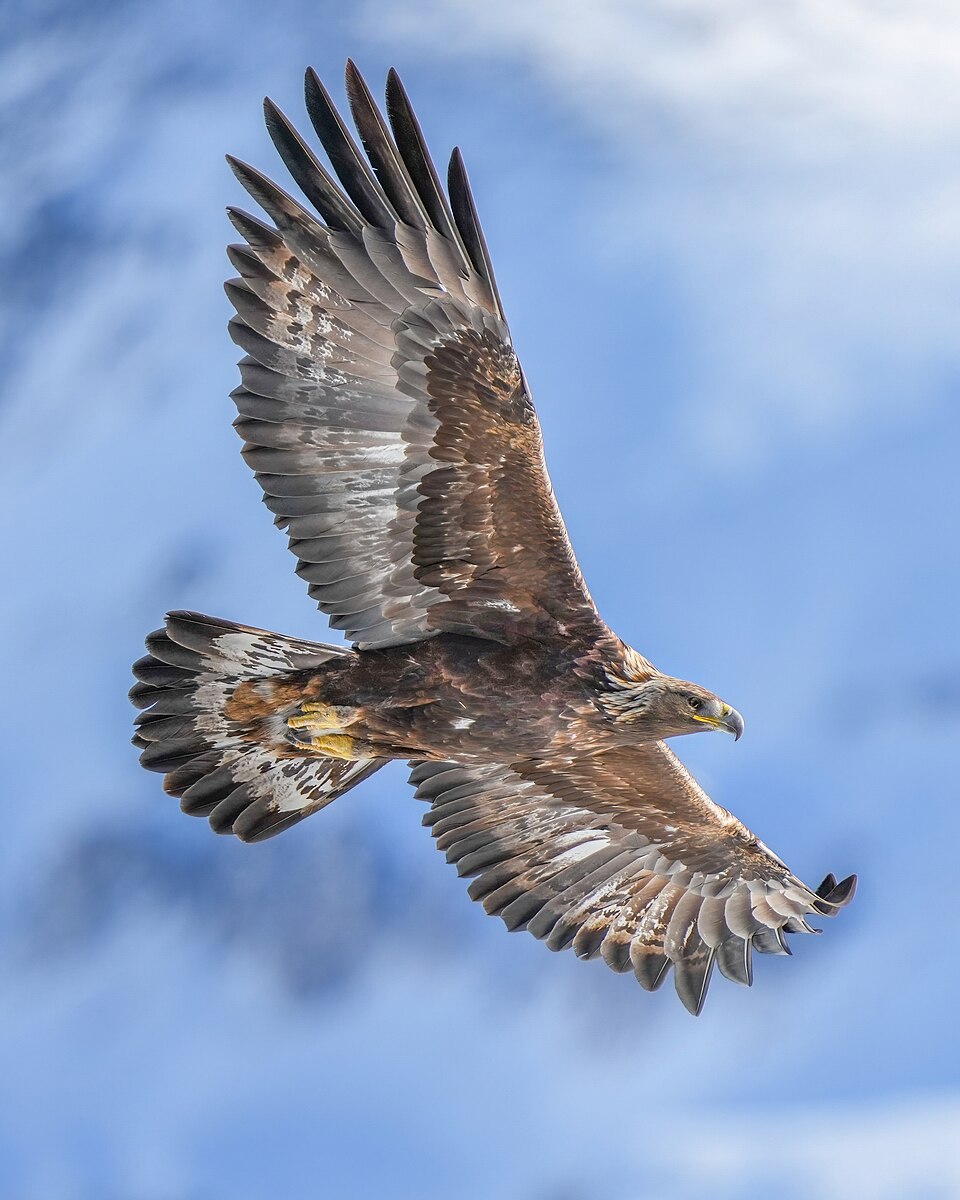
The Golden eagle is one of the largest and most powerful raptors in Eurasia. With its dark brown plumage and characteristic golden head, it embodies majesty and strength in mountainous environments. It is an apex predator that has ruled high altitudes for millennia.
This raptor is equipped with exceptional vision, approximately 8 times better than that of humans, allowing it to spot prey from afar. Its powerful claws can exert a pressure of more than 400 kg/cm², and its wide, pointed wings offer remarkable maneuverability in mountainous terrain.
Characteristics
Indicative values: they vary by subspecies, sex and region.
Habitat and distribution
The Golden eagle favors rugged mountain environments, from cliffs to wooded valleys. It frequents regions between 600 and 3000 meters above sea level depending on the latitude, where it can nest on rocky escarpments and hunt in the surrounding alpine meadows.
CURRENT RANGE
Golden eagle has a very wide circumpolar distribution, occurring in the Northern Hemisphere in North America, Europe and Asia. In North Africa, its presence is limited to the mountainous areas of the Maghreb and the central Sahara. It is a partial migrant depending on the region.
Behaviour
The Golden eagle is a solitary and territorial raptor. It adopts a spectacular hunting technique: it flies at very high altitude and dives at more than 240 km/h to capture its prey. It is active especially at the start of the day and can cover large areas to feed.
Reproduction
Golden eagle reaches sexual maturity around 4-5 years old. It forms lasting pairs and returns each year to the same nest which it gradually enlarges, reaching 2 meters in diameter. The female usually lays 2 eggs, incubated for 45 days. A single eaglet usually survives until fledging, occurring at around 70-80 days.
Peculiarities
One of the remarkable characteristics of the Golden eagle is its exceptional longevity and its fidelity to nesting sites: some pairs have used the same nests for 50 years or more. Its 340-degree panoramic vision and ability to maintain extraordinary flight altitudes make it unique among predators.
Threats and conservation
Although the Golden eagle is not globally threatened, it faces significant challenges: poisoning from lead munitions, collisions with wind turbines, electrocution on power lines, and degradation of its mountain habitat. Illegal shooting also remains a threat in some regions.
Numbers and trends vary across sources and regions. See the IUCN assessment for the latest reference data.
Gallery
1 documented photographs.
References
UICN — Liste rouge des espèces menacées
Profile updated 01 September 2026 · Reviewed by the TunisieVet editorial team.
Comments (0)
No comments yet.
CONSERVATION STATUS
Least concern (LC)
IUCN source, latest published assessment.
Species health
Documented diseases for this species.
This information is provided for educational purposes only and is not a substitute for a veterinary consultation. If you have any concerns about your animal's health, consult a veterinarian.
Related species
To discover around: Golden eagle
Videos, facts, stories and records linked to this species.
Similar animals
Other species documented in Animalpedia.

TunisieVet in your pocket 📱🐾 Access your veterinary services wherever you are. [ Download the app ]
Learn more