
Presentation
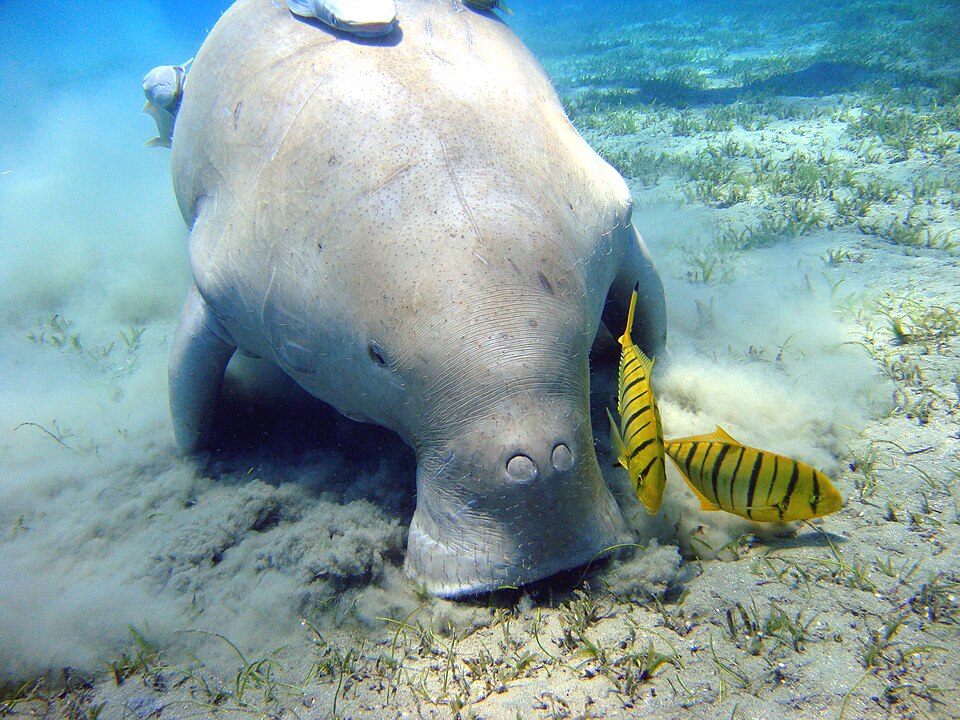
The Dugong (Dugong dugon) is a large herbivorous marine mammal belonging to the order Sirenians. It lives exclusively in the tropical and subtropical coastal waters of the Indian Ocean and the western Pacific, where it feeds on seagrass beds. Its fusiform body, crescent-shaped caudal fin and rounded snout distinguish it from the manatee, its close cousin. A discreet and slow species, the Dugong is today threatened by the degradation of its habitat and human activities. It is sometimes nicknamed "sea cow" because of its diet and peaceful behavior.
The Dugong has a massive, spindle-shaped body, thick grayish skin and a bilobed caudal fin reminiscent of cetaceans. Its head has a broad, rounded snout, oriented downwards, adapted to grazing on seagrass beds. Adult males develop small tusks, smaller versions of elongated incisors.
Characteristics
Indicative values: they vary by subspecies, sex and region.
Habitat and distribution
The Dugong frequents shallow coastal waters, lagoons and sheltered bays where seagrasses grow. It avoids deep water and generally stays less than ten meters deep. The presence of healthy seagrass meadows is essential to its survival.
CURRENT RANGE
The range of Dugong extends along the tropical and subtropical coasts of the Indian Ocean and western Pacific, from East Africa to northern Australia and the Pacific Islands. The largest populations today are in Australia. The species is absent from the Mediterranean Sea and therefore from Tunisia.
Behaviour
The Dugong is a solitary animal or living in small family groups, although larger gatherings are sometimes seen around rich feeding areas. It must come to the surface regularly to breathe, every few minutes on average. Its behavior is generally calm and not very shy, which makes it vulnerable to human activities.
Reproduction
Sexual maturity in Dugong is late, generally reached between 9 and 15 years of age. The female gives birth to a single young after a gestation of approximately 13 to 14 months. The young remain dependent on their mother for several months, even a few years, which limits the rate of population renewal.
Peculiarities
Dugong is often associated with legends of mermaids reported by ancient sailors. Unlike the manatee, its caudal fin is reminiscent of that of a dolphin. It is one of the rare strictly herbivorous marine mammals.
Threats and conservation
The main threats to Dugong are degradation and destruction of seagrass beds, coastal pollution, accidental capture in fishing nets and collisions with boats. Traditional hunting persists in certain regions. Its low reproduction rate makes populations slow to recover.
Numbers and trends vary across sources and regions. See the IUCN assessment for the latest reference data.
Gallery
1 documented photographs.
References
Profile updated 24 August 2026 · Reviewed by the TunisieVet editorial team.
Comments (0)
No comments yet.
CONSERVATION STATUS
Vulnerable (VU)
IUCN source, latest published assessment.
Species health
Documented diseases for this species.
This information is provided for educational purposes only and is not a substitute for a veterinary consultation. If you have any concerns about your animal's health, consult a veterinarian.
Similar animals
Other species documented in Animalpedia.
