
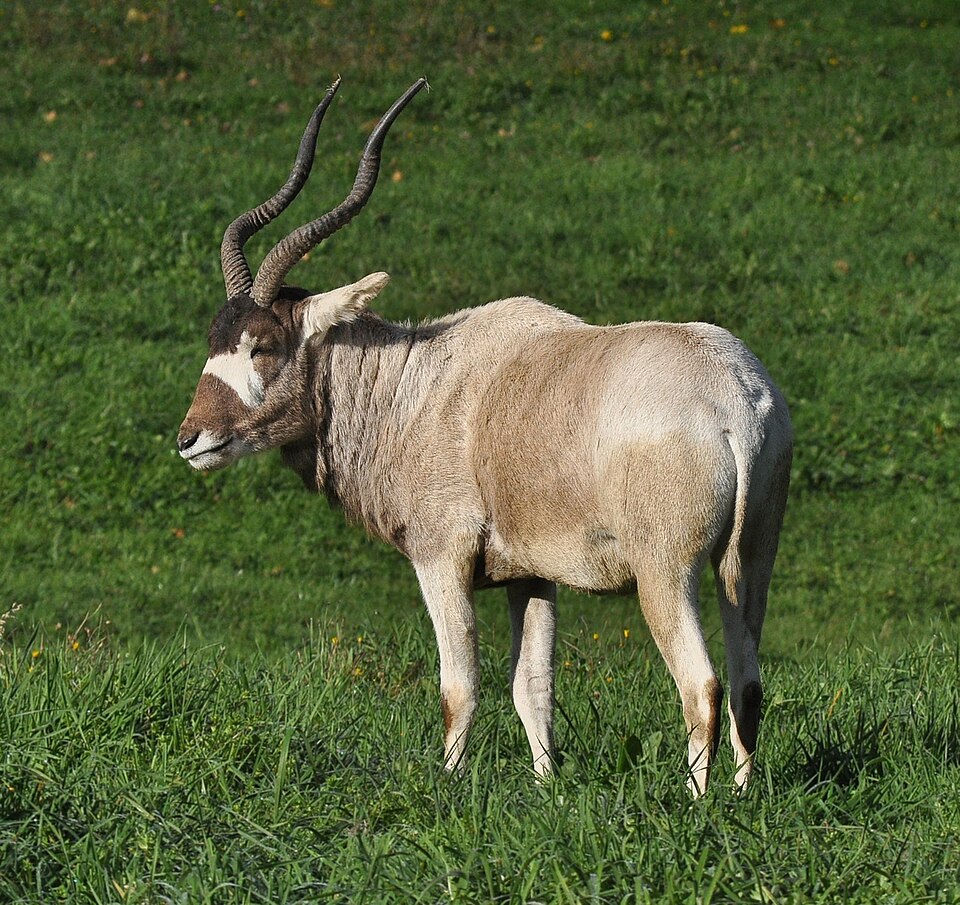
Presentation
The Addax (Addax nasomaculatus) is a desert antelope belonging to the Bovidae family, renowned for its remarkable adaptation to the driest environments of the Sahara. Its light coat and spiral horns make it an emblematic species but today extremely endangered. Once widespread across vast desert areas of North Africa, it has suffered a dramatic collapse of its populations due to poaching and habitat degradation. Only a few scattered wild individuals remain, making it one of the rarest antelopes in the world. Captive breeding programs, particularly in Tunisia, contribute to its conservation.
The Addax is a robust antelope with a light, grayish-white to beige coat, darker on the limbs and back in winter. Its spirally twisted horns, present in both sexes, can exceed 80 cm in length. Its broad, flat hooves facilitate walking on loose sand, and a tuft of brown-black frontal hair marks its forehead. Its stocky body and relatively short limbs reflect a morphological adaptation to the desert.
Characteristics
Indicative values: they vary by subspecies, sex and region.
Habitat and distribution
Addax lives in sandy deserts and arid regions of the Sahara, including ergs, regs and sparsely vegetated stony plains. It favors areas where a few clumps of drought-resistant grasses grow, essential for its nutrition and hydration. Its natural habitat is among the most extreme that an antelope can colonize, with very high temperatures and almost zero rainfall. In Tunisia, it is maintained in protected reserves reconstituting this type of desert environment.
CURRENT RANGE
Historically, the Addax occupied a vast area of the Sahara, from Morocco to Egypt, including Mauritania, Mali, Niger, Chad and Libya. Today, surviving wild populations are essentially limited to Niger and Chad, in very small numbers. Reintroduced or semi-captive populations exist in several North African countries, including Tunisia, within fenced reserves. The species has disappeared in the wild from the majority of its historic range.
Behaviour
The Addax lives in small gregarious herds of a few to twenty individuals, led by a dominant male. It adopts a mainly twilight and nocturnal activity in order to avoid the strong daytime heat, often resting in the shade or in sandy depressions. Not very shy and endurance in the face of extreme drought, it can remain for a long time without water, drawing moisture from the vegetation. Its movement is slow and energy efficient, adapted to the scarcity of resources.
Reproduction
The Addax female usually gives birth to a single young after a gestation of around nine months, with breeding occurring at any time of the year but often peaking after the rains. The young are able to follow the herd shortly after birth and remain dependent on their mother for several months. Sexual maturity is reached around two years of age. In captivity, breeding programs follow rigorous genetic management in order to preserve the diversity of the species.
Peculiarities
The Addax is among the mammals best adapted to life in extreme deserts, capable of surviving without drinking for very long periods. Its coat color changes depending on the season, darker in winter and lighter in summer, which helps it regulate its body temperature. It is one of the most endangered antelopes on the planet, with a wild population estimated at only a few dozen individuals.
Threats and conservation
The main threat is intensive poaching, particularly for meat and trophies, combined with armed conflicts in certain areas of the Sahara facilitating illegal hunting. Habitat degradation through domestic livestock grazing and expansion of human activities also reduces available resources. Climate change is accentuating aridification and the disappearance of rare vegetation. The species is now classified as critically endangered in the wild.
Numbers and trends vary across sources and regions. See the IUCN assessment for the latest reference data.
Gallery
1 documented photographs.
References
Profile updated 21 August 2026 · Reviewed by the TunisieVet editorial team.
Comments (0)
No comments yet.
CONSERVATION STATUS
Critically endangered (CR)
IUCN source, latest published assessment.
Species health
Documented diseases for this species.
See the 8 diseases of this species Find a veterinarianThis information is provided for educational purposes only and is not a substitute for a veterinary consultation. If you have any concerns about your animal's health, consult a veterinarian.
Related species
Similar animals
Other species documented in Animalpedia.

TunisieVet in your pocket 📱🐾 Access your veterinary services wherever you are. [ Download the app ]
Learn more