
Presentation
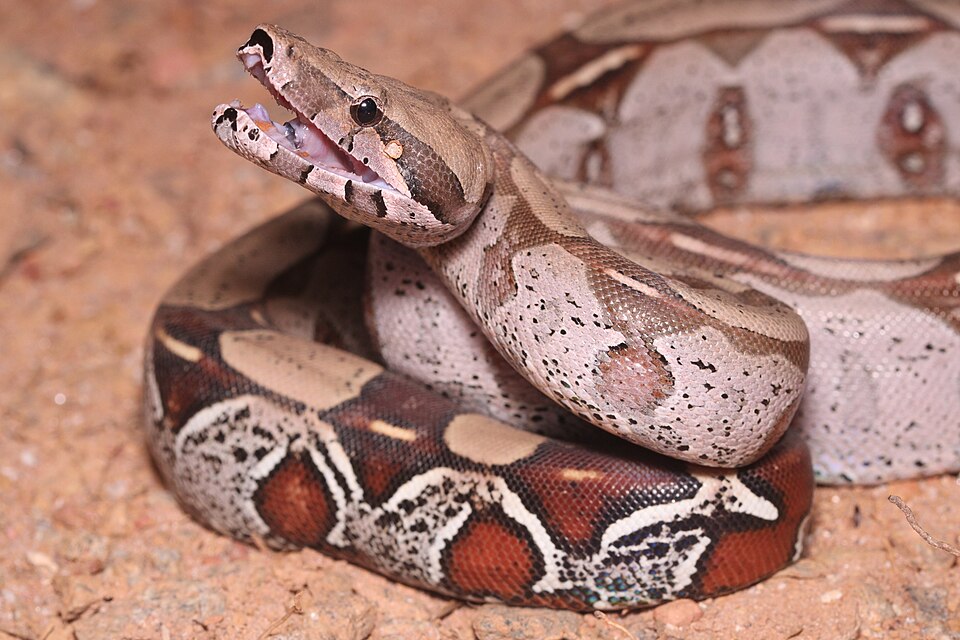
The boa constrictor is a large non-venomous snake belonging to the Boidae family. It kills its prey by constriction, enclosing them in its muscular rings until their breathing stops. Widespread from Mexico to Argentina, it occupies a wide variety of environments, from tropical forests to semi-arid zones. Its massive body is decorated with a pattern of brown to reddish saddle spots, more pronounced towards the tail. It is today one of the most popular snakes in captivity in the world. Several subspecies are recognized, differing in size and coloration.
Thick, muscular body covered in smooth scales, with a triangular head distinct from the neck. Coloration varies from light brown to gray, with characteristic saddle patterns. Males are generally smaller than females, which can exceed 3 meters.
Characteristics
Indicative values: they vary by subspecies, sex and region.
Habitat and distribution
The species frequents a wide variety of environments including tropical rainforests, savannahs, semi-desert areas and river banks. It also tolerates environments disturbed by humans, such as agricultural areas. Good plant cover or rocky hiding places are necessary for thermoregulation and protection from predators.
CURRENT RANGE
The boa constrictor is native to Central and South America, from Mexico to northern Argentina. It is also present on some Caribbean islands. Introduced populations exist in some tropical regions outside its native range, notably in Florida, following the release of pets.
Behaviour
A mainly solitary and nocturnal or crepuscular animal, it spends most of its time hidden in vegetation or burrows. Although capable of climbing, it remains mainly terrestrial as an adult. It is generally calm and not very aggressive towards humans unless it feels threatened.
Reproduction
The boa constrictor is ovoviviparous: the eggs develop inside the body of the female and the young are born alive. A litter has an average of 20 to 60 young after a gestation of 5 to 8 months. Newborns are independent from birth and receive no parental care.
Peculiarities
The boa has vestiges of pelvic dewclaws, residues of ancestral hind limbs, visible on both sides of the cloaca. It detects the body heat of its prey using infrared-sensitive labial dimples. Its very mobile jaw allows it to swallow prey larger than its head.
Threats and conservation
Habitat loss linked to deforestation threatens certain populations locally. Capture for the pet trade and skin trafficking constitute additional pressures in some regions. However, the species remains widespread and is not globally threatened.
Numbers and trends vary across sources and regions. See the IUCN assessment for the latest reference data.
Gallery
1 documented photographs.
References
Profile updated 18 August 2026 · Reviewed by the TunisieVet editorial team.
Comments (0)
No comments yet.
CONSERVATION STATUS
Least concern (LC)
IUCN source, latest published assessment.
Species health
Documented diseases for this species.
This information is provided for educational purposes only and is not a substitute for a veterinary consultation. If you have any concerns about your animal's health, consult a veterinarian.
To discover around: Boa
Videos, facts, stories and records linked to this species.
Similar animals
Other species documented in Animalpedia.
