
Presentation
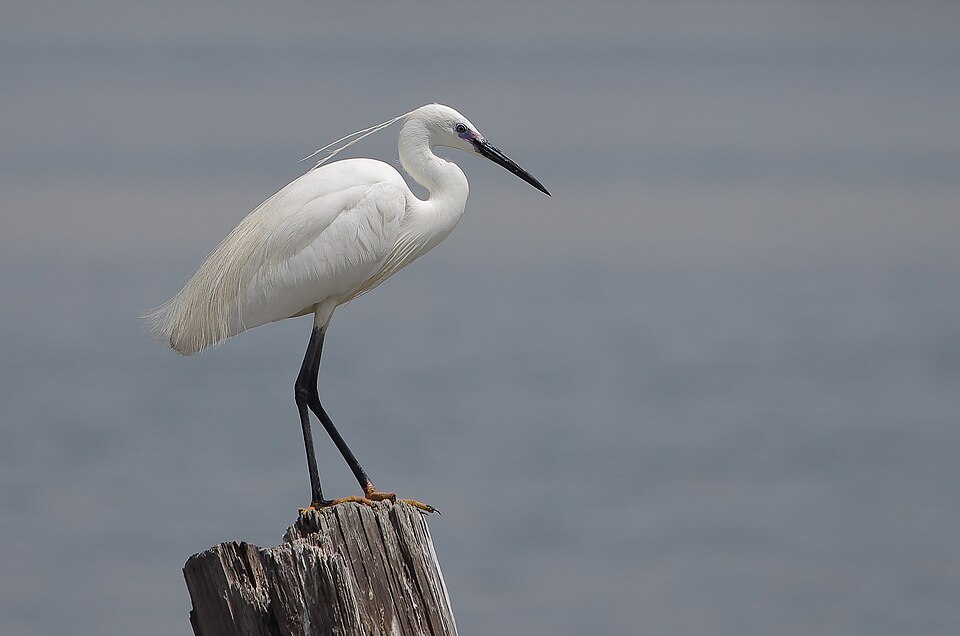
The Little Egret is a medium-sized wading bird recognized by its pure white plumage and long black legs ending in bright yellow feet. It has a slender black bill and elongated plumes on the nape during breeding season. This species inhabits coastal and inland wetlands, where it hunts by standing motionless or wading slowly through shallow water. Found across Europe, Africa, and Asia, it is also well established in Tunisia, particularly in lagoons and salt marshes. Highly social, it often gathers in mixed colonies with other wading birds for breeding. Its elegance and slender silhouette make it an icon of Mediterranean wetlands.
The Little Egret measures approximately 22 to 26 inches in height with a wingspan of 35 to 42 inches. Its plumage is pure white, contrasting sharply with its black legs and distinctive bright yellow feet. During breeding season, it displays fine ornamental plumes on the head, back, and breast.
Characteristics
Indicative values: they vary by subspecies, sex and region.
Habitat and distribution
The little egret frequents shallow wetland areas: lagoons, marshes, river mouths, rice paddies, and lakeshores. It is particularly fond of coastal brackish or saltwater environments as well as inland wetlands. In Tunisia, it is regularly observed in salt marshes and coastal lagoons.
CURRENT RANGE
The species is widely distributed across southern Europe, Africa, Asia, and Oceania. In North Africa, it is present year-round in numerous wetland areas, including Tunisia where it is common along the coast and in some inland regions.
Behaviour
The Little Egret is a diurnal species, often seen alone or in small groups while hunting. It becomes more social during breeding season, forming sometimes large colonies mixed with other herons. It is also noted for migratory movements depending on region, with some populations being resident and others migratory.
Reproduction
Breeding takes place in spring and summer, typically in colonies established in trees, reed beds, or small islands. The female lays 3 to 5 eggs, incubated by both parents for approximately 21 to 25 days. Young birds leave the nest after four to five weeks but remain dependent on adults for some time afterwards.
Peculiarities
The little egret is distinguished by its yellow feet, contrasting with its black legs, a feature that helps differentiate it from other similar egret species. It sometimes uses a hunting technique consisting of stirring one foot in the water to startle prey and capture them more easily.
Threats and conservation
The main threats facing the species are the degradation and drying out of wetlands, water pollution, and human disturbance at nesting sites. Overall, the global population remains stable, but some local populations are vulnerable to habitat loss.
Numbers and trends vary across sources and regions. See the IUCN assessment for the latest reference data.
Gallery
1 documented photographs.
References
Profile updated 07 September 2026 · Reviewed by the TunisieVet editorial team.
Comments (0)
No comments yet.
CONSERVATION STATUS
Least concern (LC)
IUCN source, latest published assessment.
Species health
Documented diseases for this species.
This information is provided for educational purposes only and is not a substitute for a veterinary consultation. If you have any concerns about your animal's health, consult a veterinarian.
To discover around: Little Egret
Videos, facts, stories and records linked to this species.
Similar animals
Other species documented in Animalpedia.

TunisieVet in your pocket 📱🐾 Access your veterinary services wherever you are. [ Download the app ]
Learn more