
Presentation
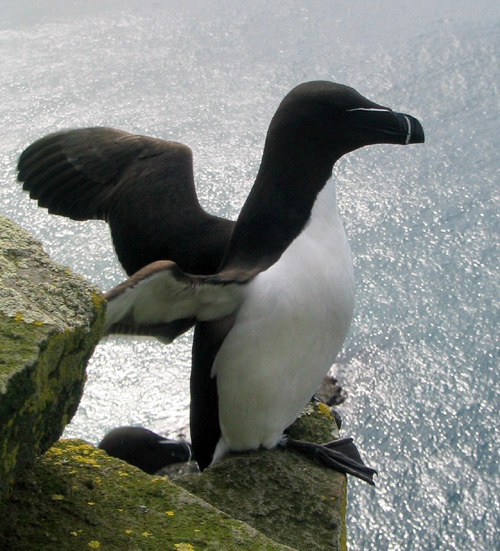
The razorbill is a seabird of the northern hemisphere belonging to the auk family, often mistakenly confused with penguins from the southern hemisphere. It is distinguished by its black and white plumage and laterally compressed beak marked with a distinctive white groove. Unlike penguins, it retains the ability to fly, though its flight is rapid and not very manoeuvrable. It spends most of its life at sea and returns to land only to breed, forming large colonies on coastal cliffs. An excellent diver, it captures its prey underwater using its wings as propellers.
The razorbill measures around 40 cm in length with black plumage on the upper parts and white underneath, providing typical camouflage for seabirds. Its thick black beak, flattened laterally, bears a characteristic vertical white band. Its short, pointed wings are adapted for both flight and underwater swimming.
Characteristics
Indicative values: they vary by subspecies, sex and region.
Habitat and distribution
The auks inhabit rocky coasts and sea cliffs of the North Atlantic during breeding season. Outside the nesting period, they spend most of their time at sea, often far from shore. They avoid warm waters and remain restricted to temperate and subarctic regions.
CURRENT RANGE
The species is found on the Atlantic coasts of Northern Europe, notably in Iceland, Norway, the United Kingdom, and the Faroe Islands, as well as along the eastern coasts of North America. In winter, some individuals migrate south as far as the western Mediterranean. It is not present in Tunisia, either in the wild or in common captivity.
Behaviour
The razorbill is a gregarious bird that nests in dense colonies on rocky ledges of cliffs. It is monogamous and forms faithful pairs across several breeding seasons. An excellent swimmer and diver, it moves clumsily on land due to the rearward position of its legs.
Reproduction
The female lays a single egg directly on bare rock without an elaborate nest. Incubation lasts about a month and is shared alternately by both parents. The young leaves the colony before it can fly, jumping into the sea accompanied by the adult male.
Peculiarities
Auks are frequently confused with Antarctic penguins because of their name and similar plumage, although the two groups are not related. Their extinct cousin species, the great auk (Pinguinus impennis), which was flightless, died out in the nineteenth century due to intensive hunting.
Threats and conservation
The main threats include marine pollution from oil spills, overfishing that reduces their food resources, and predation of eggs by introduced mammals on some islands. Climate change also affects the availability of prey in certain areas.
Numbers and trends vary across sources and regions. See the IUCN assessment for the latest reference data.
Gallery
1 documented photographs.
References
Profile updated 07 September 2026 · Reviewed by the TunisieVet editorial team.
Comments (0)
No comments yet.
CONSERVATION STATUS
Near threatened (NT)
IUCN source, latest published assessment.
Species health
Documented diseases for this species.
This information is provided for educational purposes only and is not a substitute for a veterinary consultation. If you have any concerns about your animal's health, consult a veterinarian.
To discover around: Razorbill
Videos, facts, stories and records linked to this species.
Similar animals
Other species documented in Animalpedia.

TunisieVet in your pocket 📱🐾 Access your veterinary services wherever you are. [ Download the app ]
Learn more