
Presentation
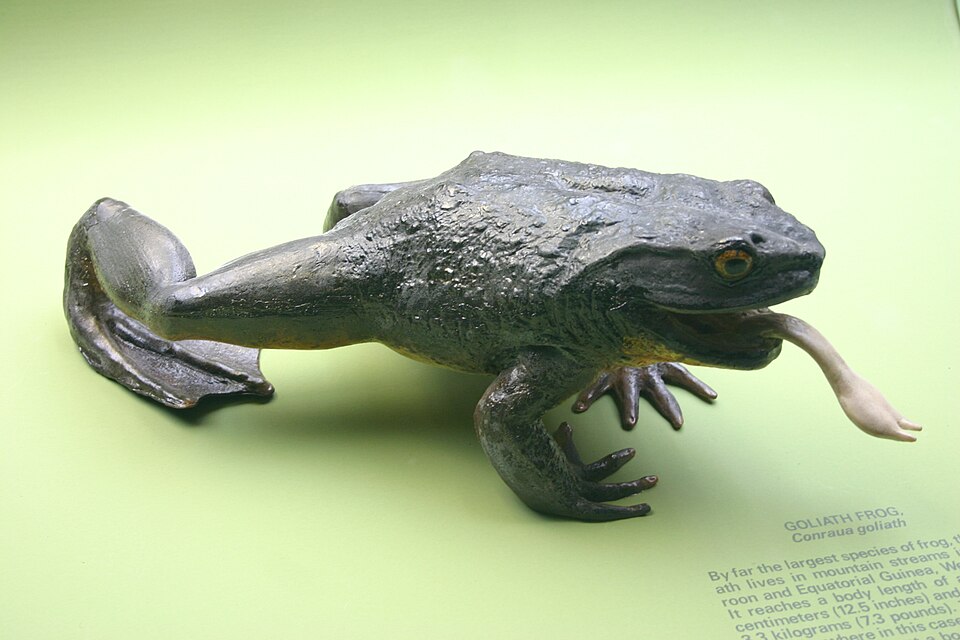
The Goliath frog (Conraua goliath) is the world's largest frog species, native to the fast-flowing waterways of central Africa. It inhabits rivers and waterfalls primarily in the tropical forests of Cameroon and Equatorial Guinea. Its massive, muscular body enables powerful leaps and vigorous swimming in swift waters. Quiet and lacking a call, it spends most of its time motionless near water, lying in wait for prey. The species is now threatened by deforestation, water pollution, and overexploitation for human consumption and the pet trade.
This frog has granular skin ranging in color from brownish-green to olive, providing effective camouflage among rocks and streamside vegetation. Its hind legs are extremely powerful and muscular, adapted for both swimming and jumping. The digits bear large adhesive discs that aid in gripping moist and slippery surfaces. Its size and mass set it distinctly apart from all other known frog species.
Characteristics
Indicative values: they vary by subspecies, sex and region.
Habitat and distribution
The goliath frog inhabits swift-current rivers and waterfall zones within humid tropical forests. It requires clear, well-oxygenated water and rocky or sandy banks for shelter. This strict dependence on specific aquatic habitats makes it particularly vulnerable to environmental changes.
CURRENT RANGE
The species is endemic to a restricted area of Central Africa, mainly in Cameroon and Equatorial Guinea. Its range is limited to tropical forest regions traversed by fast-flowing, well-oxygenated watercourses. This already-reduced natural range continues to fragment under human pressure.
Behaviour
The Goliath frog is essentially a nocturnal and solitary animal that remains close to water to escape quickly if threatened. It is capable of impressive leaps exceeding three meters when evading predators. Unlike many frogs, it is silent: it lacks a vocal sac and therefore does not produce the typical croaking call. It hunts while still, remaining motionless and watching for prey within tongue or jumping distance.
Reproduction
Breeding occurs near fast-flowing watercourses, where females lay eggs on submerged rocky or plant surfaces. The female may create small basins in the riverbed to protect the spawn from the current. Tadpoles then develop in these sheltered areas before they undergo metamorphosis. Larval development is relatively prolonged compared to that of many other frog species.
Peculiarities
It lacks a vocal sac and thus remains silent, a rare characteristic among frogs. Its tadpoles develop almost exclusively in certain fast-current river zones, a highly specific habitat. The female sometimes constructs small pools by arranging stones to protect the spawn from the current.
Threats and conservation
Deforestation and watercourse degradation severely reduce its natural habitat. It is also captured intensively for local meat consumption and for the international exotic pet trade. The combination of these pressures has resulted in marked declines in wild populations.
Numbers and trends vary across sources and regions. See the IUCN assessment for the latest reference data.
Gallery
1 documented photographs.
References
Profile updated 20 September 2026 · Reviewed by the TunisieVet editorial team.
Comments (0)
No comments yet.
CONSERVATION STATUS
Endangered (EN)
IUCN source, latest published assessment.
Species health
Documented diseases for this species.
This information is provided for educational purposes only and is not a substitute for a veterinary consultation. If you have any concerns about your animal's health, consult a veterinarian.
To discover around: Goliath Frog
Videos, facts, stories and records linked to this species.
RECORD
up to 32 cm (body length) and 3.2 kg
The world's largest frog
Measurement taken from snout to cloaca on the largest wild specimens captured in Cameroon.
Similar animals
Other species documented in Animalpedia.
