Presentation
The tube worm is a marine annelid that lives fixed within a protective tube it secretes itself, often made of limestone or mucus mixed with sediment. It belongs to the class Polychaeta and includes several families, notably the Serpulidae and Sabellidae, recognized by their colorful branching crown deployed outside the tube. The crown serves both for respiration and for capturing food particles suspended in the water. At the slightest threat, the animal retracts instantly inside its tube to protect itself from predators. It is found attached to rocks, corals, shells, or sandy bottoms, from coastal zones down to greater depths. Its presence is often used as an indicator of water quality in coastal marine ecosystems.
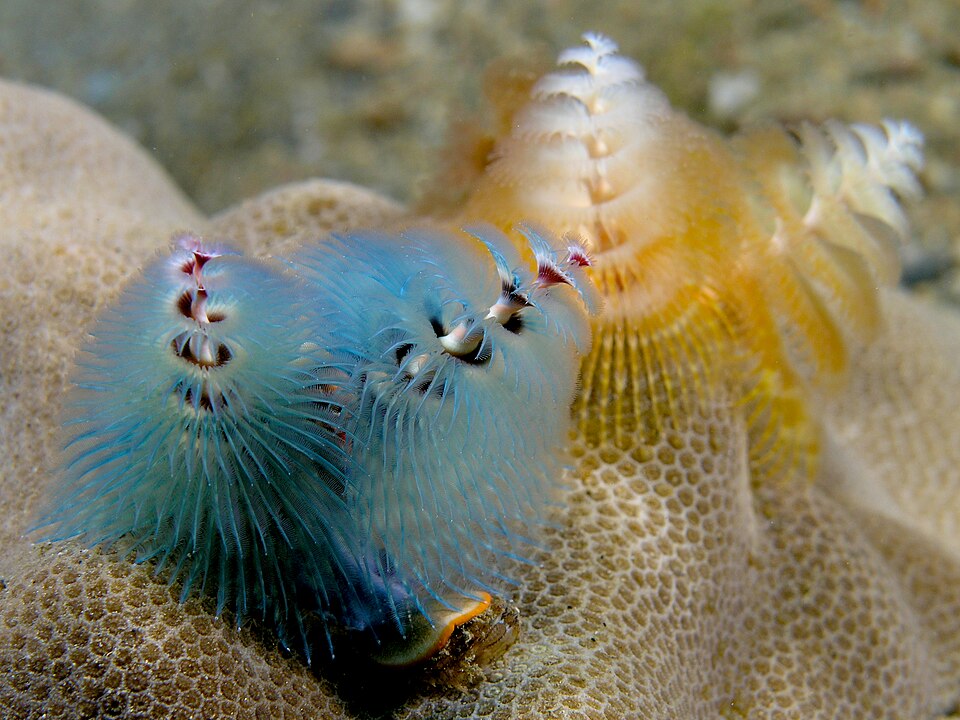
The segmented body of the tube worm is entirely hidden within a rigid or membranous tube, with only the branching crown in the shape of a colored fan or spiral protruding outside. The crown is made up of ciliated filaments that create a current of water directed toward the mouth. The crown's coloration varies considerably by species, ranging from white to red, including orange, violet, and blue. The animal lacks elaborate eyes but some species detect variations in light and shadow through photosensitive cells.
Characteristics
Indicative values: they vary by subspecies, sex and region.
Habitat and distribution
Tube worms colonize hard substrates such as rocks, coral reefs, boat hulls, and mollusk shells, as well as soft bottoms depending on the species. They are found mainly in shallow coastal zones, though some species settle at depths of several hundred meters. They prefer waters rich in suspended organic matter, which supports their filter-feeding.
CURRENT RANGE
Tube worms are found in all seas and oceans worldwide, ranging from tropical to temperate and cold waters. They occur in the Mediterranean, Atlantic, Pacific, and Indian Ocean alike. Their wide distribution results from the dispersal capacity of their planktonic larvae, which are carried by ocean currents.
Behaviour
The tube worm leads a sessile life, permanently fixed to its tube once larval metamorphosis is complete. It reacts very quickly to vibrations, shadows, or contact by retracting sharply into its tube, a characteristic defense reflex. It then gradually extends its crown again once the danger has passed. Most species are solitary, although some form dense aggregates called worm reefs.
Reproduction
Tube worms typically reproduce through external fertilization, with gametes released directly into the seawater. Fertilized eggs develop into planktonic swimming larvae called trochophores, which drift with currents for several days to weeks. Once a suitable surface is found, the larva attaches and begins metamorphosis by building its tube. Some species are hermaphroditic and can also reproduce through budding or fragmentation.
Peculiarities
The ultra-rapid withdrawal reflex into the tube, triggered by the slightest shadow or vibration, is this animal's most striking behavioral feature. The construction of the calcareous or mucilaginous tube, unique to each species, creates a protective architecture unlike any other in the animal kingdom. The colorful branchial crown, often likened to a flower or miniature Christmas tree, serves the dual vital role of respiration and feeding.
Threats and conservation
Coastal water pollution and coral reef degradation affect some local populations of tube worms. Climate change and ocean acidification can weaken tube formation in affected species. Overall, the group is not considered threatened due to its wide distribution and species diversity.
Numbers and trends vary across sources and regions. See the IUCN assessment for the latest reference data.
Gallery
1 documented photographs.
References
Profile updated 31 August 2026 · Reviewed by the TunisieVet editorial team.
Comments (0)
No comments yet.
CONSERVATION STATUS
Least concern (LC)
IUCN source, latest published assessment.
Species health
Documented diseases for this species.
Find a veterinarianThis information is provided for educational purposes only and is not a substitute for a veterinary consultation. If you have any concerns about your animal's health, consult a veterinarian.
Similar animals
Other species documented in Animalpedia.

Be among the first to use our app. Sign up and get early Google Play access.
Discover