Presentation
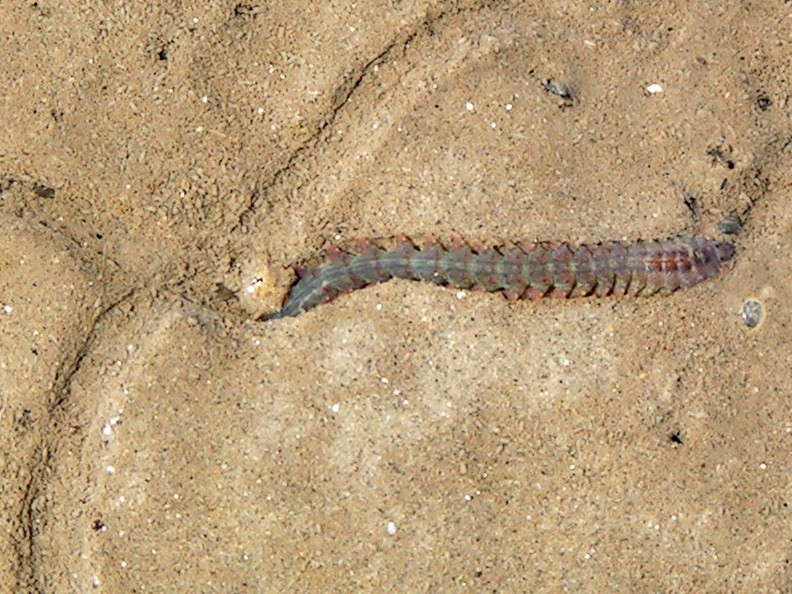
The term "marine worm" refers to a large group of polychaete annelids living in seas and oceans throughout the world. Their segmented body, often decorated with many lateral bristles called parapodia, allows them to swim, crawl, or burrow into sediment. Size varies greatly depending on the species, from a few millimetres to over a metre for some tropical forms. They are found from the intertidal zone to the deepest ocean depths. They play a major ecological role as sediment bioturbators and as essential links in marine food chains. Their soft, often brightly coloured body (red, green, iridescent) makes them discreet but highly diverse animals.
Elongated and segmented body, each segment bearing a pair of parapodia equipped with chitinous bristles. The skin is thin, often iridescent, and allows direct gas exchange with the water. The head bears palps, antennae, and sometimes rudimentary eyes depending on the species. Some species have an eversible proboscis armed with jaws for capturing prey.
Characteristics
Indicative values: they vary by subspecies, sex and region.
Habitat and distribution
Marine worms occupy a wide variety of marine habitats, from coastal mudflats to sandy bottoms, including coral reefs. Some live buried in intertidal sediment, others are associated with rocky structures or calcareous tubes. Depth ranges from the tidal zone to the abyss.
CURRENT RANGE
This group is found in all oceans worldwide, from tropical zones to polar regions. The Mediterranean, including the Tunisian coast, hosts many species of polychaetes in its mudflats and sandy bottoms. Their distribution depends mainly on sediment type and salinity rather than latitude.
Behaviour
Many species are burrowers and spend most of their lives buried in sand or mud. Others are swimmers and can move actively through the water column, particularly during reproduction. Marine worms are generally nocturnal or inconspicuous, avoiding direct light. Some species live in tubes that they construct themselves from mucus and sediment.
Reproduction
Reproduction is most often sexual, with separate sexes, though some species are hermaphroditic. Many polychaetes practice epitoky, a body transformation enabling active swimming to the surface to release gametes and reproduce in mass. Fertilization is external, in seawater. The larvae, called trochophores, disperse before settling and metamorphosing into adults.
Peculiarities
Some species are bioluminescent, producing light during nocturnal reproduction. Others possess remarkable regenerative capacity, able to reconstitute a severed body section. Marine worms are also used as fish bait in many coastal regions.
Threats and conservation
Pollution of coastal sediments and degradation of littoral habitats locally threaten some populations. Overexploitation for fish bait can affect certain species in heavily frequented areas. Overall, the group remains highly diverse and widely distributed.
Numbers and trends vary across sources and regions. See the IUCN assessment for the latest reference data.
Gallery
1 documented photographs.
References
Profile updated 31 August 2026 · Reviewed by the TunisieVet editorial team.
Comments (0)
No comments yet.
CONSERVATION STATUS
Data deficient (DD)
IUCN source, latest published assessment.
Similar animals
Other species documented in Animalpedia.

Be among the first to use our app. Sign up and get early Google Play access.
Discover