
Presentation
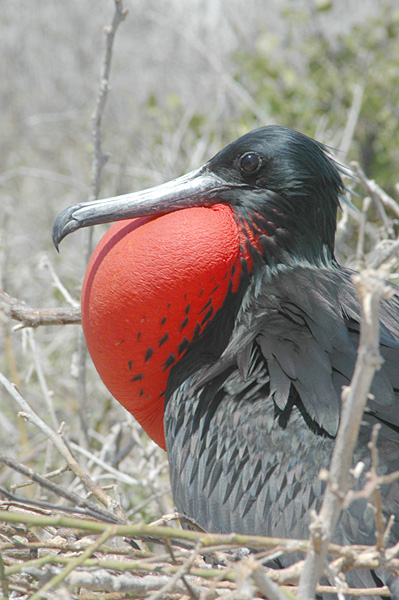
The frigatebird is a large seabird of tropical regions, recognized by its streamlined silhouette, long angled wings, and forked tail. The male displays a bright red throat pouch that he inflates spectacularly during courtship display. An excellent flier, it spends most of its life airborne and seldom lands on water, as its feathers lack sufficient waterproofing and would make it vulnerable. It frequently practices kleptoparasitism, harassing other seabirds to steal their catches. Several species make up the genus Fregata, found along coasts and tropical islands throughout the world.
The frigatebird measures 90 to 105 cm in length with a wingspan exceeding 2 meters, giving it an exceptional weight-to-wing-surface ratio. Its plumage is predominantly black with metallic sheen in males, while females have a white breast. Its long, hooked bill is adapted for capturing flying fish and prey at the water's surface. Its feet are small and only partially webbed, with little use for swimming.
Characteristics
Indicative values: they vary by subspecies, sex and region.
Habitat and distribution
The frigatebird inhabits tropical and subtropical coastal zones, isolated islands, and mangroves where it nests. It hunts over the open ocean but generally stays close to shore to rest. It avoids cold waters and temperate regions, limiting its presence to warm parts of the globe.
CURRENT RANGE
The genus Fregata is found in tropical and subtropical waters of the Atlantic, Pacific, and Indian Oceans. It occurs notably in the Caribbean, in the tropical Pacific, around Madagascar, and on certain Indian Ocean islands. It is absent from Tunisian coasts and the Mediterranean in general.
Behaviour
The frigatebird is a gregarious bird that nests in sometimes dense colonies on islands or coastal mangroves. It can remain airborne for several consecutive days, taking advantage of thermal currents to conserve energy. The male performs a spectacular courtship display by inflating his red throat pouch to attract females. It is territorial at the nest but tolerates close proximity to other pairs within the colony.
Reproduction
The female lays a single egg, which both parents incubate for about six to seven weeks. The chick remains dependent on its parents for a very long time, sometimes more than a year, which limits breeding frequency to one cycle every two years in some species. Sexual maturity is reached late, between seven and ten years of age. Breeding colonies are usually located on shrubs or mangroves protected from terrestrial predators.
Peculiarities
The male's red throat pouch, inflated like a balloon during courtship display, is its most distinctive feature. Its relative inability to land on water makes it an almost exclusively aerial bird outside of breeding season. It has one of the lowest wing loadings of seabirds, which accounts for its remarkable sustained flight capabilities.
Threats and conservation
Degradation of coastal nesting sites and plastic pollution of the oceans threaten certain populations. Predation by introduced species on nesting islands, such as rats, impacts breeding success. Climate change and overfishing of flying fish could reduce its food resources.
Numbers and trends vary across sources and regions. See the IUCN assessment for the latest reference data.
Gallery
1 documented photographs.
References
Profile updated 07 September 2026 · Reviewed by the TunisieVet editorial team.
Comments (0)
No comments yet.
CONSERVATION STATUS
Least concern (LC)
IUCN source, latest published assessment.
Species health
Documented diseases for this species.
This information is provided for educational purposes only and is not a substitute for a veterinary consultation. If you have any concerns about your animal's health, consult a veterinarian.
To discover around: Frigatebird
Videos, facts, stories and records linked to this species.
RECORD
Wingspan up to 2.3 m for approximately 1.5 kg
The lowest weight-to-wingspan ratio in a seabird
Comparative measurement in adult seabirds, enabling prolonged flight without landing.
Similar animals
Other species documented in Animalpedia.

TunisieVet in your pocket 📱🐾 Access your veterinary services wherever you are. [ Download the app ]
Learn more