
Presentation
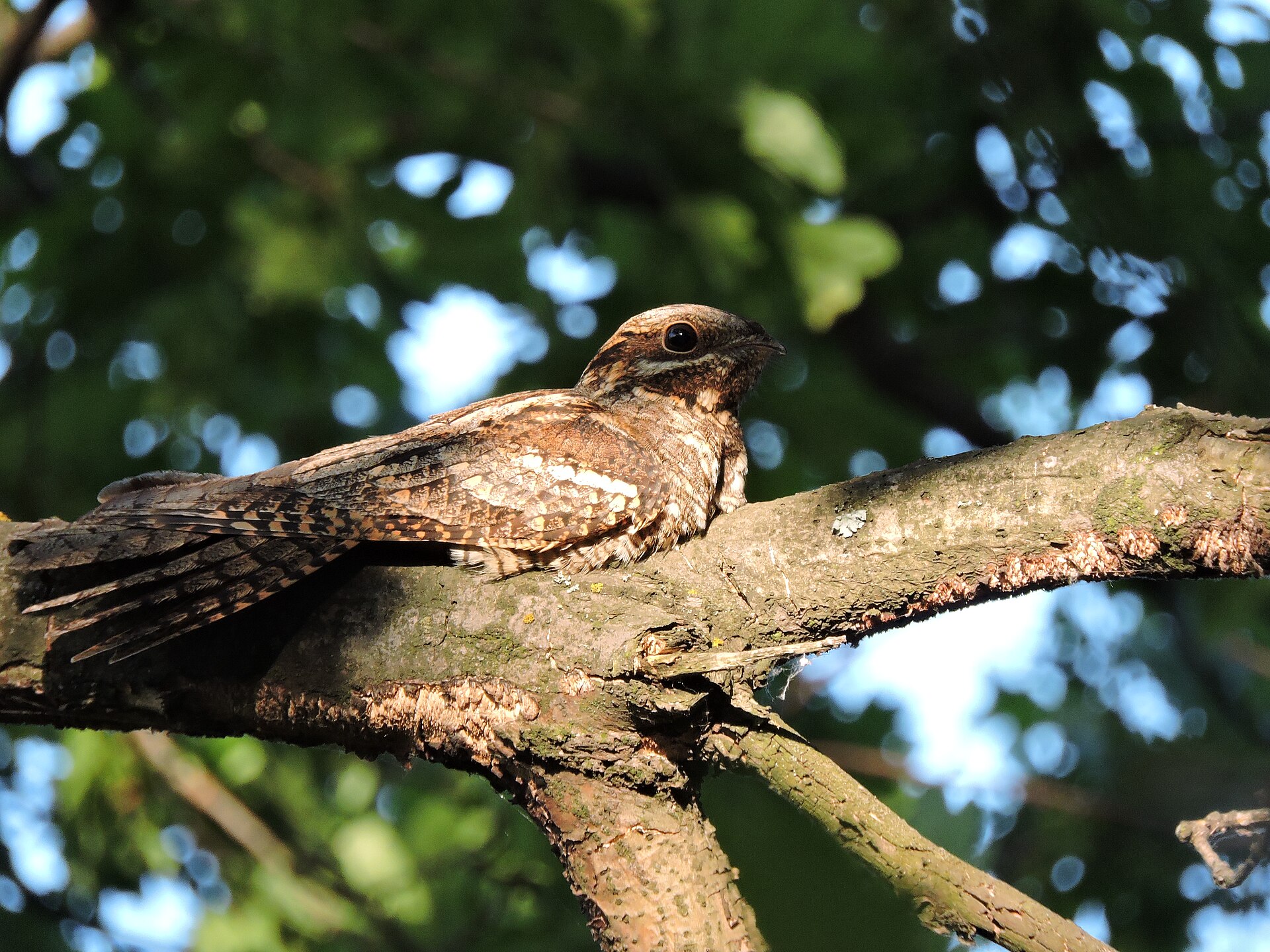
The European Nightjar (Caprimulgus europaeus) is a medium-sized nocturnal bird renowned for its cryptic brown-grey plumage that allows it to blend seamlessly with dead leaves and tree bark. Discreet and rarely visible during the day, it is chiefly recognized by its distinctive call—a kind of continuous churring emitted at dusk. It hunts flying insects in flight, mouth wide open, using an aerial interception technique. A migrant, it leaves Europe and the Maghreb in winter to reach sub-Saharan Africa. In Tunisia, it is observed mainly during spring and autumn migration passages. Its secretive lifestyle and twilight habits make it a little-known bird to the general public.
The nightjar displays mottled plumage in brown, grey, and black, providing remarkable camouflage. Its head is flattened, its eyes are large and adapted for night vision, and its beak is small but its mouth opens extraordinarily wide. Its long, pointed wings give it silent and agile flight, comparable to that of certain nocturnal raptors.
Characteristics
Indicative values: they vary by subspecies, sex and region.
Habitat and distribution
This species frequents heathland, forest clearings, scrubby areas, and semi-open terrain with bare or sparse vegetation. It favours the edges of pine forests and steppic zones. In Tunisia, it may be seen during migration stopover in various open and wooded habitats.
CURRENT RANGE
The Eurasian Nightjar breeds in Europe, western Asia, and the Maghreb, and winters in sub-Saharan Africa. It crosses Tunisia during seasonal migration between breeding and wintering grounds. Its range is extensive but sightings remain occasional owing to its secretive habits.
Behaviour
The nightjar is a solitary and territorial bird during breeding season, active chiefly at dawn and dusk. It spends the day motionless on the ground or perched lengthwise on a branch, relying on its camouflage to escape predators. Its vibrant, continuous call serves to mark territory and attract mates.
Reproduction
The female typically lays two eggs directly on bare ground with no elaborate nest, often among dead leaves or gravel. Incubation lasts about 17 to 21 days and is shared by both parents. Young leave the nest shortly after hatching but remain dependent on the adults for several weeks.
Peculiarities
Its vernacular name stems from an old belief that the bird would drink goats' milk, hence its scientific name derived from the Latin 'capra' (goat) and 'mulgere' (to milk). Its mouth can open spectacularly, far wider than that of most birds of comparable size. Its camouflage is so effective that it is usually detected only by its call.
Threats and conservation
Degradation and fragmentation of natural habitats, particularly the loss of heathland and clearings, pose a threat to the species. Declining insect populations linked to pesticide use reduce food availability. Vehicle collisions are also a significant risk, as the bird is attracted to roads at night.
Numbers and trends vary across sources and regions. See the IUCN assessment for the latest reference data.
Gallery
1 documented photographs.
References
Profile updated 06 September 2026 · Reviewed by the TunisieVet editorial team.
Comments (0)
No comments yet.
CONSERVATION STATUS
Least concern (LC)
IUCN source, latest published assessment.
Species health
Documented diseases for this species.
Find a veterinarianThis information is provided for educational purposes only and is not a substitute for a veterinary consultation. If you have any concerns about your animal's health, consult a veterinarian.
Similar animals
Other species documented in Animalpedia.

TunisieVet in your pocket 📱🐾 Access your veterinary services wherever you are. [ Download the app ]
Learn more