
Presentation
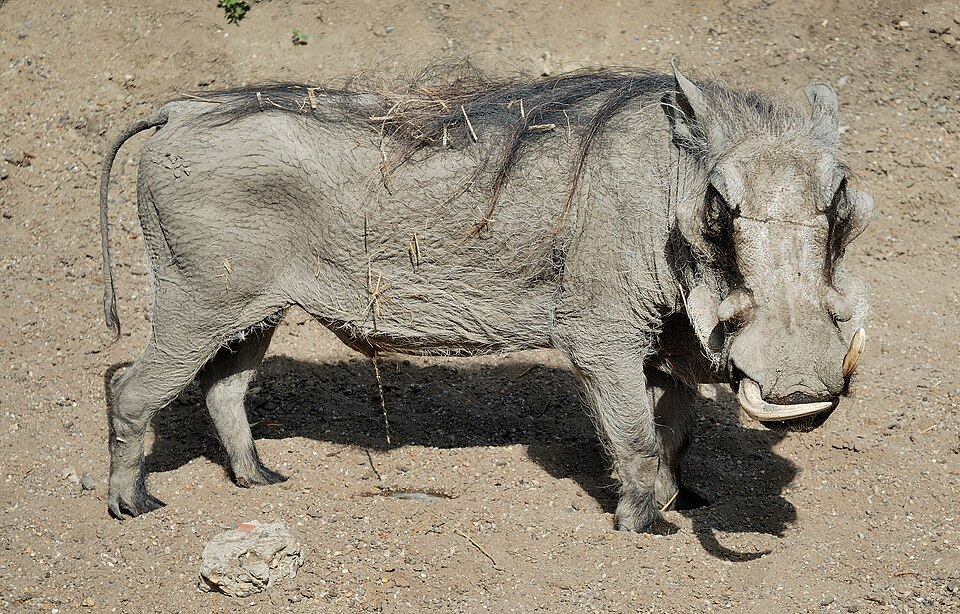
The Warthog (Phacocoerus africanus) is a mammal of the Suidae family, recognizable by its curved tusks and the fleshy growths adorning its face. Originally from sub-Saharan Africa, it lives in small family groups in savannahs and open areas. Its stocky appearance, its massive head and its erect, fleeing tail give it a characteristic silhouette. Although it appears not very graceful, it runs quickly and takes refuge in burrows abandoned by other animals. It plays an important ecological role by digging into the ground in search of food.
The Warthog has grayish skin that is almost hairless, except for a shaggy dorsal mane. Its large head is decorated with two pairs of facial warts and curved tusks that can exceed 30 cm. Its eyes are set high on the skull, allowing it to survey its surroundings while searching the ground with its snout.
Characteristics
Indicative values: they vary by subspecies, sex and region.
Habitat and distribution
The Warthog frequents grassy savannahs, open meadows and edges of light forests. It avoids dense forests and areas that are too arid, preferring environments offering both food and water points. The abandoned burrows of anteaters or other mammals serve as refuge.
CURRENT RANGE
The species is widely distributed in sub-Saharan Africa, from the Sahel to southern Africa. It is absent from North Africa and the most extreme desert areas. It is found in particular in many national parks in eastern and southern Africa.
Behaviour
Warthog live in matriarchal groups called “sounders,” made up of females and their young. Adult males are more solitary and only join groups during the breeding season. It is diurnal and takes refuge at night in burrows, often entering backwards to face possible predators.
Reproduction
Gestation lasts approximately 170 to 175 days and results in the birth of two to four pigs. The female gives birth in an isolated burrow where the young remain protected during their first weeks. Weaning occurs around three to four months of age, but the young often stay within the maternal group for longer.
Peculiarities
The Warthog is capable of running up to 55 km/h for short distances despite its heavy appearance. Its facial warts protect its face during fights between males. It sometimes shares its burrow with mongooses or other small animals without apparent conflict.
Threats and conservation
The species is not globally threatened, but it is subject to hunting pressure in certain regions for its meat. Habitat loss linked to agricultural expansion locally reduces its populations. It is sometimes considered harmful by farmers due to the damage caused to crops.
Numbers and trends vary across sources and regions. See the IUCN assessment for the latest reference data.
Gallery
1 documented photographs.
References
Profile updated 20 August 2026 · Reviewed by the TunisieVet editorial team.
Comments (0)
No comments yet.
CONSERVATION STATUS
Least concern (LC)
IUCN source, latest published assessment.
Species health
Documented diseases for this species.
See the 8 diseases of this species Find a veterinarianThis information is provided for educational purposes only and is not a substitute for a veterinary consultation. If you have any concerns about your animal's health, consult a veterinarian.
Related species
To discover around: Warthog
Videos, facts, stories and records linked to this species.
Similar animals
Other species documented in Animalpedia.

TunisieVet in your pocket 📱🐾 Access your veterinary services wherever you are. [ Download the app ]
Learn more