
Presentation
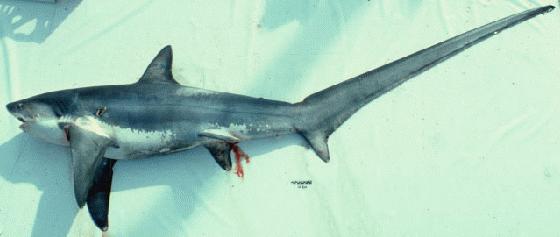
The thresher shark is a pelagic shark recognizable by its extremely elongated upper caudal fin, almost as long as the rest of its body. This shark uses this tail like a whip to stun schools of small fish before feeding on them. Present in most temperate and tropical seas around the world, it frequents both coastal waters and the deep ocean floors. Three main species make up the Alopiidae family, including the pelagic thresher shark, the most common. Despite its impressive size, it remains discreet and not very aggressive towards humans. Its slow reproduction and vulnerability to fishing make it a species of concern for marine conservation today.
The thresher shark is distinguished by its extremely elongated upper caudal fin, which can represent up to half of the total body length. Its body is fusiform and hydrodynamic, adapted to fast swimming in open water. Coloration varies from bluish gray to brown on the back, with a lighter belly, providing effective camouflage. The eyes are relatively large, especially in species living in deep waters.
Characteristics
Indicative values: they vary by subspecies, sex and region.
Habitat and distribution
The thresher shark mainly frequents open ocean waters, both coastal and offshore, to depths that can exceed 500 meters. It favors temperate and tropical zones, sometimes carrying out daily vertical migrations between surface waters and depths. It can occasionally approach the coast to feed.
CURRENT RANGE
thresher shark is present throughout the world's oceans, in temperate and tropical waters. It is found in the Atlantic, Pacific and Indian Ocean, including the Mediterranean. Its wide distribution makes it a cosmopolitan species of open seas.
Behaviour
The thresher shark is an active swimmer and generally solitary, although it may gather in small groups when breeding or near areas rich in prey. It hunts by using its long upper tail fin like a whip to stun schools of fish before capturing them. This spectacular hunting technique, observed in particular in the pelagic thresher shark, involves rapid and coordinated movements. The species is rather timid towards humans and avoids direct contact.
Reproduction
The thresher shark is ovoviviparous, with the eggs developing inside the female's body until hatching. Embryos engage in oophagy, feeding on unfertilized eggs produced by the mother during gestation. The female gives birth to a small number of young, usually between two and four, already well developed and capable of swimming immediately. Sexual maturity is reached between 3 and 9 years depending on the species.
Peculiarities
The thresher shark's most notable feature is its disproportionately elongated upper tail fin, which serves as a hunting weapon. This unique morphological adaptation among sharks makes them an easily identifiable species. The oophagy behavior of its embryos is also remarkable in the animal world.
Threats and conservation
The thresher shark is strongly threatened by overfishing, both targeted and as bycatch in pelagic nets, particularly for its highly prized fins. Its slow growth and low fertility make populations particularly vulnerable to decline. The degradation of marine ecosystems and climate change constitute additional threats.
Numbers and trends vary across sources and regions. See the IUCN assessment for the latest reference data.
Gallery
1 documented photographs.
References
Profile updated 28 August 2026 · Reviewed by the TunisieVet editorial team.
Comments (0)
No comments yet.
CONSERVATION STATUS
Vulnerable (VU)
IUCN source, latest published assessment.
Species health
Documented diseases for this species.
This information is provided for educational purposes only and is not a substitute for a veterinary consultation. If you have any concerns about your animal's health, consult a veterinarian.
To discover around: thresher shark
Videos, facts, stories and records linked to this species.
RECORD
up to 3 m, or almost 50% of the total length
Proportionally longest caudal fin
Measurement carried out on adult specimens of pelagic thresher shark.
Similar animals
Other species documented in Animalpedia.

TunisieVet in your pocket 📱🐾 Access your veterinary services wherever you are. [ Download the app ]
Learn more