
Presentation
The Marmoset is a small primate native to South America, belonging to the Callitrichidae family. It is distinguished by its reduced size, its long non-prehensile tail and its claws rather than flat nails. Very lively and sociable, it lives in small family groups in the canopy of tropical forests. Its popularity as an exotic pet has contributed to its spread outside its natural range, notably via the NAC trade. Several species of Marmosets exist, the best known being the common Marmoset (Callithrix jacchus).
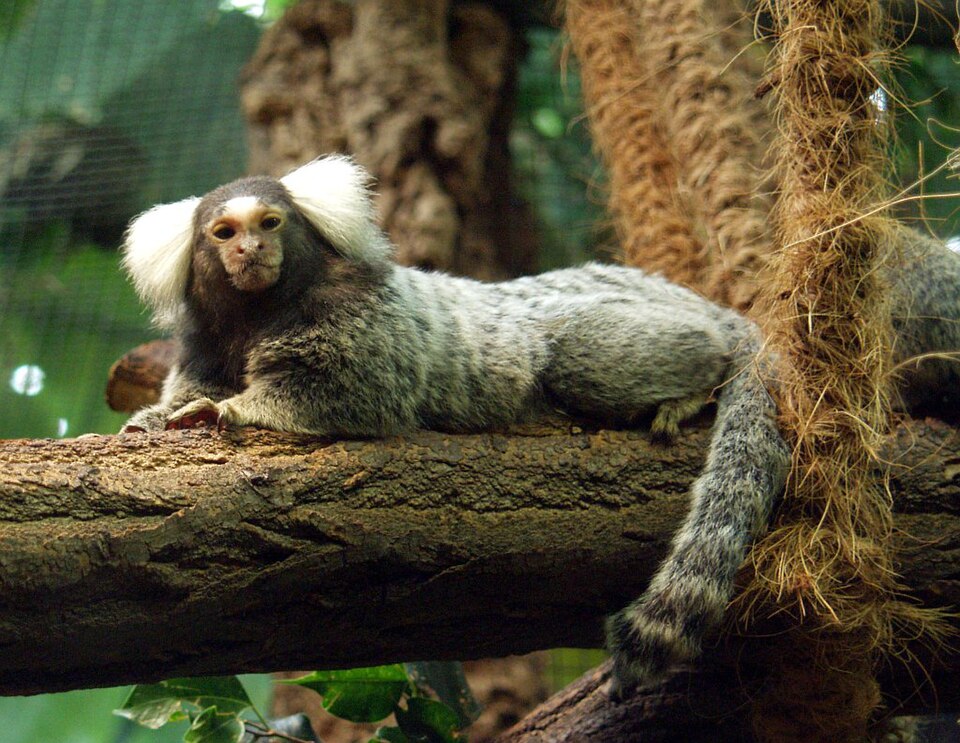
The Marmoset measures around fifteen centimeters long, excluding tail, and weighs between 300 and 400 grams. Its coat is dense and often adorned with distinctive tufts or patterns around the ears depending on the species. Its hook-shaped claws, called claw nails, allow it to cling vertically to tree trunks. Its specialized lower teeth are used to pierce the bark to extract the gum.
Characteristics
Indicative values: they vary by subspecies, sex and region.
Habitat and distribution
Marmoset lives mainly in tropical rainforests, secondary forests and woodland edges in South America. It appreciates areas with dense vegetation offering gum and shelter from predators. Some species have adapted to drier or human-disturbed environments. In captivity, it requires an enriched environment reproducing these arboreal conditions.
CURRENT RANGE
Marmoset is native to Brazil and neighboring areas of South America. Certain species have been introduced outside their native area, particularly in Europe, following escapes or the release of pets. However, its presence outside its natural habitat remains limited and localized. There is no established wild population in Tunisia.
Behaviour
The Marmoset is a diurnal and arboreal animal, living in family groups of up to fifteen individuals. Vocal and olfactory communication play an important role in group cohesion and territory marking. Members of the group often cooperate in raising their young, a notable feature of this primate. It moves in rapid leaps between branches and remains very vigilant against predators.
Reproduction
The Marmoset female usually gives birth to twins after a gestation of about five months. The father and other members of the group actively participate in carrying and caring for the young, a rare behavior among primates. The young are weaned around two to three months but remain dependent on the group for longer. Sexual maturity is reached around a year and a half.
Peculiarities
Marmoset is one of the rare primates to regularly give birth to twins. Its ability to extract gum from trees using specialized teeth is an unusual dietary adaptation among primates. Its small size and endearing appearance make it a highly sought-after species in the exotic pet trade.
Threats and conservation
Habitat loss due to deforestation poses a major threat to several species of Marmosets. The illegal trade in exotic pets also puts pressure on wild populations. Certain species are also threatened by hybridization with introduced species. Forest fragmentation limits genetic exchanges between populations.
Numbers and trends vary across sources and regions. See the IUCN assessment for the latest reference data.
Gallery
1 documented photographs.
References
Profile updated 26 August 2026 · Reviewed by the TunisieVet editorial team.
Comments (0)
No comments yet.
CONSERVATION STATUS
Least concern (LC)
IUCN source, latest published assessment.
Species health
Documented diseases for this species.
This information is provided for educational purposes only and is not a substitute for a veterinary consultation. If you have any concerns about your animal's health, consult a veterinarian.
To discover around: Marmoset
Videos, facts, stories and records linked to this species.
Similar animals
Other species documented in Animalpedia.
