
Presentation
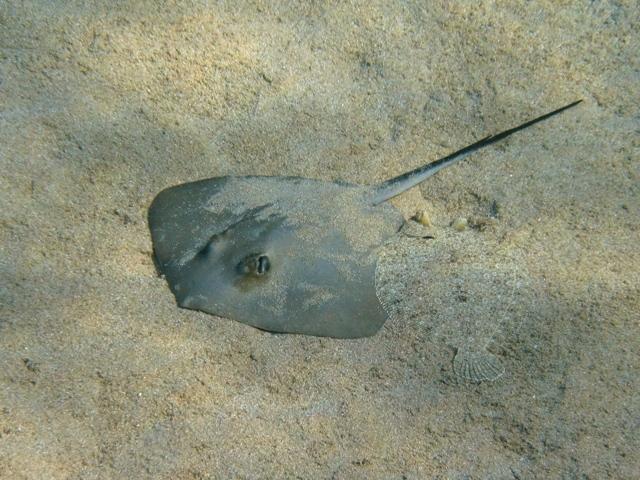
The Stingray is a cartilaginous fish with a flattened, disc-shaped body, equipped with a long, thin tail armed with one or more venomous spines. It belongs to the group of batoids, close relatives of sharks. This term actually designates several species of the Dasyatidae family distributed in temperate and tropical seas, as well as certain brackish or fresh waters. It generally lives on sandy or muddy bottoms, half buried, where it feeds on small invertebrates. Discreet and non-aggressive, it only stings if it feels threatened or trampled.
The diamond- or disc-shaped body is dorsoventrally flattened, with pectoral fins fused to the head forming flexible wings. The tail, thin and whipping, bears one or more serrated prickles connected to venomous glands. The dorsal color is often gray, brown or sandy, while the belly is light, a camouflage suitable for life on the bottom. The eyes and vents (spiracles) are located on the top of the body, the mouth and gill slits below.
Characteristics
Indicative values: they vary by subspecies, sex and region.
Habitat and distribution
Stingray mainly frequents sandy or muddy bottoms of shallow coastal areas, lagoons and estuaries. Some species tolerate brackish water, or even migrate upstream into freshwater rivers in the tropics. It likes sheltered areas where it can easily burrow into the loose substrate.
CURRENT RANGE
The species grouped under the name Stingray occur in temperate, subtropical and tropical seas around the world, including the Mediterranean. They are found along the Atlantic, Indo-Pacific and Mediterranean coasts, as well as in some large tropical rivers of South America, Africa or Asia. In Tunisia, it is observed along the coasts, particularly in the Gulf of Gabès.
Behaviour
A rather solitary animal, the Stingray spends a large part of its time immobile, partially buried in the sand. It can group together seasonally during migrations linked to reproduction or the search for food. Its behavior is generally fearful towards humans, the sting only occurring in the event of accidental contact, often when a swimmer steps on it.
Reproduction
Reproduction is ovoviviparous: the eggs develop inside the body of the female and the young are born already formed, completely autonomous. Gestation generally lasts several months depending on the species. The number of young per litter is low, often between two and ten individuals.
Peculiarities
The caudal sting, covered with a venomous sheath, serves exclusively for defense and not for hunting. Some species of stingrays are among the largest rays in existence, with a disc that can exceed two meters wide. The sting wound is painful and may require medical attention, although fatal accidents remain rare.
Threats and conservation
Overfishing, particularly bycatch in nets and trawls, poses the main threat to many stingray populations. Degradation of coastal habitats, such as mangroves and sandy bottoms, also reduces their breeding and feeding areas. Certain species are also sought after for their skin or flesh, increasing fishing pressure.
Numbers and trends vary across sources and regions. See the IUCN assessment for the latest reference data.
Gallery
1 documented photographs.
References
Profile updated 28 August 2026 · Reviewed by the TunisieVet editorial team.
Comments (0)
No comments yet.
CONSERVATION STATUS
Near threatened (NT)
IUCN source, latest published assessment.
Species health
Documented diseases for this species.
This information is provided for educational purposes only and is not a substitute for a veterinary consultation. If you have any concerns about your animal's health, consult a veterinarian.
To discover around: Stingray
Videos, facts, stories and records linked to this species.
Similar animals
Other species documented in Animalpedia.

TunisieVet in your pocket 📱🐾 Access your veterinary services wherever you are. [ Download the app ]
Learn more