
Presentation
The Caribou is a large deer from the Arctic and subarctic regions of North America, known in Europe as reindeer when referring to the Eurasian form of the same species. It is distinguished by its massive antlers present in both sexes, a rare characteristic among deer. This species performs some of the longest terrestrial migrations observed among mammals, traveling several thousand kilometers each year between summering and calving areas. The Caribou lives in herds whose size varies from a few individuals to several hundred thousand during major migrations. It is perfectly adapted to the cold thanks to a dense coat and large hooves making it easier to move on the snow. Several subspecies and ecotypes exist, adapted to the tundra, boreal forest or mountains.
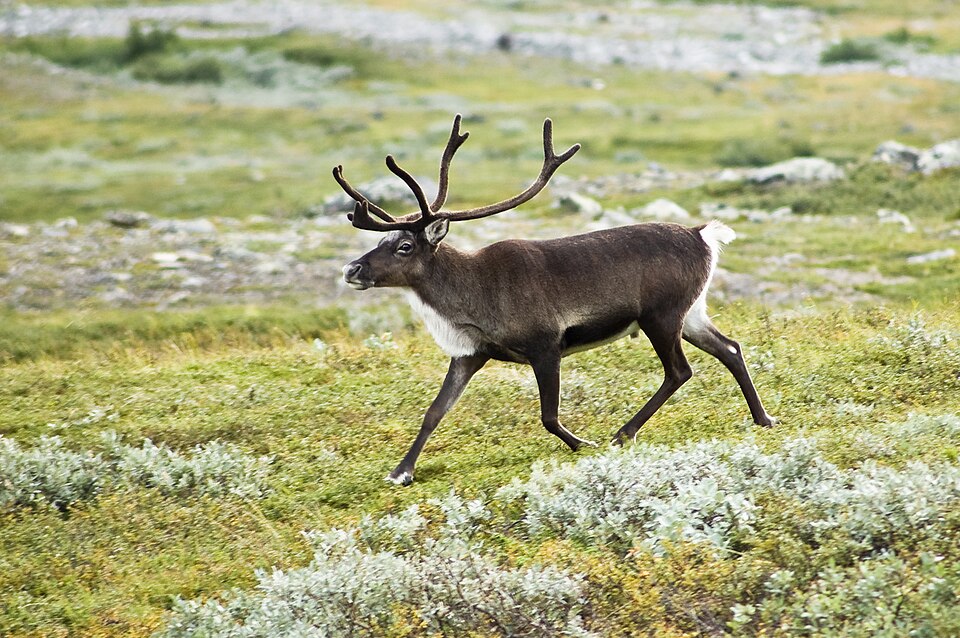
The Caribou has a massive body, sturdy legs and wide, concave hooves that serve it equally well for digging in snow and swimming. The antlers, worn by males and often by females, can reach more than a meter in size and are renewed every year. Its thick, double-layered coat, gray-brown to whitish depending on the season and subspecies, provides effective thermal insulation. The snout is covered in hair, a rare adaptation in mammals that helps limit heat loss.
Characteristics
Indicative values: they vary by subspecies, sex and region.
Habitat and distribution
Caribou frequents the arctic tundra, taiga and boreal forests depending on subspecies and seasons. Some mountain populations occupy high altitude areas in summer and return to the forest during winter. Wetlands and the edges of lakes and rivers are important during migrations and for access to summer food.
CURRENT RANGE
The species is present in North America, mainly in Canada and Alaska, as well as Greenland. The Eurasian form, called reindeer, occupies Scandinavia and Siberia. North American populations are divided into several ecotypes depending on their habitat, from the Arctic tundra to the boreal forests of southern Canada.
Behaviour
The Caribou is a gregarious animal that forms herds whose cohesion varies depending on the season and the availability of food. It is renowned for its massive seasonal migrations between calving grounds and wintering areas, guided by pregnant females. Males compete during the rutting period using their antlers for access to females. Outside of the rut, the species remains rather peaceful and favors collective vigilance against predators such as wolves and bears.
Reproduction
The rutting period occurs in autumn, when dominant males gather a harem of females. Gestation lasts about seven to eight months and ends with the birth of a single fawn in the spring, often in isolated areas suitable for giving birth. The fawn is able to move quickly after birth, a necessary adaptation to keep up with the herd. Sexual maturity is reached around the age of two to three years depending on sex and environmental conditions.
Peculiarities
The Caribou is one of the only deer in which females also bear antlers, although generally smaller than those of males. Its hooves change texture depending on the season, becoming harder and sharper in winter to better adhere to the ice. The species is closely associated with northern indigenous peoples, who historically depended on it for food, clothing and tools.
Threats and conservation
Climate change is altering freezing and thawing cycles, affecting access to lichens and disrupting migratory routes. Logging, mining and oil exploitation fragment the habitat of many populations, particularly in Canada. Natural predation, hunting and disease also contribute to the decline of some subpopulations, several of which are classified as locally threatened despite a less critical overall status.
Numbers and trends vary across sources and regions. See the IUCN assessment for the latest reference data.
Gallery
1 documented photographs.
References
Profile updated 20 August 2026 · Reviewed by the TunisieVet editorial team.
Comments (0)
No comments yet.
CONSERVATION STATUS
Vulnerable (VU)
IUCN source, latest published assessment.
Species health
Documented diseases for this species.
This information is provided for educational purposes only and is not a substitute for a veterinary consultation. If you have any concerns about your animal's health, consult a veterinarian.
To discover around: Caribou
Videos, facts, stories and records linked to this species.
RECORD
up to approximately 5000 km per year
Longest land migration
Cumulative distance traveled annually by certain migratory populations between summering a...
Similar animals
Other species documented in Animalpedia.

TunisieVet in your pocket 📱🐾 Access your veterinary services wherever you are. [ Download the app ]
Learn more