
Presentation
The Saïmiri, also called squirrel monkey, is a small neotropical primate recognizable by its white face and black snout. It lives in large social groups in the tropical forests of South and Central America. Active and agile, it moves quickly through the canopy in search of insects and fruits. Its proportionally large brain makes it one of the most studied primates in neuroscience. Although classified as a species of least concern, it is subject to the effects of deforestation and exotic trade. Its small size and attractive appearance also make it a sought-after animal in captivity.
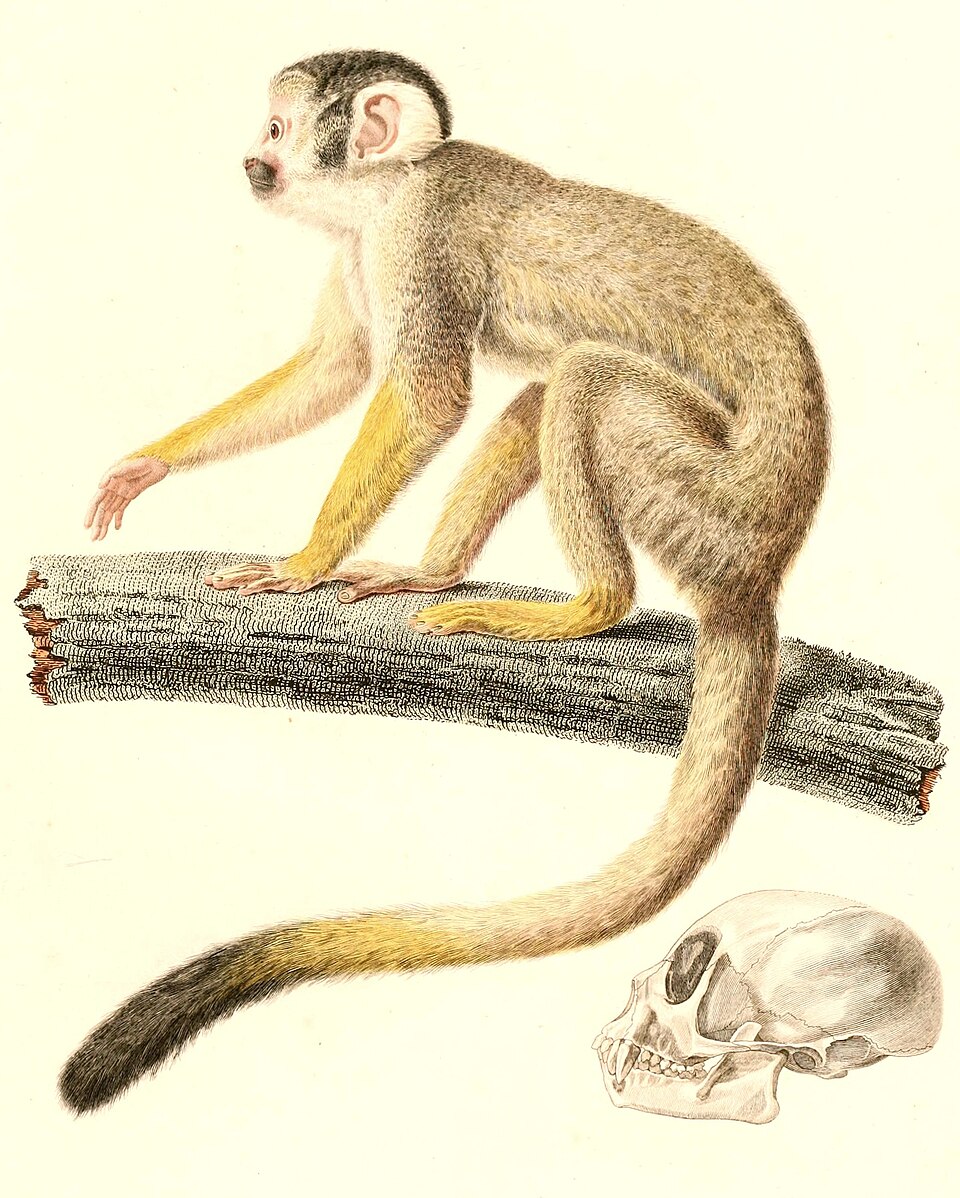
The Saïmiri is a small primate with short fur, generally gray-green on the back and yellow-orange on the limbs. His white face around his eyes and his black mouth earned him the nickname “death’s head monkey”. Its long, non-prehensile tail is mainly used for balance during arboreal movements. The body is thin and light, adapted to an agile life in the trees.
Characteristics
Indicative values: they vary by subspecies, sex and region.
Habitat and distribution
The Saïmiri lives mainly in tropical rainforests, particularly in areas of primary and secondary forest close to watercourses. It also frequents swamp forests and the edges of gallery forests. This species favors the middle and lower strata of the canopy. Its presence is often linked to the availability of water and dense vegetation.
CURRENT RANGE
Saïmiri is native to South and Central America, with a distribution spanning the Amazon basin and some coastal regions. It is found in particular in Brazil, Peru, Colombia, Guyana and Costa Rica depending on the subspecies. Some populations have been introduced to Florida, United States. Its natural range, however, remains centered on the tropical regions of South America.
Behaviour
The Saïmiri is a diurnal and arboreal species, living in social groups that can number from a few individuals to more than fifty members. These groups are highly hierarchical and communicate through a wide range of vocalizations and visual signals. The species is particularly agile, moving quickly through the canopy in successive leaps. She sometimes shows curiosity and a great capacity to adapt to her environment.
Reproduction
The Saïmiri female generally gives birth to a single young after a gestation of about five months. The newborn clings to its mother's back during the first weeks of life. Weaning occurs after several months, but the young person remains close to the social group. Sexual maturity is reached between two and three years depending on the sex.
Peculiarities
Saïmiri has a particularly large brain relative to its body size, one of the highest ratios among primates. It uses urine to mark its territory and communicate, a behavior called “urine-washing”. This species is also known for its popularity in the exotic pet trade, which poses conservation challenges. Its ability to imitate certain human behaviors has contributed to its cultural notoriety.
Threats and conservation
Deforestation linked to agriculture and urbanization constitutes the main threat to Saïmiri. The illegal trade in exotic pets also affects some wild populations. Fragmentation of forest habitat reduces the areas available for these arboreal primates. Some subspecies are more vulnerable than others depending on their geographic distribution.
Numbers and trends vary across sources and regions. See the IUCN assessment for the latest reference data.
Gallery
1 documented photographs.
References
Profile updated 26 August 2026 · Reviewed by the TunisieVet editorial team.
Comments (0)
No comments yet.
CONSERVATION STATUS
Least concern (LC)
IUCN source, latest published assessment.
Species health
Documented diseases for this species.
This information is provided for educational purposes only and is not a substitute for a veterinary consultation. If you have any concerns about your animal's health, consult a veterinarian.
To discover around: Saïmiri
Videos, facts, stories and records linked to this species.
Similar animals
Other species documented in Animalpedia.

TunisieVet in your pocket 📱🐾 Access your veterinary services wherever you are. [ Download the app ]
Learn more