
Presentation
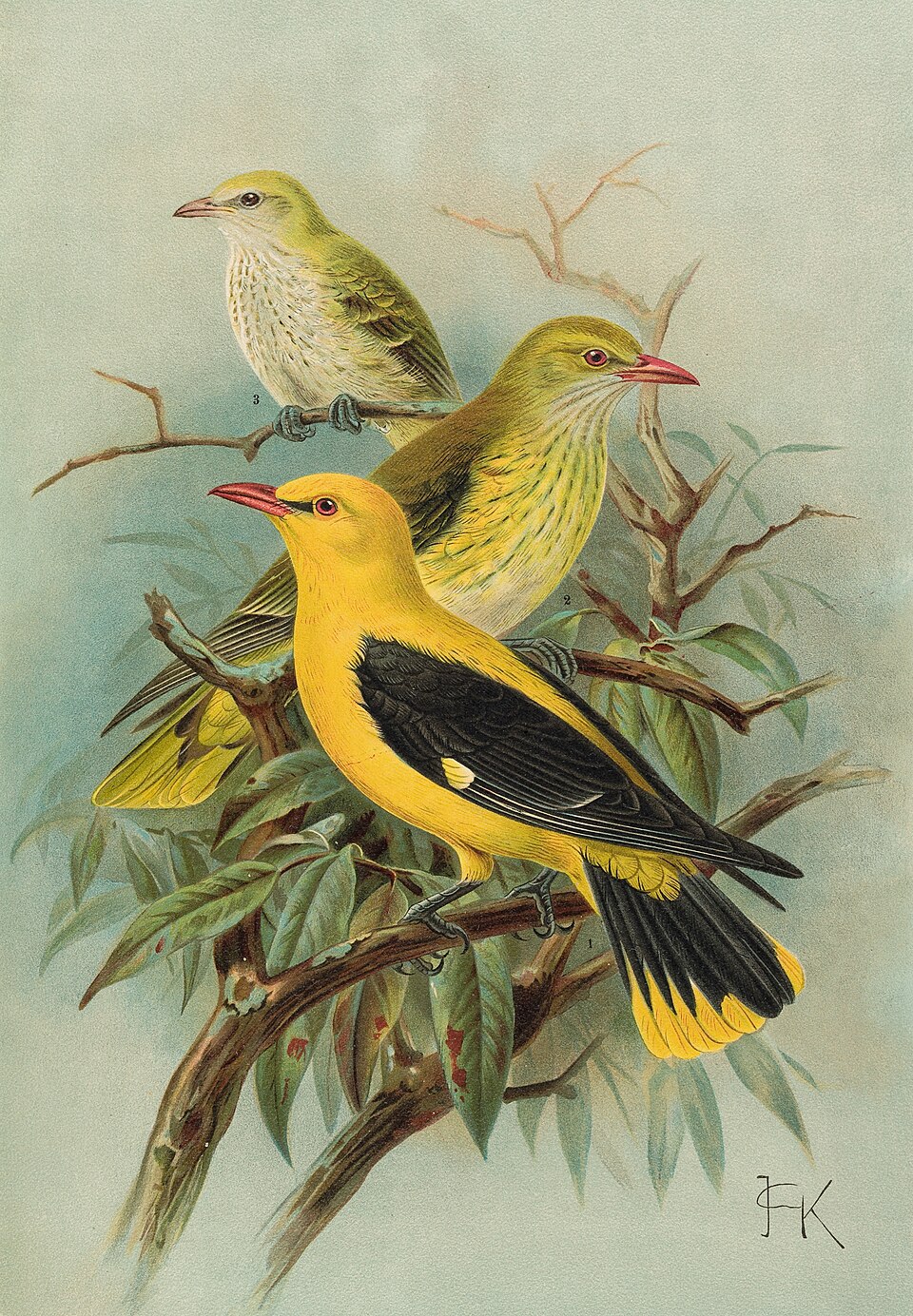
The European Oriole (Oriolus oriolus) is a migratory passerine bird recognizable by the bright yellow plumage of the male contrasting with black wings. The female has duller plumage, yellow-green with an olive upper surface. Discreet despite its bright colors, it hides in the dense foliage of large trees. Its fluty, melodious song is often easier to spot than the bird itself. It frequents open forests, groves and orchards during the summer before migrating towards sub-Saharan Africa. In Tunisia, it is observed mainly during spring and autumn migratory passages.
The adult male has bright golden yellow plumage with black wings and part of the tail. The female and juveniles have more discreet hues, yellow-green to greenish, facilitating their camouflage in the foliage. The bill is robust, pinkish to reddish, adapted to a mixed diet. Its silhouette is stocky with a short tail and pointed wings favoring rapid, undulating flight.
Characteristics
Indicative values: they vary by subspecies, sex and region.
Habitat and distribution
The Oriole favors light deciduous forests, groves, orchards and large wooded parks. It looks for trees with dense foliage to hide its nest and escape predators. In Tunisia, it mainly frequents wooded areas and oases during its migratory stopovers.
CURRENT RANGE
The species nests in Europe and western Asia during the summer, then migrates to sub-Saharan Africa to winter. Tunisia is located on its migration corridor, which explains its seasonal presence in the territory. It does not breed regularly in Tunisia but transits there in spring and autumn.
Behaviour
It is a shy and discreet bird that most often remains hidden in the canopy of trees. It is territorial during the breeding season and actively defends its area through song. Its flight is rapid, direct and undulating, often carried out in the open between two wooded areas. It generally lives alone or in pairs, rarely in groups.
Reproduction
The female builds a cup-shaped nest suspended between two thin branches, often high up. She generally lays 3 to 4 eggs there which she incubates alone for about two weeks. Both parents participate in feeding the young once hatched. The young leave the nest after about two weeks but remain dependent on adults for some time.
Peculiarities
The striking contrast between the yellow of the male and the black of its wings makes it one of the most colorful passerines in Europe. Its fluty singing, often described as melodious, is an excellent indicator of its presence despite its visual discretion. It is sometimes confused from a distance with other yellow birds, but its silhouette and song remain distinctive.
Threats and conservation
The destruction of forest habitats and the reduction of hedges and groves threaten nesting sites. The use of pesticides reduces the populations of insects on which it strongly depends. Collisions during migration and climate changes affecting stopover areas constitute additional risks.
Numbers and trends vary across sources and regions. See the IUCN assessment for the latest reference data.
Gallery
1 documented photographs.
References
Profile updated 27 August 2026 · Reviewed by the TunisieVet editorial team.
Comments (0)
No comments yet.
CONSERVATION STATUS
Least concern (LC)
IUCN source, latest published assessment.
Species health
Documented diseases for this species.
Find a veterinarianThis information is provided for educational purposes only and is not a substitute for a veterinary consultation. If you have any concerns about your animal's health, consult a veterinarian.
Similar animals
Other species documented in Animalpedia.

TunisieVet in your pocket 📱🐾 Access your veterinary services wherever you are. [ Download the app ]
Learn more