
Presentation
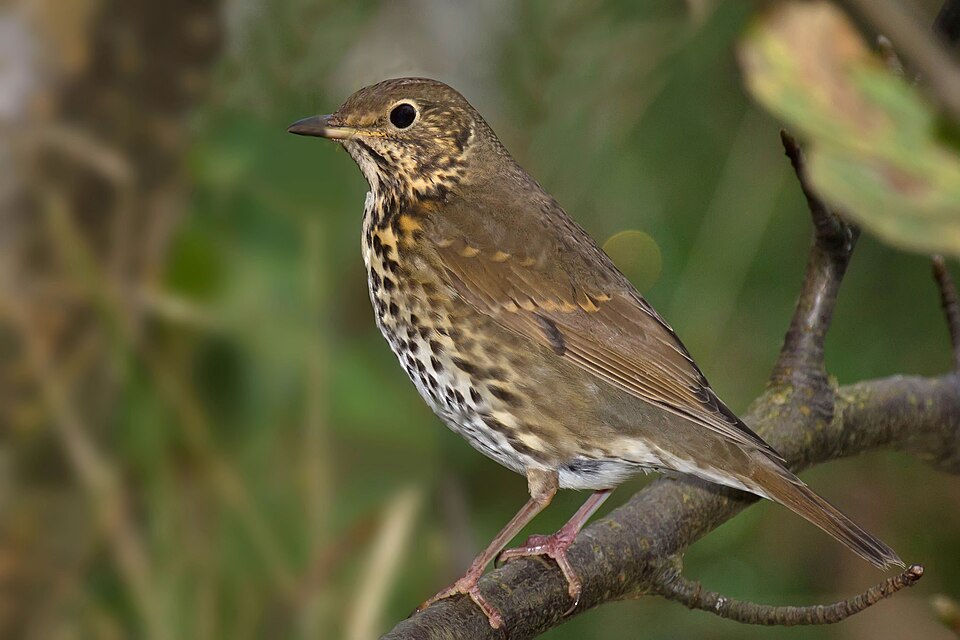
The thrush is a small songbird belonging to the genus Turdus, valued for its melodious and varied song. Several thrush species frequent Europe, North Africa, and Asia, including the song thrush and fieldfare. In Tunisia, the song thrush is a common winter visitor, seen in forests, gardens, and agricultural areas. Its brown plumage spotted on the breast provides effective camouflage on the ground and in bushes. It feeds mainly on invertebrates and fruit depending on the season. It is a discreet bird but very vocal, especially during breeding season.
The thrush measures between 20 and 27 cm depending on the species, with brown plumage on the upperside and a pale breast spotted with dark brown. Its beak is slender and slightly curved, suited both to catching invertebrates and eating berries. It has large dark eyes and an upright posture characteristic of when it moves along the ground with small hops.
Characteristics
Indicative values: they vary by subspecies, sex and region.
Habitat and distribution
The thrush inhabits deciduous and coniferous forests, hedgerows, orchards, and gardens with sufficient shrub cover. In winter, it adapts to open agricultural areas and urban parks where food remains accessible. In Tunisia, it is found in the wooded areas of the north and olive groves during the cold season.
CURRENT RANGE
The song thrush breeds throughout Europe and western Asia, migrating to North Africa, the Middle East, and southern Europe in winter. Other species of the genus Turdus are found in the Americas, sub-Saharan Africa, and Asia. In Tunisia, it is present mainly as a winter visitor, from the north to the central regions.
Behaviour
The thrush is a rather solitary bird or in loose small groups outside the breeding season. It is territorial in spring, with the male singing from a high perch to establish its territory and attract a partner. Many European populations are migratory, wintering in North Africa and the Middle East. It remains alert and takes flight quickly if threatened.
Reproduction
The female builds a cup-shaped nest made of twigs, moss, and mud, often lined with dried droppings inside. She lays 3 to 5 pale blue eggs spotted with brown, which she incubates alone for about two weeks. Young birds leave the nest approximately 14 days after hatching but remain dependent on their parents for several more weeks. Two broods per year are common.
Peculiarities
The song thrush is recognized for its rich song: it typically repeats each melodic phrase two or three times before moving to a new sequence. This distinctive vocal characteristic sets it apart clearly from other European songbirds.
Threats and conservation
The thrush faces pressure from traditional hunting in certain Mediterranean countries, particularly during migration. Loss of hedgerow habitats and pesticide use reducing invertebrate populations also pose threats. Overall, its populations remain abundant and stable globally.
Numbers and trends vary across sources and regions. See the IUCN assessment for the latest reference data.
Gallery
1 documented photographs.
References
Profile updated 04 September 2026 · Reviewed by the TunisieVet editorial team.
Comments (0)
No comments yet.
CONSERVATION STATUS
Least concern (LC)
IUCN source, latest published assessment.
Species health
Documented diseases for this species.
See the 4 diseases of this species Find a veterinarianThis information is provided for educational purposes only and is not a substitute for a veterinary consultation. If you have any concerns about your animal's health, consult a veterinarian.
Similar animals
Other species documented in Animalpedia.

TunisieVet in your pocket 📱🐾 Access your veterinary services wherever you are. [ Download the app ]
Learn more