
Presentation
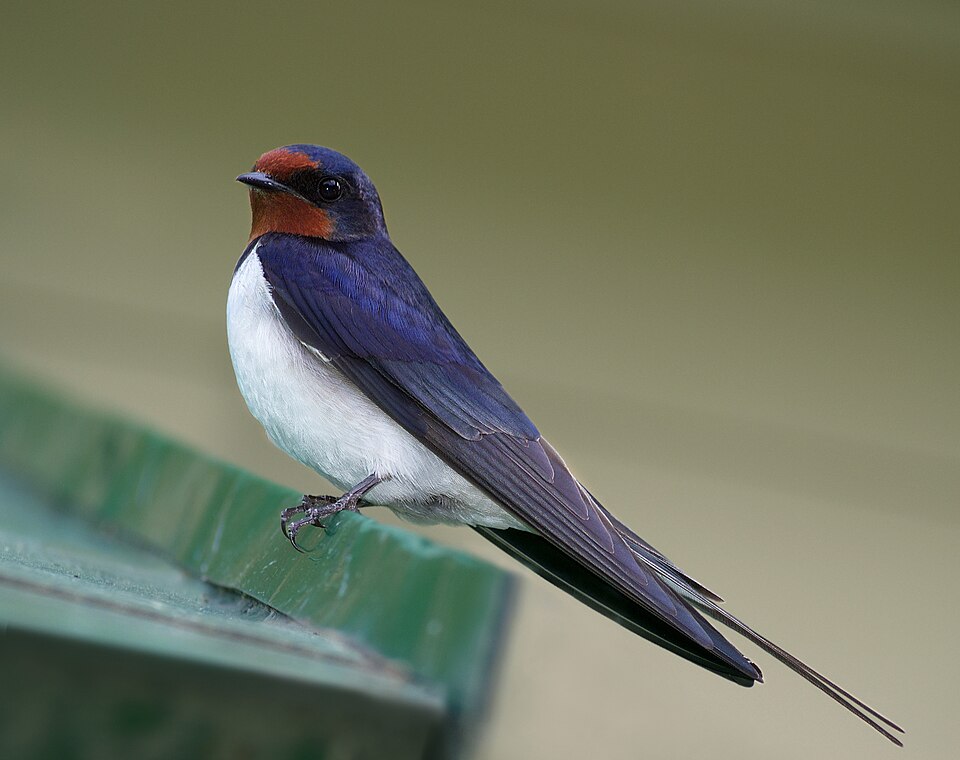
The barn swallow is a small migratory bird recognizable by its metallic blue-black back, russet throat, and long forked tail. It is closely associated with human habitation, building its mud nest under eaves, in barns, or under bridges. An excellent flier, it spends much of the day on the wing hunting insects. In Tunisia as in Europe, its spring arrival is traditionally seen as a sign that fine weather is returning. The species has experienced decline in several regions of the world due to loss of traditional agricultural habitats.
The barn swallow measures approximately 17 to 19 cm in length, including the tail, with long pointed wings adapted for fast, agile flight. Its iridescent blue-black plumage contrasts with a whitish belly and red-brown throat. Its deeply forked tail, adorned with elongated outer feathers, distinguishes it from other similar perching birds.
Characteristics
Indicative values: they vary by subspecies, sex and region.
Habitat and distribution
Swallows frequent open areas near water, meadows, farms, and villages. They are closely tied to human structures for nesting, making them common in rural and semi-urban environments. They avoid dense forests and highly urbanised areas lacking suitable nesting sites.
CURRENT RANGE
The species breeds throughout Europe, Asia, North Africa, and North America. It winters in sub-Saharan Africa, South America, and South Asia. In Tunisia, it is a common breeding migrant, observed mainly in spring and summer.
Behaviour
A diurnal and gregarious species, the barn swallow forms large gatherings before migration, often perching on power lines. It is highly faithful to its nesting site, frequently reused from year to year. Its flight is rapid, agile, and marked by sharp turns to capture prey.
Reproduction
The female typically lays 4 to 6 eggs in a cup-shaped nest made of mud and twigs, often attached to a beam or wall. Incubation lasts about two weeks, and both parents feed the young. Two broods per season are common in suitable regions, including Tunisia.
Peculiarities
Its navigational ability during migration, spanning thousands of kilometres, remains a subject of scientific study. It is capable of returning year after year to the same nest, sometimes with remarkable precision. Its presence is traditionally associated with good fortune in several Mediterranean cultures.
Threats and conservation
The disappearance of traditional barns and modernisation of farm buildings reduce nesting sites. Intensive pesticide use diminishes the insect populations on which swallows depend. Climate change can also disrupt their migration schedule.
Numbers and trends vary across sources and regions. See the IUCN assessment for the latest reference data.
Gallery
1 documented photographs.
References
Profile updated 05 September 2026 · Reviewed by the TunisieVet editorial team.
Comments (0)
No comments yet.
CONSERVATION STATUS
Least concern (LC)
IUCN source, latest published assessment.
Species health
Documented diseases for this species.
Find a veterinarianThis information is provided for educational purposes only and is not a substitute for a veterinary consultation. If you have any concerns about your animal's health, consult a veterinarian.
To discover around: Barn Swallow
Videos, facts, stories and records linked to this species.
Similar animals
Other species documented in Animalpedia.

TunisieVet in your pocket 📱🐾 Access your veterinary services wherever you are. [ Download the app ]
Learn more