
Presentation
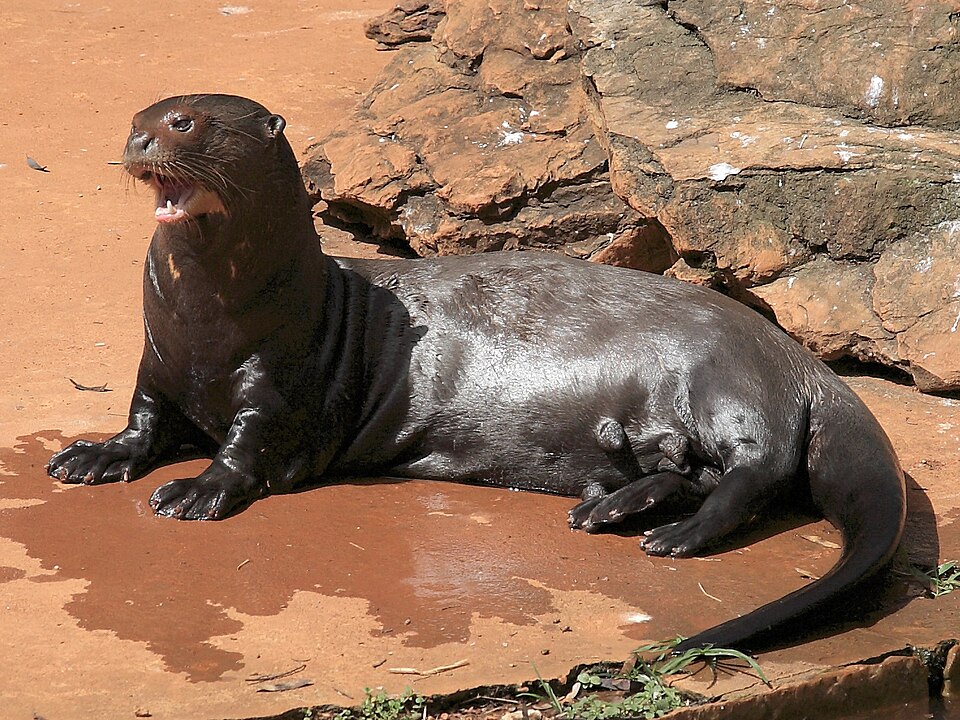
The giant otter is the largest mustelid in the world and one of South America's biggest carnivores. It lives in tight-knit family groups along rivers, lakes and wetland areas of the Amazon basin and other river systems across South America. Its elongated body, dense fur and powerful tail make it a formidable swimmer, capable of hunting fish of considerable size. Highly social and vocal, it communicates through a wide range of calls audible from a distance. Once hunted intensively for its fur, it has suffered severe decline and remains threatened today. It holds a symbolic place among the iconic predators of South American freshwater ecosystems.
It has a streamlined body that can exceed 1.5 metres in length not including the tail, extended by a flattened paddle-shaped tail. Its dark brown to blackish fur bears characteristic cream-coloured patches on the throat, unique to each individual like a fingerprint. Its webbed feet and sensitive whiskers aid in detecting and capturing prey in murky water.
Characteristics
Indicative values: they vary by subspecies, sex and region.
Habitat and distribution
It frequents slow-flowing rivers, lakes, marshes, and forested wetland areas of the Amazon basin and adjacent basins. It needs clear riverbanks for resting and wooded banks to build its burrows and shelters. Water quality and the abundance of fish strongly determine the species' presence.
CURRENT RANGE
The species is found in several South American countries, notably Brazil, Peru, Bolivia, Ecuador, Colombia, and the Guianas. Its populations are now fragmented and concentrated mainly in remote areas of the Amazon and Pantanal, where human pressure remains limited.
Behaviour
A diurnal and social species, it lives in family groups of four to eight individuals organised around a breeding pair. Group members hunt, play and rest together on open banks called "campsites". It is particularly vocal, using whistles, growls and calls to coordinate group activities and signal danger. Territorial, it marks its territory with scent secretions and vigorously defends its hunting areas.
Reproduction
The female gives birth after a gestation period of approximately 65 to 70 days, producing a litter of one to five young in a burrow dug into the riverbank. The young remain dependent on the family group for several months, with all members participating in their protection and feeding. Sexual maturity is reached at around two to three years of age, and breeding is often limited to the dominant pair within the group.
Peculiarities
The light-colored patch of fur on its throat is unique to each individual, allowing researchers to identify animals without capture. It is one of the most social and vocal otter species in the world.
Threats and conservation
Habitat destruction, water pollution from mining operations, and illegal fishing pose serious threats to the species. Poaching for fur, though significantly reduced since its prohibition, has left populations severely depleted that struggle to recover.
Numbers and trends vary across sources and regions. See the IUCN assessment for the latest reference data.
Gallery
1 documented photographs.
References
Profile updated 04 September 2026 · Reviewed by the TunisieVet editorial team.
Comments (0)
No comments yet.
CONSERVATION STATUS
Endangered (EN)
IUCN source, latest published assessment.
Species health
Documented diseases for this species.
This information is provided for educational purposes only and is not a substitute for a veterinary consultation. If you have any concerns about your animal's health, consult a veterinarian.
To discover around: Giant Otter
Videos, facts, stories and records linked to this species.
RECORD
up to approximately 1.8 to 2 m long
The world's largest otter
Total length measured in the largest adult individuals, including the tail.
Similar animals
Other species documented in Animalpedia.

TunisieVet in your pocket 📱🐾 Access your veterinary services wherever you are. [ Download the app ]
Learn more