
Presentation
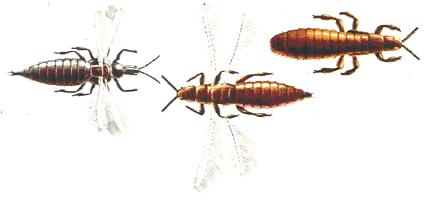
Thrips are a group of tiny insects belonging to the order Thysanoptera. Their elongated bodies typically measure less than two millimeters and feature characteristically fringed wings. They are found on nearly every continent and colonize many cultivated and wild plants. Some species are considered agricultural pests because of the damage they cause to crops. Others play a subtle role in pollination or feed on fungi and other small arthropods.
The thrips' body is slender, elongated, and varies in color from pale yellow to dark brown depending on the species. When present, the wings are narrow and bordered by long fine bristles called fringes. Asymmetrical mouthparts allow them to pierce plant tissues and suck out the contents. The small size of these insects often makes them invisible to the naked eye without magnification.
Characteristics
Indicative values: they vary by subspecies, sex and region.
Habitat and distribution
Thrips are found in agricultural areas, gardens, greenhouses, and natural vegetation zones. They colonize vegetable crops, fruit trees, cereals, and ornamental plants alike. Their small size allows them to lodge in flowers, buds, and bark crevices.
CURRENT RANGE
Thrips are distributed across all continents except the most extreme polar regions. They are particularly abundant in temperate and tropical agricultural zones. International plant trade has promoted the spread of certain invasive species worldwide.
Behaviour
Thrips move by flying short distances or being passively carried by wind over long distances. They typically live in groups on young shoots, flowers, or the undersides of leaves. Their activity is often most intense in hot, dry weather, a time favoring their rapid reproduction.
Reproduction
Reproduction can be sexual or parthenogenetic depending on the species, which promotes rapid population growth. Females lay small eggs inserted into plant tissues or deposited on their surface. Development progresses through several larval stages before adult winged forms emerge, with the entire cycle taking just a few weeks.
Peculiarities
Fringed wings, which gave rise to the scientific name of the order Thysanoptera, are a distinctive feature of this group. Some species can reproduce without fertilization through parthenogenesis. Thrips are also vectors of certain plant viruses, particularly those affecting tomatoes and other vegetable crops.
Threats and conservation
Pest thrips are themselves controlled through the use of insecticides and biological control methods, which limit their populations in agricultural areas. Natural predators such as certain mites and predatory bugs also regulate their numbers. As a group, they are not threatened and have no particular conservation status.
Numbers and trends vary across sources and regions. See the IUCN assessment for the latest reference data.
Gallery
1 documented photographs.
References
Profile updated 11 September 2026 · Reviewed by the TunisieVet editorial team.
Comments (0)
No comments yet.
CONSERVATION STATUS
Least concern (LC)
IUCN source, latest published assessment.
Species health
Documented diseases for this species.
Find a veterinarianThis information is provided for educational purposes only and is not a substitute for a veterinary consultation. If you have any concerns about your animal's health, consult a veterinarian.
Similar animals
Other species documented in Animalpedia.
