
Presentation
Amphipods are a highly diverse order of small crustaceans found in nearly all aquatic environments worldwide, as well as in some damp terrestrial habitats. They play a major ecological role as decomposers and essential components of marine and freshwater food chains. This group includes thousands of species, among them the well-known sand fleas and scuds. Their segmented body, compressed from side to side, and their characteristic swimming motion set them apart from other crustaceans. They are an important food source for many fish, birds, and marine mammals. In Tunisia, several amphipod species are commonly observed along the coast, particularly in tidal wrack.
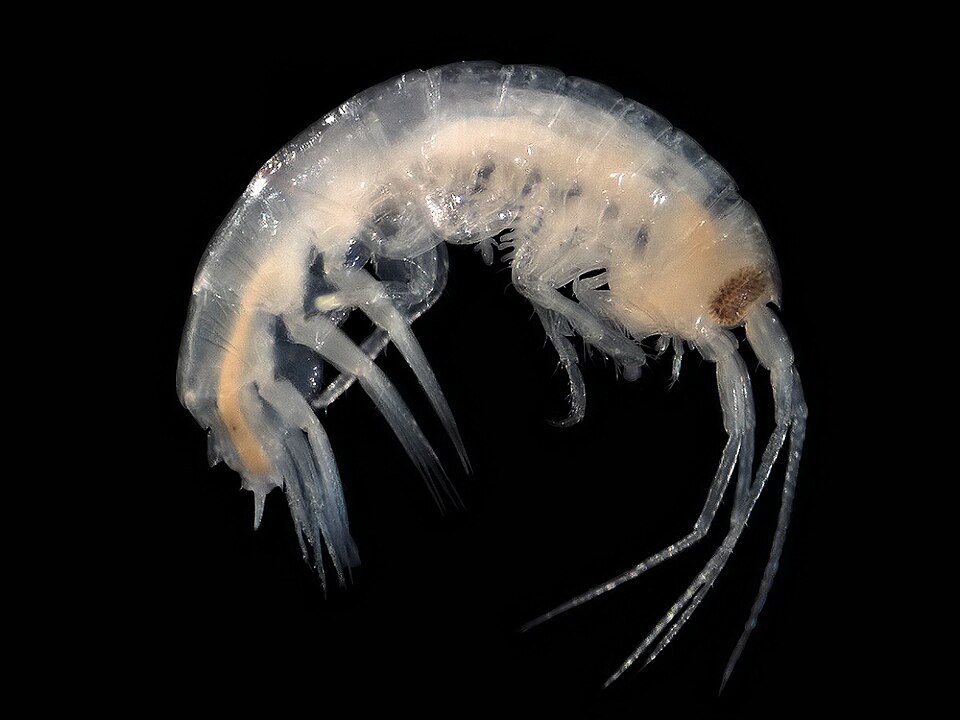
Amphipods are small crustaceans with bodies compressed from side to side and no carapace. They have two pairs of antennae and seven pairs of thoracic legs adapted for swimming, walking, or burrowing. Their size usually ranges from a few millimetres to about three centimetres depending on the species. Their colour, often translucent, brown, or greyish, provides good camouflage in their environment.
Characteristics
Indicative values: they vary by subspecies, sex and region.
Habitat and distribution
The vast majority of amphipods inhabit marine environments, ranging from the intertidal zone to the deepest ocean trenches. Other species occupy freshwater habitats, including rivers, lakes, and underground aquifers. A few terrestrial groups are found in damp soil, leaf litter, and caves.
CURRENT RANGE
Amphipods are distributed worldwide, from abyssal zones to continental freshwaters and the coastlines of all continents. Some terrestrial species live in damp forest leaf litter or caves. The Mediterranean region, including Tunisian coasts, supports a diverse amphipod fauna.
Behaviour
Amphipods are mainly active at night, feeding by sifting through sediment, algae, or organic debris. Most move by swimming on their side or crawling among aquatic plants and soft substrates. Some species burrow into sand for protection from predators, while others live in association with hosts such as sponges or algae. They are generally gregarious animals, sometimes forming large local concentrations.
Reproduction
Reproduction occurs through direct mating, with the male often carrying the female before her moult to fertilize the eggs. Eggs are incubated in a ventral pouch called a marsupium until juvenile amphipods hatch; these resemble miniature adults. Most amphipod species have no free-living planktonic larval stage.
Peculiarities
Female amphipods carry their eggs and young in a ventral incubation pouch called a marsupium, without undergoing a free-living larval stage. Certain species live in close symbiosis with host invertebrates such as jellyfish or sponges. Their characteristic swimming style—jerky lateral movements—is easily recognized on beaches.
Threats and conservation
Pollution of coastal and inland waters, along with degradation of littoral habitats, locally threatens some populations. Climate change and ocean acidification may affect the physiology of these sensitive crustaceans. Overall, the group as a whole is not considered threatened, as most species are common.
Numbers and trends vary across sources and regions. See the IUCN assessment for the latest reference data.
Gallery
1 documented photographs.
References
Profile updated 13 September 2026 · Reviewed by the TunisieVet editorial team.
Comments (0)
No comments yet.
CONSERVATION STATUS
Least concern (LC)
IUCN source, latest published assessment.
Similar animals
Other species documented in Animalpedia.
