
Presentation
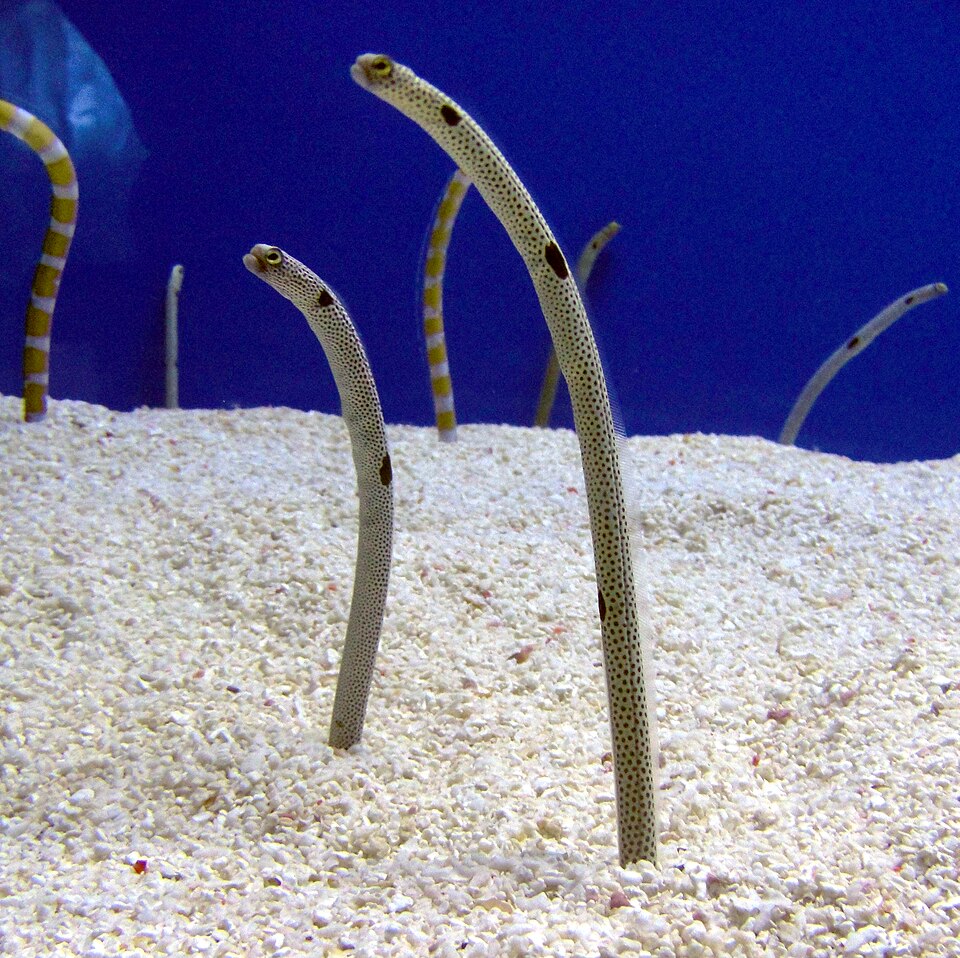
The garden eel is a marine fish belonging to the family Congridae, known for its sedentary and gregarious lifestyle. Entire colonies live buried in the sand, with only the front part of the body emerging to feed on plankton. This collective behavior, where hundreds of individuals sway out of their burrows, resembles an underwater garden, hence its common name. It inhabits tropical and subtropical waters on sandy bottoms near coral reefs.
The body is slender, elongated, and gray to brown in color, often marked with small dark spots. The eyes are prominent and the head is slightly darker than the rest of the body. Its tubular shape allows it to remain anchored in its burrow while remaining flexible enough to capture food particles. It rarely leaves its burrow throughout its entire adult life.
Characteristics
Indicative values: they vary by subspecies, sex and region.
Habitat and distribution
The species favours sandy or slightly muddy bottoms, typically near coral reefs that provide currents rich in plankton. It is found at depths ranging from a few metres to more than 45 metres. Soft substrate is essential for digging and maintaining its permanent burrow.
CURRENT RANGE
The garden eel is found in tropical and subtropical waters of the Indo-Pacific, as well as in certain areas of the Red Sea and Atlantic Ocean depending on species within the genus. It is not recorded in Tunisian waters or in the Mediterranean. Populations concentrate on stable sandy sites near reefs.
Behaviour
This species lives in dense colonies that can number several hundred individuals on the same sandy site. Each individual remains anchored in its own permanent burrow, never emerging completely from its hole. Highly wary, it retracts instantly into its burrow at any suspicious movement or the approach of a diver. Communication between neighboring individuals may occur through visual signals.
Reproduction
Reproduction of garden eels remains poorly documented in the wild because of their highly sedentary lifestyle. The larvae, called leptocephali, are pelagic and drift in the plankton before settling on a suitable sandy bottom. This larval phase lasts several months before metamorphosis into a benthic juvenile. Colonies then form through successive settlement of young individuals in close proximity to one another.
Peculiarities
The sight of an entire colony swaying out of the sand is unique among marine fish. Each individual practically never leaves its burrow throughout its entire life, an extreme territorial behaviour rare among marine vertebrates. This lifestyle particularly fascinates divers and aquarium enthusiasts.
Threats and conservation
Degradation of coral reefs and associated sandy bottoms is the primary threat to this species. Marine pollution and poorly managed dive tourism can disturb these colonies, which are sensitive to disturbance. No major commercial overexploitation has been reported to date.
Numbers and trends vary across sources and regions. See the IUCN assessment for the latest reference data.
Gallery
1 documented photographs.
References
Profile updated 07 September 2026 · Reviewed by the TunisieVet editorial team.
Comments (0)
No comments yet.
CONSERVATION STATUS
Least concern (LC)
IUCN source, latest published assessment.
Species health
Documented diseases for this species.
Find a veterinarianThis information is provided for educational purposes only and is not a substitute for a veterinary consultation. If you have any concerns about your animal's health, consult a veterinarian.
Similar animals
Other species documented in Animalpedia.

TunisieVet in your pocket 📱🐾 Access your veterinary services wherever you are. [ Download the app ]
Learn more