
Presentation
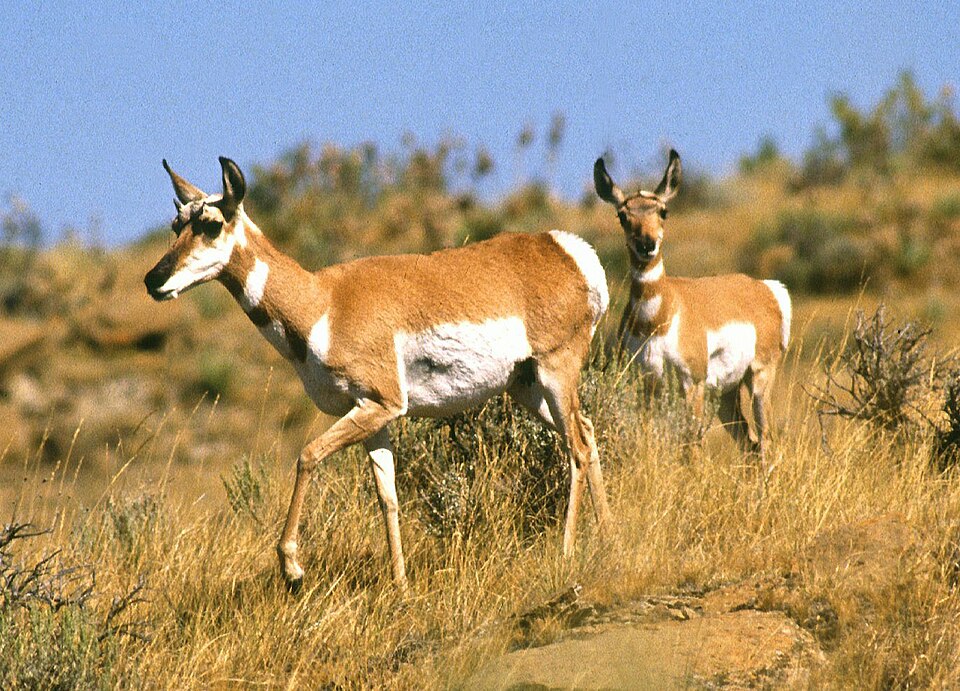
The pronghorn (Antilocapra americana) is an hoofed mammal native to the great plains of North America. Often called the "American antelope," it does not actually belong to any true antelope family and stands as the sole living member of the Antilocapridae family. It is renowned as the fastest land mammal on the American continent, capable of sustaining high speeds over long distances when escaping from predators. Its tan and white coat, forked and ringed horns, and large lateral eyes give it a distinctive silhouette well adapted to life in open terrain. Long hunted and threatened by habitat loss, it benefited from conservation programs that enabled populations to recover substantially during the twentieth century. Today it remains an emblematic symbol of the fauna of the North American great plains.
The pronghorn has a slender body, long slender legs adapted for fast running, and lungs and a heart that are proportionally large. Its horns, unique among mammals because they consist of a keratinous sheath that renews each year over a permanent bony core, are present in males and sometimes in females in a reduced form. Its vision is exceptionally keen, allowing it to spot predators at great distances in open landscapes.
Characteristics
Indicative values: they vary by subspecies, sex and region.
Habitat and distribution
The pronghorn inhabits grasslands, semi-arid prairies, and scrubland steppe and desert areas of North America. It favors open, unobstructed landscapes that allow it to detect threats from a distance and use its speed to flee.
CURRENT RANGE
The species is found in the western and central regions of North America, mainly in the United States, western Canada, and northern Mexico. Its range follows the continent's major prairie and steppe zones.
Behaviour
The pronghorn is a gregarious animal that forms herds whose size varies by season, larger in winter. It is diurnal and undertakes seasonal migrations over long distances between summer and winter ranges. Its primary defense strategy against predators is fleeing at high speed rather than confrontation.
Reproduction
The rut occurs in autumn, when dominant males defend either a harem of females or a territory. Gestation lasts about eight months and usually results in twin fawns born in spring. Young pronghorns can stand and follow their mother shortly after birth, and quickly develop the high running speed needed to escape predators.
Peculiarities
The pronghorn is the sole surviving member of the Antilocapridae family, a group once more diverse in North America. Its forked horns, shed and regrown annually, are unique among horned mammals. It is also considered the second-fastest land mammal in the world after the cheetah, but capable of maintaining high speed over a much longer distance.
Threats and conservation
The main historical threats were excessive hunting and conversion of grasslands to agricultural land. Today, habitat fragmentation caused by fences, roads, and urban development limits its ability to migrate. Current populations are generally stable thanks to management and protection measures.
Numbers and trends vary across sources and regions. See the IUCN assessment for the latest reference data.
Gallery
1 documented photographs.
References
Profile updated 06 September 2026 · Reviewed by the TunisieVet editorial team.
Comments (0)
No comments yet.
CONSERVATION STATUS
Least concern (LC)
IUCN source, latest published assessment.
Species health
Documented diseases for this species.
This information is provided for educational purposes only and is not a substitute for a veterinary consultation. If you have any concerns about your animal's health, consult a veterinarian.
To discover around: Pronghorn
Videos, facts, stories and records linked to this species.
RECORD
up to 88 km/h
Fastest land mammal over long distances in North America
Top speed measured during running, sustained over several kilometres—an endurance record a...
Similar animals
Other species documented in Animalpedia.

TunisieVet in your pocket 📱🐾 Access your veterinary services wherever you are. [ Download the app ]
Learn more