
Presentation
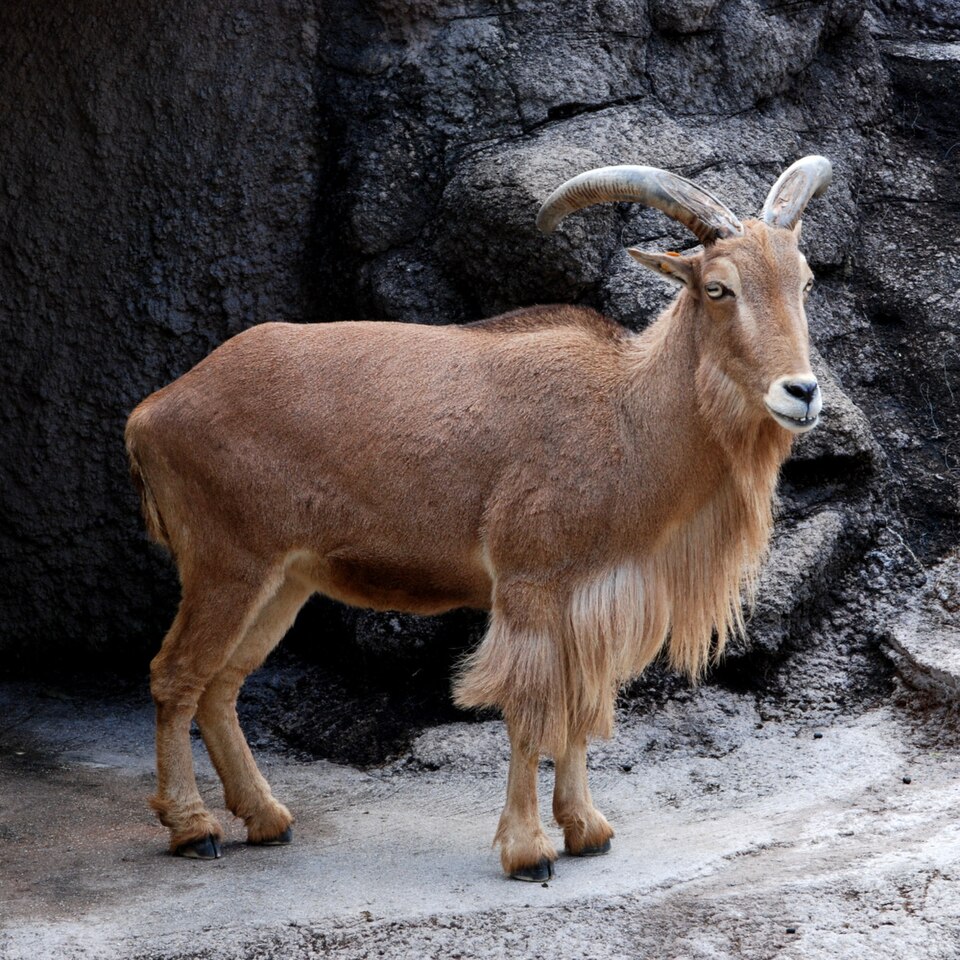
The Barbary sheep is a wild bovid from the arid regions of North Africa, recognizable by its impressive “cuffs” of long hairs which fall along its neck, chest and forelimbs. This camelid from rocky deserts has a fawn to gray coat and massive spiral horns, particularly developed in males.
The Barbary sheep has distinctive morphological characteristics: a stocky, muscular build, sturdy legs, and a unique hair system composed of long, dense hairs forming characteristic “cuffs.” The horns, present in both sexes, are spirally curved and can reach an impressive length in adult males.
Characteristics
Indicative values: they vary by subspecies, sex and region.
Habitat and distribution
Barbary sheep occupies the rocky deserts and semi-arid mountain ranges of the Sahara and Sahel. It frequents areas of intermediate altitude, stony plateaus and gorges where sparse vegetation and runoff water accumulate. Its exceptional adaptation to extreme conditions allows it to survive in the most hostile environments.
CURRENT RANGE
Barbary sheep is endemic to North Africa, its natural range extending from Morocco to Libya, via Algeria and Tunisia. Its historical distribution was much broader, but it has become significantly fragmented and reduced due to overexploitation and habitat degradation.
Behaviour
The Barbary sheep is a gregarious animal living in small herds led by a dominant male. It is particularly active at dawn and dusk, resting during the hot hours. An excellent climber, it frequents rocky mountainous areas where it finds refuge and protection against predators.
Reproduction
Reproduction of Barbary sheep occurs mainly in autumn and winter. After a gestation of approximately 5 to 6 months, the female gives birth to one or two kids. The young are breastfed for several months and stay with their mother until about a year old.
Peculiarities
The “cuffs” of the Barbary sheep constitute a unique thermoregulated adaptation: these long hairs offer protection against the cold of desert nights while allowing better heat dissipation. This species also has remarkable renal efficiency allowing it to conserve water and minimize its hydration needs, a crucial characteristic for survival in desert environments.
Threats and conservation
The Barbary sheep faces significant threats including intensive poaching, overexploitation for meat and trophies, and progressive habitat degradation due to overgrazing and climate change. The fragmentation of its isolated populations and competition with domestic livestock are gradually reducing its distribution area.
Numbers and trends vary across sources and regions. See the IUCN assessment for the latest reference data.
Gallery
1 documented photographs.
References
UICN — Liste rouge des espèces menacées
Profile updated 02 September 2026 · Reviewed by the TunisieVet editorial team.
Comments (0)
No comments yet.
CONSERVATION STATUS
Vulnerable (VU)
IUCN source, latest published assessment.
Species health
Documented diseases for this species.
See the 4 diseases of this species Find a veterinarianThis information is provided for educational purposes only and is not a substitute for a veterinary consultation. If you have any concerns about your animal's health, consult a veterinarian.
Related species
Similar animals
Other species documented in Animalpedia.

TunisieVet in your pocket 📱🐾 Access your veterinary services wherever you are. [ Download the app ]
Learn more