
Presentation
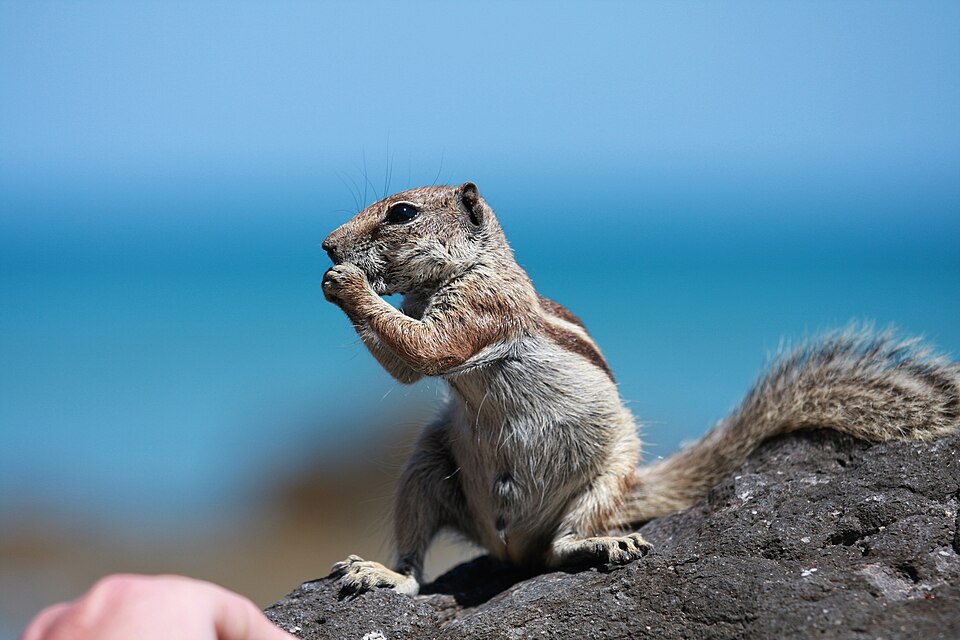
The Barbary ground squirrel (Atlantoxerus getulus) is a small rodent native to the mountain ranges of North Africa. It is distinguished by its brown-gray coat streaked with light longitudinal bands on the back and sides. Very sociable, it lives in colonies in burrows dug between rocks. Introduced on the island of Fuerteventura in the Canary Islands in 1965, it is today considered an invasive species. This terrestrial sciurid is active during the day and spends most of its time searching for food on the ground.
The Barbary ground squirrel has a stocky body, a bushy tail almost as long as the body, and characteristic light longitudinal stripes on the back. Its short legs and strong claws allow it to climb rocks and dig burrows. Its large eyes and short ears are adapted to life in open and rocky environments.
Characteristics
Indicative values: they vary by subspecies, sex and region.
Habitat and distribution
The species frequents rocky areas, arid mountain slopes and semi-desert terrain with crevices and rocky outcrops. It avoids overly vegetated environments, preferring open spaces offering good visibility against predators.
CURRENT RANGE
Barbary ground squirrel is endemic to Morocco and northwestern Algeria, where it occupies the Anti-Atlas and High Atlas. A population was introduced to the island of Fuerteventura, in the Canary Islands, where it spread widely. The species is not present in Tunisia.
Behaviour
It is a diurnal and gregarious species, living in colonies structured around networks of common burrows. Individuals spend much of the day feeding and scanning their surroundings for predators. Alarm cries are emitted in case of danger, triggering collective flight towards shelters. Mutual grooming strengthens social bonds within the group.
Reproduction
The female gives birth to one or two litters per year, generally numbering two to four young. Gestation lasts about a month. The young are born in the burrow and remain dependent on their mother for several weeks before becoming independent.
Peculiarities
Its light dorsal stripes are reminiscent of those of certain North American ground squirrels, although the species is not directly related to them. The population introduced to Fuerteventura constitutes a classic case study in invasion biology.
Threats and conservation
Locally, the species can be perceived as harmful to crops in certain Moroccan agricultural areas. On the island of Fuerteventura, it is itself considered a threat to native flora and fauna. In its native area, it is not subject to any major identified threats.
Numbers and trends vary across sources and regions. See the IUCN assessment for the latest reference data.
Gallery
1 documented photographs.
References
Profile updated 17 August 2026 · Reviewed by the TunisieVet editorial team.
Comments (0)
No comments yet.
CONSERVATION STATUS
Least concern (LC)
IUCN source, latest published assessment.
Species health
Documented diseases for this species.
See the 8 diseases of this species Find a veterinarianThis information is provided for educational purposes only and is not a substitute for a veterinary consultation. If you have any concerns about your animal's health, consult a veterinarian.
To discover around: Barbary ground squirrel
Videos, facts, stories and records linked to this species.
Similar animals
Other species documented in Animalpedia.

TunisieVet in your pocket 📱🐾 Access your veterinary services wherever you are. [ Download the app ]
Learn more