
Presentation
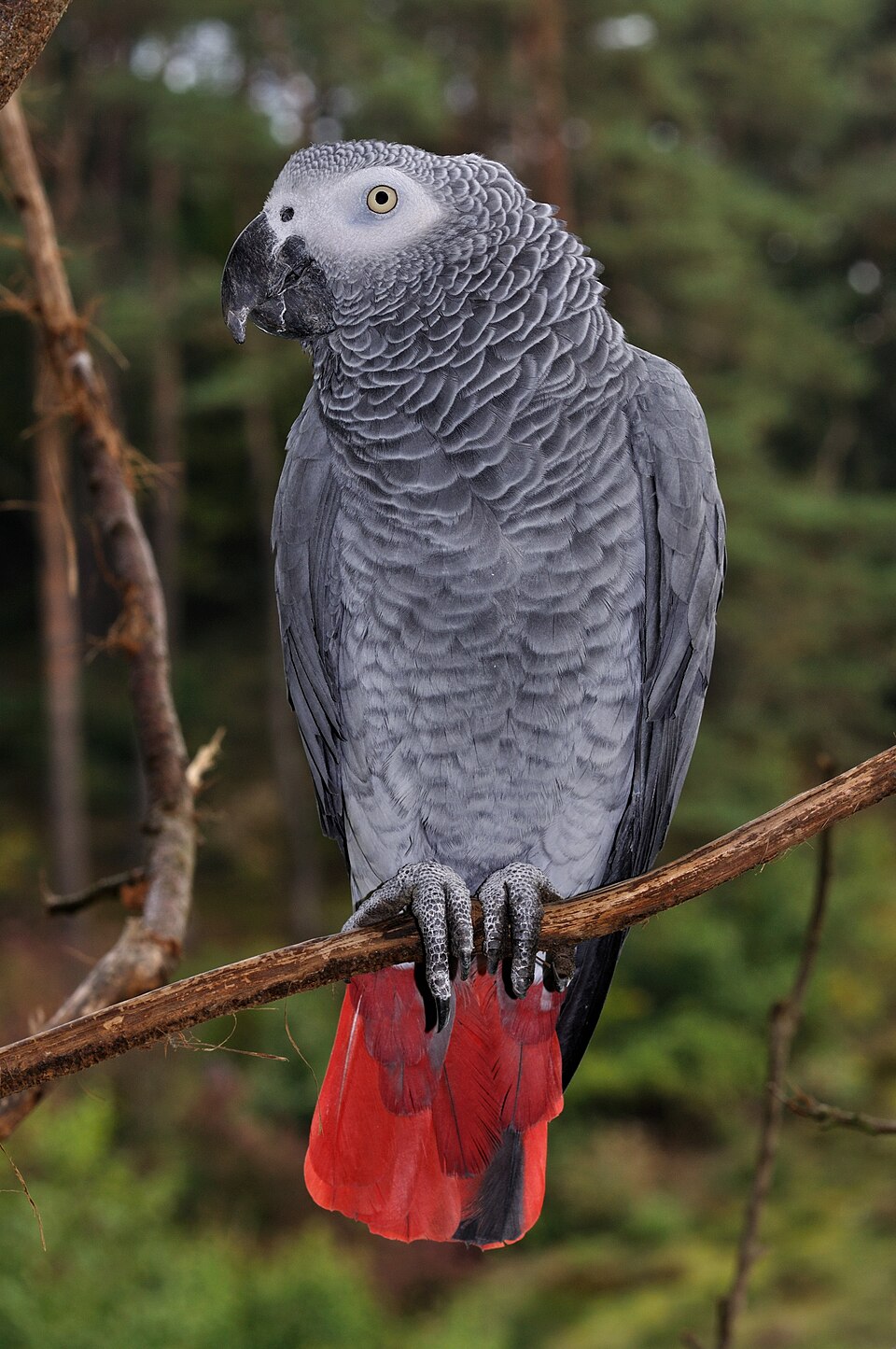
The African grey parrot is one of the largest and most intelligent parrots in the world. With its ash gray plumage and distinctive scarlet red tail, it is easily recognizable and fascinating with its remarkable cognitive abilities.
Its plumage is entirely ash gray, except for its bright scarlet tail. Its pale yellow eyes and powerful black beak complete an imposing and elegant morphology. The head is large and rounded, typical of parrots of high cognitive level.
Did you know?
Why do parrots imitate human voices?
Characteristics
Indicative values: they vary by subspecies, sex and region.
Habitat and distribution
The species inhabits the dense tropical forests of West and Central Africa, mainly in Equatorial Guinea, Cameroon and Gabon. It frequents thick forest canopies and areas of primary forest, rarely open areas.
CURRENT RANGE
African grey parrot is endemic to central and west Africa. Its range extends from Equatorial Guinea and Cameroon south to Gabon and Congo. Two subspecies are recognized, with fragmented populations.
Behaviour
It is a very social bird, living in groups which can reach several dozen individuals. It is renowned for its exceptional intelligence, capable of learning and reproducing hundreds of words, and interacting complexly with its environment and its peers.
Reproduction
Gabon gray parrots are monogamous and nest in the cavities of large forest trees. The female usually lays 3 to 4 eggs, which are incubated for about 30 days. The young remain in the nest for 80 to 90 days before taking flight.
Peculiarities
The African grey parrot has exceptional intelligence comparable to that of a 4-6 year old human child. It can not only imitate sounds, but also associate them with abstract concepts, making it unique among birds. Its remarkable longevity often exceeds 40 years in nature.
Threats and conservation
The species faces major threats from illegal collection for the pet trade and loss of forest habitat. Fragmentation of tropical forests and intensive poaching have reduced wild populations drastically, listing the species as Endangered.
Numbers and trends vary across sources and regions. See the IUCN assessment for the latest reference data.
Gallery
1 documented photographs.
References
UICN — Liste rouge des espèces menacées
Profile updated 28 August 2026 · Reviewed by the TunisieVet editorial team.
Comments (0)
No comments yet.
CONSERVATION STATUS
Endangered (EN)
IUCN source, latest published assessment.
Species health
Documented diseases for this species.
This information is provided for educational purposes only and is not a substitute for a veterinary consultation. If you have any concerns about your animal's health, consult a veterinarian.
To discover around: African grey parrot
Videos, facts, stories and records linked to this species.
Similar animals
Other species documented in Animalpedia.

TunisieVet in your pocket 📱🐾 Access your veterinary services wherever you are. [ Download the app ]
Learn more