
Presentation
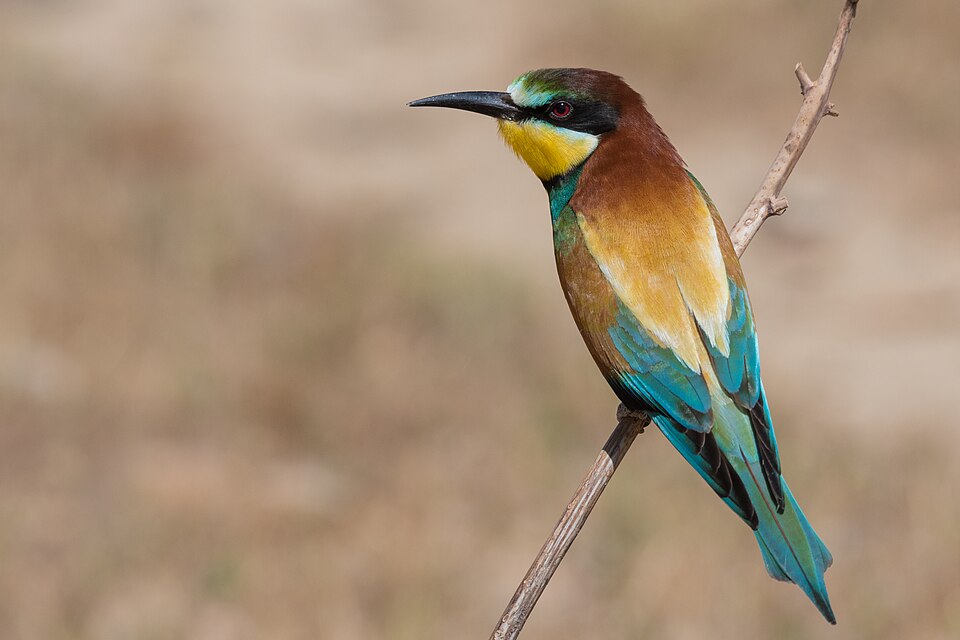
The European Bee-eater (Merops apiaster) is a colorful bird belonging to the Meropidae family, recognized by its distinctive multicolored plumage combining yellow, turquoise, and chestnut-brown. Its name reflects its specialized diet of hymenopterans, particularly wasps and honeybees. A migratory species, it nests in colonies on sandy banks and winters in sub-Saharan Africa. In Tunisia, it is observed during migration periods and breeding season in certain regions. Its acrobatic flight and fluent calls make it an easily identifiable species.
The bee-eater displays brilliantly colored plumage, with a chestnut-brown back, bright yellow throat bordered in black, and blue-green wings and upper back. Its beak is long, slender, and slightly curved, well-suited for capturing insects in flight. The tail has two elongated central tail feathers forming a fine point. Males and females resemble each other, though the female's coloration is sometimes duller.
Characteristics
Indicative values: they vary by subspecies, sex and region.
Habitat and distribution
The bee-eater inhabits open spaces such as agricultural areas, grasslands, and watercourse margins where it finds favourable nesting sites. It particularly prefers sandy banks, slopes, and soft cliffs for digging its burrows. It is also encountered in semi-arid and steppe regions during its movements.
CURRENT RANGE
The European bee-eater breeds in southern Europe, North Africa, and western and central Asia. It winters in sub-Saharan Africa, crossing the Sahara during migration. In Tunisia, it is present during the breeding season and during spring and autumn migration passages.
Behaviour
The bee-eater is a highly gregarious species living and nesting in sometimes large colonies. It hunts from a perch, watching for passing insects before launching into flight. A migratory bird, it travels long distances between its European breeding grounds and African winter quarters. Loud, repeated calls help locate groups in flight.
Reproduction
The bee-eater nests in burrows it digs itself in sandy banks or vertical cliffs, sometimes in dense colonies. The female typically lays 5 to 7 white eggs, which both parents incubate for about three weeks. Young birds remain in the nest for several weeks before fledging and are fed by both adults, occasionally assisted by helper birds.
Peculiarities
The bee-eater possesses a remarkable technique for neutralizing the venom of its prey before swallowing it. Its bright colours contrast with its discreet behaviour outside active flight periods. The formation of breeding colonies on sandy cliff faces represents marked social behaviour in this species.
Threats and conservation
The degradation of natural banks and sand extraction reduce available nesting sites. Pesticide use decreases the insect populations on which it depends for food. It is sometimes perceived as a pest by beekeepers because of its predation on honeybees, which can lead to local culling.
Numbers and trends vary across sources and regions. See the IUCN assessment for the latest reference data.
Gallery
1 documented photographs.
References
Profile updated 06 September 2026 · Reviewed by the TunisieVet editorial team.
Comments (0)
No comments yet.
CONSERVATION STATUS
Least concern (LC)
IUCN source, latest published assessment.
Species health
Documented diseases for this species.
Find a veterinarianThis information is provided for educational purposes only and is not a substitute for a veterinary consultation. If you have any concerns about your animal's health, consult a veterinarian.
Similar animals
Other species documented in Animalpedia.

TunisieVet in your pocket 📱🐾 Access your veterinary services wherever you are. [ Download the app ]
Learn more