
Presentation
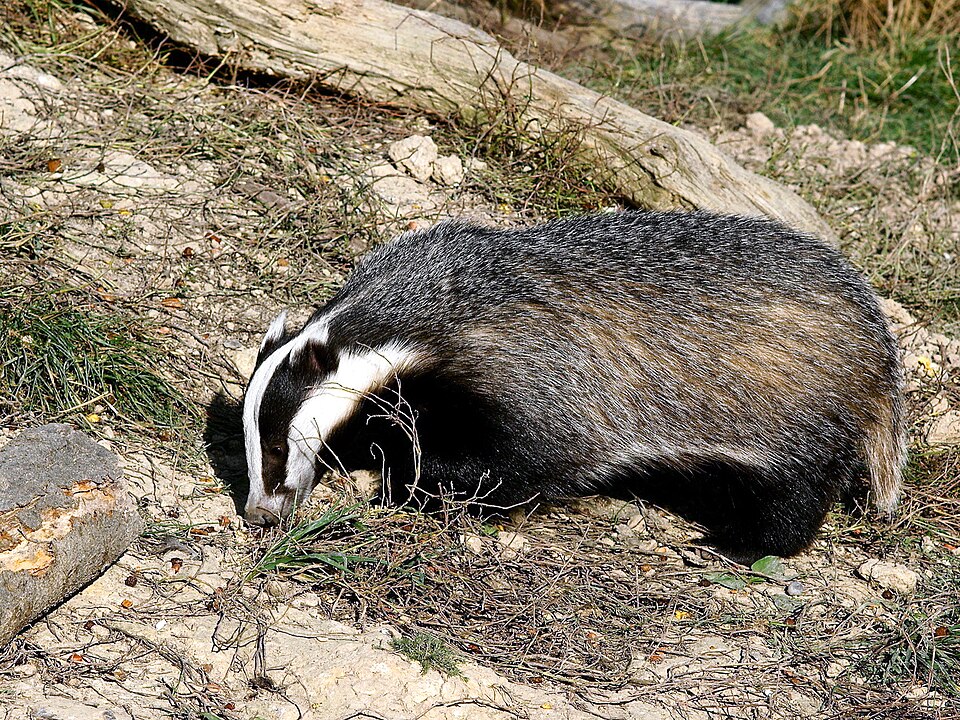
The European Badger (Meles meles) is a medium-sized carnivorous mammal, recognizable by its gray coat and its white facial mask barred with two black bands. It lives in family groups organized around a complex burrow called a burrow, dug and enlarged over several generations. A discreet and mainly nocturnal species, it is widely distributed in Europe and certain regions of North Africa. Badger plays an important ecological role by regulating populations of invertebrates and small vertebrates.
The body is stocky and muscular, with short legs equipped with powerful claws adapted to burrowing. The head is elongated, wearing a distinctive white mask crossed by two black bands passing through the eyes. The dorsal coat is silvery gray while the belly and legs are black.
Characteristics
Indicative values: they vary by subspecies, sex and region.
Habitat and distribution
The Badger mainly frequents forests, wooded areas and meadows offering soft soil suitable for digging burrows. It also adapts to agricultural areas and around hedgerows. In North Africa, it can be found in mountain and scrub areas.
CURRENT RANGE
The species is widely distributed across Europe and much of temperate Asia. It is also present in North Africa, particularly in certain regions of the Maghreb. Its distribution generally follows temperate zones offering forests and soft ground.
Behaviour
An essentially nocturnal and burrowing animal, the Badger spends the day in its burrow and comes out at nightfall to look for its food. It lives in social groups called clans, sharing the same burrow but often hunting alone. The species marks its territory using glandular secretions and communicates through vocalizations and postures.
Reproduction
Reproduction generally takes place in spring or summer, with a possibility of delayed implantation of the embryo. The female gives birth in the burrow after a gestation whose effective duration varies due to this implantation delay. A litter usually has two to four young, which remain dependent on their mother for several months before they are completely weaned.
Peculiarities
The black and white facial mask of the Badger constitutes one of the most recognizable distinctive marks of the European animal world. The species can reuse and expand the same family burrow for decades or even successive generations. Its highly developed sense of smell compensates for relatively poor eyesight.
Threats and conservation
Major threats include road collisions, habitat destruction and, in some areas, persecution linked to unfounded health fears. Hunting and trapping remain practiced locally in some European countries. The fragmentation of natural habitats limits movements and genetic exchanges between populations.
Numbers and trends vary across sources and regions. See the IUCN assessment for the latest reference data.
Gallery
1 documented photographs.
References
Profile updated 26 August 2026 · Reviewed by the TunisieVet editorial team.
Comments (0)
No comments yet.
CONSERVATION STATUS
Least concern (LC)
IUCN source, latest published assessment.
Species health
Documented diseases for this species.
See the 4 diseases of this species Find a veterinarianThis information is provided for educational purposes only and is not a substitute for a veterinary consultation. If you have any concerns about your animal's health, consult a veterinarian.
To discover around: Badger
Videos, facts, stories and records linked to this species.
Similar animals
Other species documented in Animalpedia.
