
Presentation
The Boreal Lynx (Lynx lynx) is a medium to large feline, characterized by ears decorated with brushes of black hair and a short tail tipped with black. It inhabits the temperate and boreal forests of Eurasia, where it mainly hunts ungulates and hares. Solitary and discreet, this animal is rarely observed despite a very large distribution area. It disappeared from many regions of Western Europe before being reintroduced there during the 20th century. This predator plays an important role in regulating deer populations. It is not present in North Africa or Tunisia.
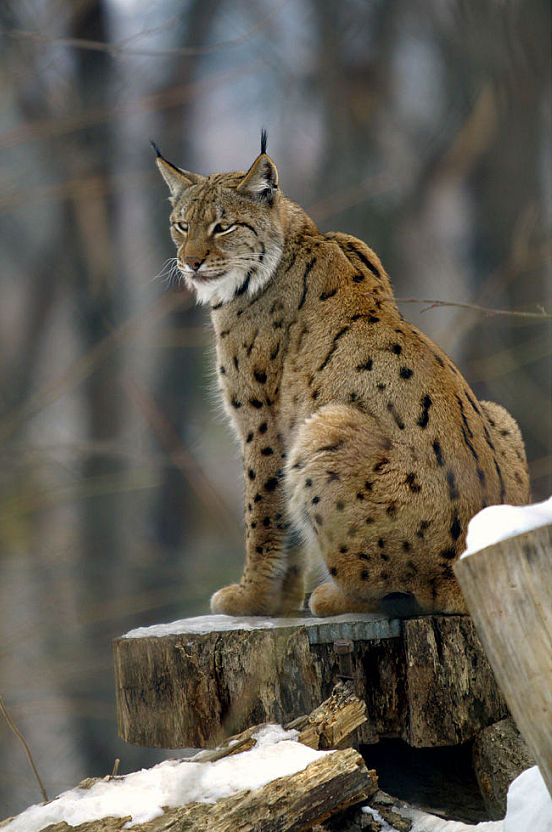
The Boreal Lynx is distinguished by its dense spotted fur, which varies depending on the population, and its thick coat adapted to the cold. Its large, well-furred paws make it easier to move around in the snow. It has characteristic brushes of hair at the tips of its ears and a short black tail at the tip.
Characteristics
Indicative values: they vary by subspecies, sex and region.
Habitat and distribution
The Boreal Lynx mainly frequents boreal and temperate forests with dense cover. It also adapts to mountainous areas and mixed forests with good prey availability. It generally avoids open environments devoid of protective vegetation.
CURRENT RANGE
The species is widely distributed across northern and eastern Europe, Siberia and parts of central Asia. Populations also remain in Scandinavia, in the Carpathians and in some areas of Western Europe following reintroductions. It is absent from Africa and the Middle East.
Behaviour
The Boreal Lynx is a solitary and territorial animal, active mainly at dusk and night. Each individual defends a home range whose size varies depending on the availability of prey. It communicates by scent marking and scratching on trees. Meetings between adults are essentially limited to the breeding period.
Reproduction
Mating generally takes place at the end of winter, between February and April. After a gestation of approximately 70 days, the female gives birth to one to four young in a sheltered den. The young stay with their mother for almost a year before becoming independent.
Peculiarities
Its ear brushes are said to improve its hearing acuity, a trait shared with other lynx species. Its ability to move efficiently in the snow thanks to its large legs constitutes a notable adaptation to the cold climate.
Threats and conservation
The main threats include the fragmentation of forest habitats, poaching and conflicts with pastoralists. Reduction in natural prey populations in some areas also affects its survival. Reintroduction and legal protection programs have enabled stabilization in several European countries.
Numbers and trends vary across sources and regions. See the IUCN assessment for the latest reference data.
Gallery
1 documented photographs.
References
Profile updated 25 August 2026 · Reviewed by the TunisieVet editorial team.
Comments (0)
No comments yet.
CONSERVATION STATUS
Least concern (LC)
IUCN source, latest published assessment.
Species health
Documented diseases for this species.
See the 8 diseases of this species Find a veterinarianThis information is provided for educational purposes only and is not a substitute for a veterinary consultation. If you have any concerns about your animal's health, consult a veterinarian.
Related species
To discover around: Boreal Lynx
Videos, facts, stories and records linked to this species.
Similar animals
Other species documented in Animalpedia.

TunisieVet in your pocket 📱🐾 Access your veterinary services wherever you are. [ Download the app ]
Learn more