
Presentation
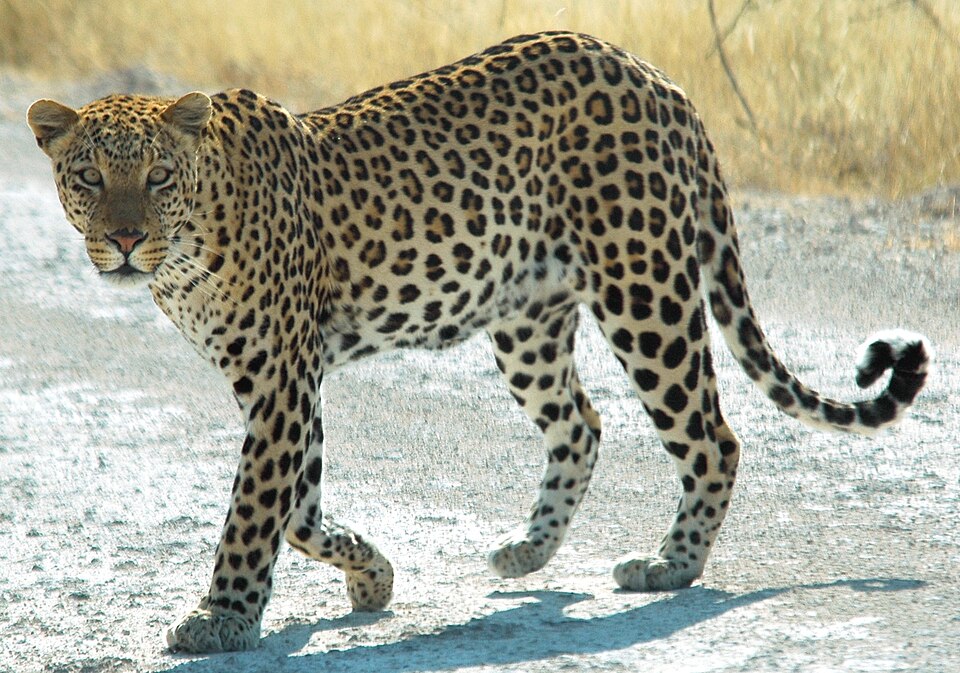
The Leopard is a large felid, characterized by a tawny to golden coat dotted with black rosettes (rose-shaped spots) which make it unique among large African predators. It is a solitary and discreet hunter, renowned for its exceptional agility and its ability to adapt to a wide variety of environments. Unlike the lion or cheetah, the Leopard is a nocturnal and stealthy animal, rarely seen in the wild.
The Leopard has a muscular, slender body, with powerful front legs and sharp retractable claws. Its head is rounded with large, yellow eyes, adapted for night vision. The characteristic rosettes on its dress are larger than those of the snow leopard and lack a central point. Its dense coat provides excellent protection and camouflage.
Characteristics
Indicative values: they vary by subspecies, sex and region.
Habitat and distribution
The Leopard is a remarkably adaptable animal that occupies a wide variety of habitats: savannahs, dense forests, mountains, desert areas, and riparian forests. It prefers regions with good vegetation cover which allows it to camouflage itself and hunt effectively. The Leopard is more flexible than the lion in terms of habitat choice and can survive in fragmented environments and near areas of human habitation.
CURRENT RANGE
Leopard is found in sub-Saharan Africa and South Asia, from the Caucasus to Southeast Asia. Its distribution area extends from Senegal to Somalia in West and Central Africa, and as far as South Africa. In Asia, it is found mainly in India, Sri Lanka, and the Caucasus. The species is absent from North Africa and Tunisia, where it has long since disappeared.
Behaviour
The Leopard is an essentially solitary and territorial animal, except during the breeding season. Nocturnal and crepuscular, it hunts mainly at night using its excellent night vision. It is extremely cautious and discreet, which makes it difficult to observe in the natural environment. The Leopard is an excellent climber and swims very well, allowing it to access a wide variety of habitats.
Reproduction
The Leopard female reaches sexual maturity at around 2-3 years of age. The gestation period lasts approximately 90 to 105 days, and the female generally gives birth to 2 to 3 young. The young stay with their mother for about 18 to 24 months before becoming independent. Males are polygamous and do not participate in raising the young.
Peculiarities
A notable feature of the Leopard is its ability to drag prey weighing up to twice its own weight up trees, making it a unique predator. Melanistic (black) individuals exist in the wild and are sometimes called black panthers, although this is simply a variation in pigmentation. The Leopard is also renowned for its incredible flexibility and ability to jump up to 6 meters in length and 3 meters in height.
Threats and conservation
The Leopard faces several major threats: habitat loss and fragmentation due to agricultural and urban expansion, poaching for its fur and body parts used in traditional medicine, and conflict with pastoralists who view it as a threat to livestock. The decimation of its natural prey through hunting overexploitation also reduces its food availability.
Numbers and trends vary across sources and regions. See the IUCN assessment for the latest reference data.
Gallery
1 documented photographs.
References
UICN — Liste rouge des espèces menacées
Profile updated 31 August 2026 · Reviewed by the TunisieVet editorial team.
Comments (0)
No comments yet.
CONSERVATION STATUS
Vulnerable (VU)
IUCN source, latest published assessment.
Species health
Documented diseases for this species.
See the 4 diseases of this species Find a veterinarianThis information is provided for educational purposes only and is not a substitute for a veterinary consultation. If you have any concerns about your animal's health, consult a veterinarian.
Related species
To discover around: Leopard
Videos, facts, stories and records linked to this species.
Similar animals
Other species documented in Animalpedia.

TunisieVet in your pocket 📱🐾 Access your veterinary services wherever you are. [ Download the app ]
Learn more