
Presentation
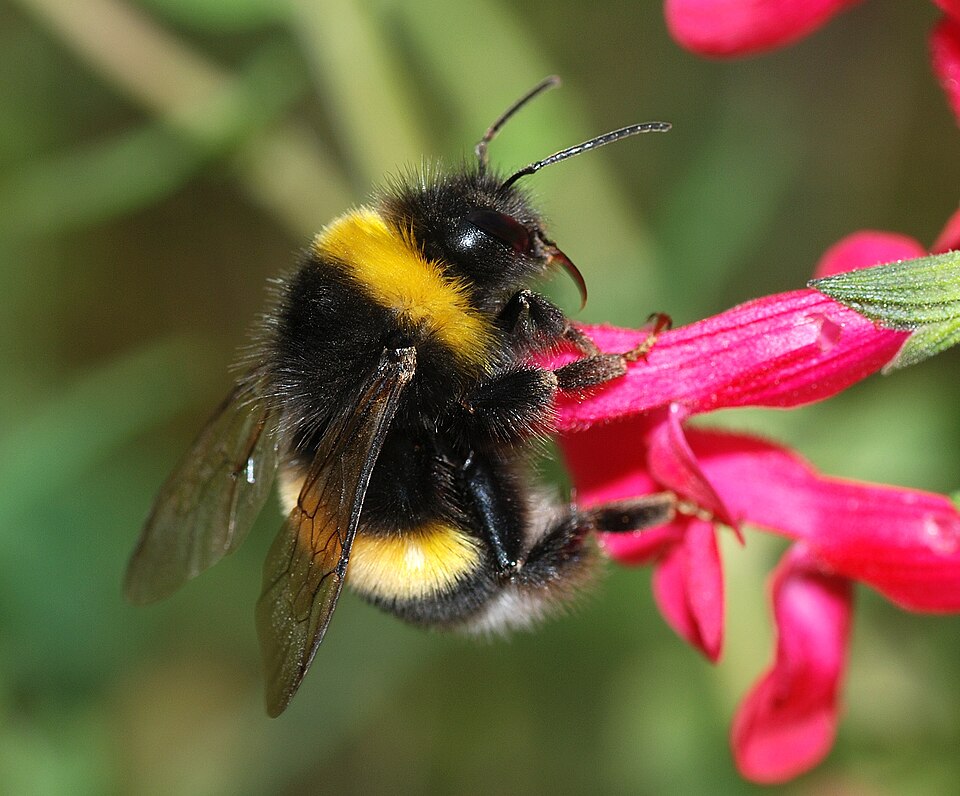
The bumblebee is a social flying insect belonging to the Apidae family, closely related to honeybees but stockier and hairier. It is distinguished by its massive body covered in dense hair, often striped with black and yellow, sometimes orange or white depending on the species. Found in temperate regions, it plays an essential role in pollinating wild and cultivated plants. The genus Bombus comprises several dozen species distributed mainly in the northern hemisphere.
The bumblebee's body is rounded, compact and covered in thick fur called pile, which allows it to regulate its body temperature. Its colors range from black to yellow, orange or white depending on the species and often serve as a warning to predators. Unlike the honeybee, it has a smooth stinger that it can reuse without dying.
Characteristics
Indicative values: they vary by subspecies, sex and region.
Habitat and distribution
Bumblebees inhabit flowering meadows, gardens, forest edges, and agricultural areas offering an abundance of flowers. They establish their nests in natural cavities such as abandoned rodent burrows, under leaf piles, or within hollow structures. They tolerate cooler climates than many other pollinating insects, including in mountain regions.
CURRENT RANGE
The genus Bombus is widely distributed across Europe, Asia, and North America, with some species present in South America and North Africa. It is absent from hot lowland tropical regions but can colonize tropical mountain zones. In North Africa, certain species are found in temperate and mountainous areas.
Behaviour
The bumblebee lives in small social colonies, generally numbering from a few dozen to a few hundred individuals, founded each spring by a mated queen. It remains active in cool temperatures thanks to its ability to warm its flight muscles through shivering. Less aggressive than the honeybee, it rarely stings, only when the nest is under direct threat.
Reproduction
Only the queen survives the winter and establishes a new colony in spring by laying her first eggs in an underground or sheltered nest. The colony develops during summer with the production of worker bees, then toward the end of the season new queens and males are produced. After mating, the fertilized young queens enter winter dormancy while the rest of the colony dies.
Peculiarities
Bumblebees can fly at relatively low temperatures thanks to their ability to generate body heat through muscular vibration. They sometimes practise 'buzz pollination', vibrating their flight muscles to release pollen from certain flowers such as tomatoes. Their characteristic buzzing sound gave them their common name.
Threats and conservation
Bumblebee populations are declining in several regions due to loss of floral habitats, pesticide use, and climate change. Competition from introduced species and certain parasitic diseases also affect colonies. Several species are monitored because of their major ecological role in pollination.
Numbers and trends vary across sources and regions. See the IUCN assessment for the latest reference data.
Gallery
1 documented photographs.
References
Profile updated 25 August 2026 · Reviewed by the TunisieVet editorial team.
Comments (0)
No comments yet.
CONSERVATION STATUS
Least concern (LC)
IUCN source, latest published assessment.
Species health
Documented diseases for this species.
Find a veterinarianThis information is provided for educational purposes only and is not a substitute for a veterinary consultation. If you have any concerns about your animal's health, consult a veterinarian.
Similar animals
Other species documented in Animalpedia.
