
Presentation
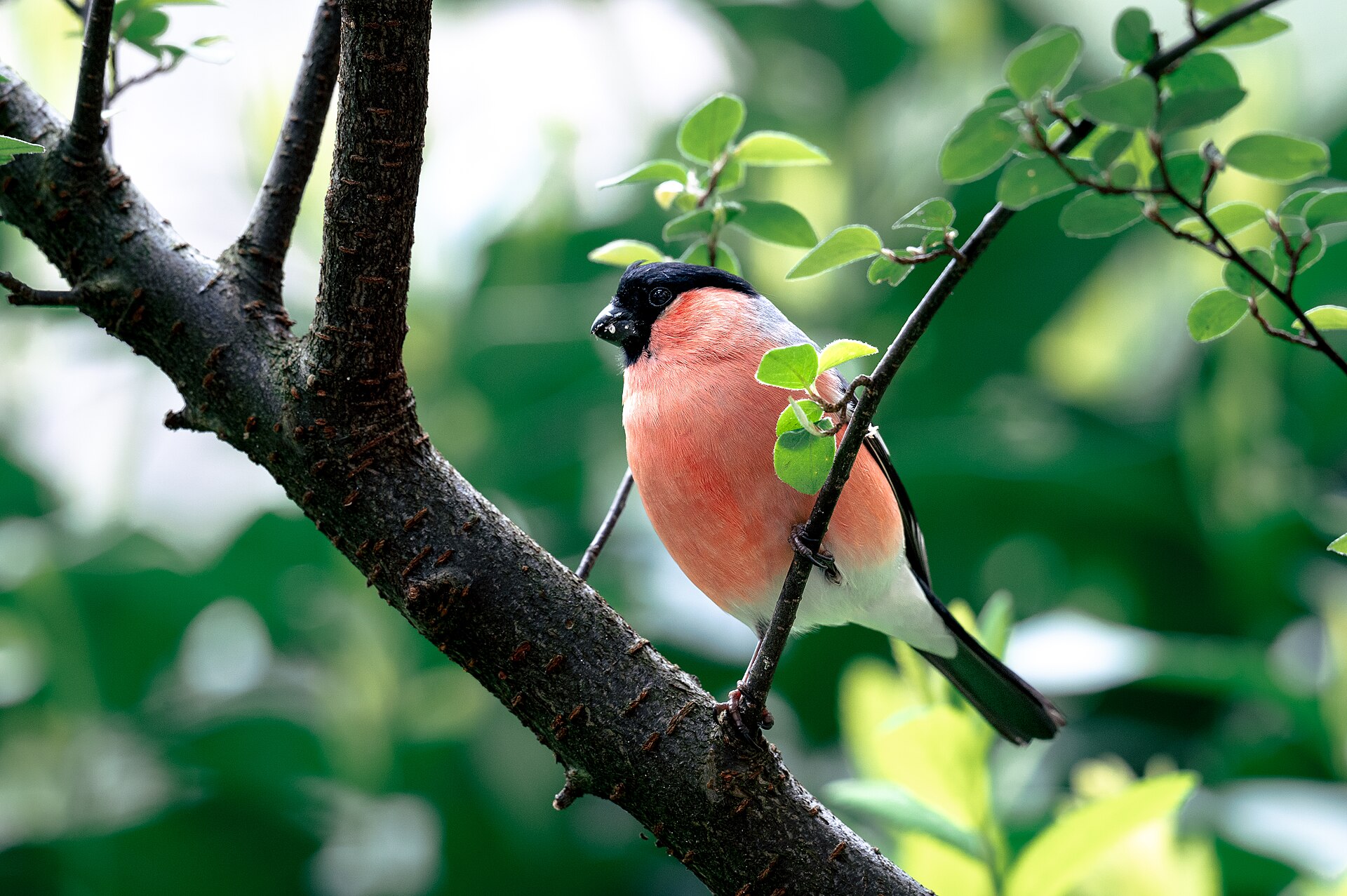
The Eurasian bullfinch (Pyrrhula pyrrhula) is a small, compact songbird recognised by its colourful plumage and short, rounded bill. The male displays a bright rose-red breast, while the female shows more subtle brownish-pink tones. The species is found across Europe and temperate Asia, inhabiting forests, hedgerows and gardens. Shy and retiring by nature, it moves about in pairs or small family groups. Its song is quiet and melodious, seldom heard in public. In North Africa, its presence remains marginal and restricted to mountainous areas.
The Eurasian bullfinch measures approximately 14 to 16 cm in length with a wingspan of 22 to 26 cm. It has a short, conical black bill adapted for cracking seeds and buds. The crown is glossy black, the back blue-grey, and the rump distinctly white and visible in flight. Sexual dimorphism is pronounced, with males being considerably more brightly coloured than females.
Characteristics
Indicative values: they vary by subspecies, sex and region.
Habitat and distribution
The bullfinch frequents coniferous and deciduous forests, hedgerows, orchards and wooded gardens. It favours habitats with dense vegetation for concealment as well as sources of seeds and buds. In North Africa, it is found mainly in wooded mountainous areas.
CURRENT RANGE
The species is widely distributed across temperate Europe and Asia, from the United Kingdom to Japan. Isolated populations also exist in North Africa, particularly in the mountainous massifs of the Maghreb. In Tunisia, its presence remains rare and restricted to a few high-altitude forest zones.
Behaviour
The bullfinch is a quiet, largely sedentary bird across much of its range. It lives in pairs year-round or in small family groups outside the breeding season. Wary but difficult to observe due to its calm behaviour and preference for dense undergrowth. It communicates through soft, gentle whistles with a melancholic tone.
Reproduction
The breeding season runs from April to July, usually with two clutches per year. The female builds a discrete nest in a dense shrub or hedge and lays 4 to 5 pale blue spotted eggs. Incubation lasts approximately 12 to 14 days, carried out mainly by the female. The young leave the nest around two weeks after hatching.
Peculiarities
The male has distinctive rose-red plumage that makes it easily identifiable among European songbirds. Its white rump contrasts sharply with the rest of its dark plumage in flight. The species has long been valued as a cage bird for its soft song and colour, although this practice is now regulated by law.
Threats and conservation
The destruction of hedgerows and fragmentation of forest habitats pose local threats to some populations. Illegal trapping for the pet bird trade remains an occasional pressure in certain regions. Overall, the species remains common across much of its range.
Numbers and trends vary across sources and regions. See the IUCN assessment for the latest reference data.
Gallery
1 documented photographs.
References
Profile updated 05 September 2026 · Reviewed by the TunisieVet editorial team.
Comments (0)
No comments yet.
CONSERVATION STATUS
Least concern (LC)
IUCN source, latest published assessment.
Species health
Documented diseases for this species.
Find a veterinarianThis information is provided for educational purposes only and is not a substitute for a veterinary consultation. If you have any concerns about your animal's health, consult a veterinarian.
Similar animals
Other species documented in Animalpedia.

TunisieVet in your pocket 📱🐾 Access your veterinary services wherever you are. [ Download the app ]
Learn more