Presentation
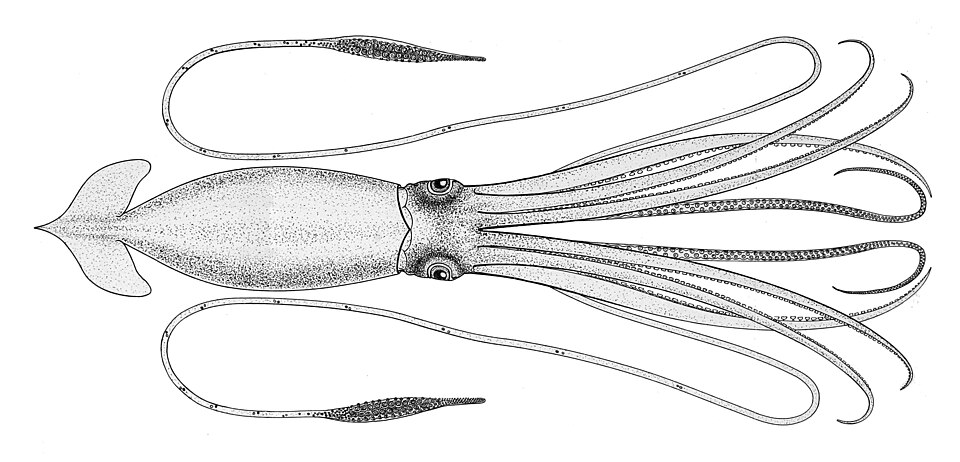
The giant squid is a cephalopod that inhabits the deep ocean, long the subject of sailors' legends before being documented by science. It has an elongated body, eight arms, and two long tentacles equipped with notched suckers. Its eyes rank among the largest in the animal kingdom, an adaptation for detecting faint light at depth. The species is rarely observed alive; most knowledge comes from stranded or accidentally captured individuals. It belongs to the family Architeuthidae, the sole recognized representative of its genus. Its biology and behavior in the natural environment remain partially unknown.
The body, or mantle, can reach several meters in length, extended by two long prehensile tentacles. The skin is covered with pigment cells that allow color changes. The suckers bear notched chitinous rings that help capture prey. The nervous system includes a giant axon, long studied in neurophysiology.
Characteristics
Indicative values: they vary by subspecies, sex and region.
Habitat and distribution
Giant squid inhabit bathypelagic and mesopelagic zones at depths exceeding one thousand metres. They live in deep, cold ocean waters far from shore. This dark, high-pressure environment severely limits direct scientific study of the species.
CURRENT RANGE
The species is found in all oceans worldwide, with more frequent records from the North Atlantic and around New Zealand. Its exact distribution remains uncertain due to the rarity of observations and the difficulty of accessing its habitat. Stranded individuals have been reported on several continents.
Behaviour
The species is solitary and lives in the darkness of the deep ocean, which greatly limits direct observation of its behavior. It is thought to be primarily active hunting for food, moving by jet propulsion through water expelled by a siphon. The sperm whale is its main known predator, and numerous battle scars have been observed on whale carcasses. Its social behavior and interactions with others of its kind remain largely unknown.
Reproduction
Reproduction in giant squid remains poorly documented through direct in situ observation. Males possess a specialized reproductive organ for transferring spermatophores to females. Females are thought to lay a large number of eggs clustered in gelatinous masses. No parental care is known to occur after egg-laying, and adults likely die shortly after reproduction, as is the case with other cephalopods.
Peculiarities
Giant squid have inspired numerous maritime myths, most notably the legend of the kraken. Their eyes rank among the largest known in any living animal. The first photograph of a living individual in its natural environment was not obtained until the early twenty-first century.
Threats and conservation
No major direct threat clearly linked to human activity has been documented, owing to the minimal interaction with this species. Deep-sea fishing and ocean pollution could nonetheless indirectly affect its habitat. The lack of data makes precise assessment of threats difficult.
Numbers and trends vary across sources and regions. See the IUCN assessment for the latest reference data.
Gallery
1 documented photographs.
References
Profile updated 19 September 2026 · Reviewed by the TunisieVet editorial team.
Comments (0)
No comments yet.
CONSERVATION STATUS
Data deficient (DD)
IUCN source, latest published assessment.
Species health
Documented diseases for this species.
Find a veterinarianThis information is provided for educational purposes only and is not a substitute for a veterinary consultation. If you have any concerns about your animal's health, consult a veterinarian.
To discover around: Giant squid
Videos, facts, stories and records linked to this species.
RECORD
up to about 13 m in total length
The longest known invertebrate
Measurement including the mantle and the two long extended tentacles, based on the largest...
Similar animals
Other species documented in Animalpedia.