Presentation
The vampire squid (Vampyroteuthis infernalis) is a unique marine cephalopod and the sole living member of the order Vampyromorphida. Despite its name, it is neither a true squid nor an octopus, but rather occupies an intermediate position between the two groups. It inhabits the deep ocean, typically at depths between 600 and 900 metres, in a zone known as the "oxygen minimum zone". Its dark appearance, large eyes, and the membrane connecting its arms—resembling a cape—inspired its common name. Marine biologists find this species fascinating due to its extreme adaptations to an oxygen-poor, lightless environment. It is considered a living fossil, having changed little over millions of years.
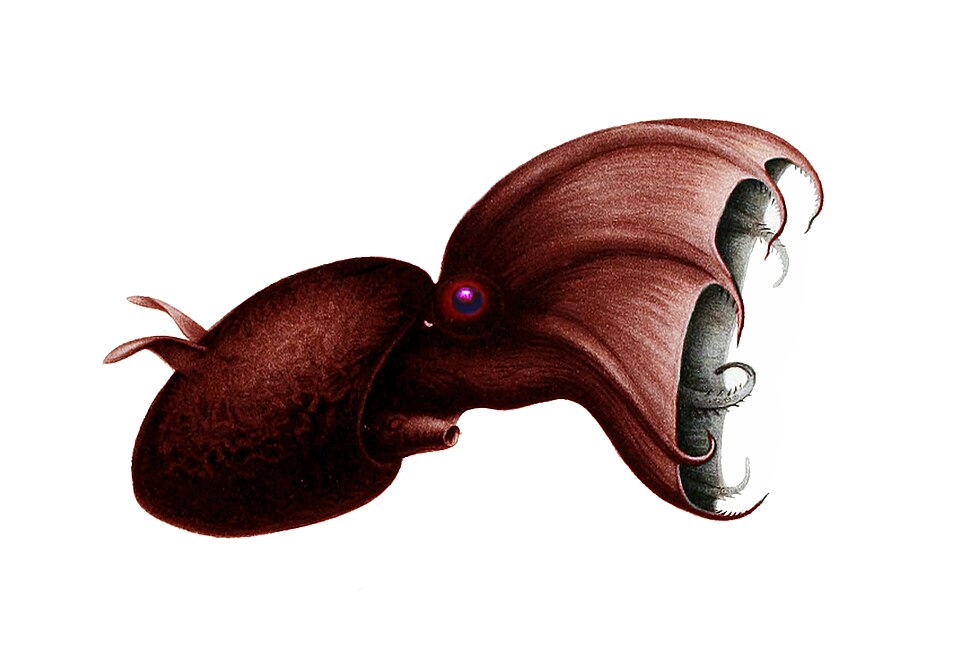
The vampire squid measures about thirty centimetres and has a gelatinous body ranging from black to dark red, dotted with photophores. Its eight arms are joined by a membrane and lined with sensory filaments called cirri, unique among cephalopods. Its large eyes are proportionally among the largest in the animal kingdom relative to body size, allowing it to capture the faint residual light. Unlike true squids, it possesses neither an ink gland nor true feeding tentacles.
Characteristics
Indicative values: they vary by subspecies, sex and region.
Habitat and distribution
This species lives exclusively in the deep ocean, between 600 and 1,200 metres deep. It favours the oxygen minimum zone, where oxygen concentration is extremely low but predators are rare. Pressure is high and sunlight completely absent, forcing the species to depend on bioluminescence. This extreme habitat greatly limits interactions with other large marine predators.
CURRENT RANGE
The vampire squid is found in temperate and tropical waters throughout all the world's oceans. It is notably present in the Atlantic, Pacific and Indian oceans at significant depths. Its distribution is therefore nearly cosmopolitan within deep ocean zones suited to its lifestyle. No populations are recorded in the Mediterranean near Tunisia.
Behaviour
The vampire squid inhabits zones of very low oxygen concentration, where few predators venture, affording it relative safety. It moves slowly, conserving energy through a reduced metabolic rate adapted to great depths. When threatened, it curls its arms—covered with fleshy spines (cirri)—around its body into a defensive posture known as the "pineapple posture". It can also release a cloud of bioluminescent mucus instead of ink to disorient its predators.
Reproduction
Vampire squid reproduction is poorly documented due to its difficult-to-access habitat. Females appear capable of breeding multiple times during their lifetime, unlike most cephalopods which reproduce only once. Egg-laying occurs in several separate episodes, with relatively large eggs that are few in number compared to other cephalopods. Juvenile development takes place directly in the deep waters, without a known planktonic larval stage at the surface.
Peculiarities
The vampire squid possesses the largest eyes proportionally to body size of any animal in the kingdom. It produces bioluminescence through organs called photophores, distributed across the entire body, which it can modulate in intensity and duration. Unlike other cephalopods, it does not expel ink but instead releases a viscous, luminous mucus to escape predators. Its blood, rich in haemocyanin, allows it to survive in extremely oxygen-poor waters.
Threats and conservation
The vampire squid is not directly exploited by commercial fisheries due to its deep habitat and lack of sought-after food value. The main potential threats concern the expansion of oxygen minimum zones and changes in deep-water currents linked to climate change. The lack of data makes precise assessment of population status difficult. No specific conservation measures are currently dedicated to it.
Numbers and trends vary across sources and regions. See the IUCN assessment for the latest reference data.
Gallery
1 documented photographs.
References
Profile updated 19 September 2026 · Reviewed by the TunisieVet editorial team.
Comments (0)
No comments yet.
CONSERVATION STATUS
Data deficient (DD)
IUCN source, latest published assessment.
Species health
Documented diseases for this species.
Find a veterinarianThis information is provided for educational purposes only and is not a substitute for a veterinary consultation. If you have any concerns about your animal's health, consult a veterinarian.
To discover around: Vampire Squid
Videos, facts, stories and records linked to this species.
RECORD
about 2.5 cm in diameter for a body length of 15 to 30 cm
The largest eyes relative to body size in the animal kingdom
Measurement of eye diameter in relation to body size in the deep-sea cephalopods studied.
Similar animals
Other species documented in Animalpedia.